Applied Markets
Installed Gases
Project Details

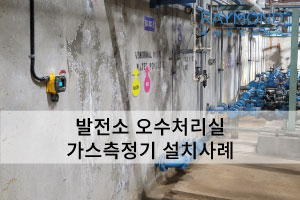
This site is a wastewater treatment facility at a department store.
First, we'd like to share KOSHA's (Korea Occupational Safety and Health Agency) official position on wastewater treatment facilities.
Even though wastewater facilities may be open spaces, the wide variety of gas-generating factors means KOSHA classifies them as confined spaces. Wastewater facilities in department stores or office buildings in particular are usually located in basement levels, which makes them especially vulnerable to accidents in the event of a gas leak.
Where is the right place to install a gas detector for a wastewater treatment tank?
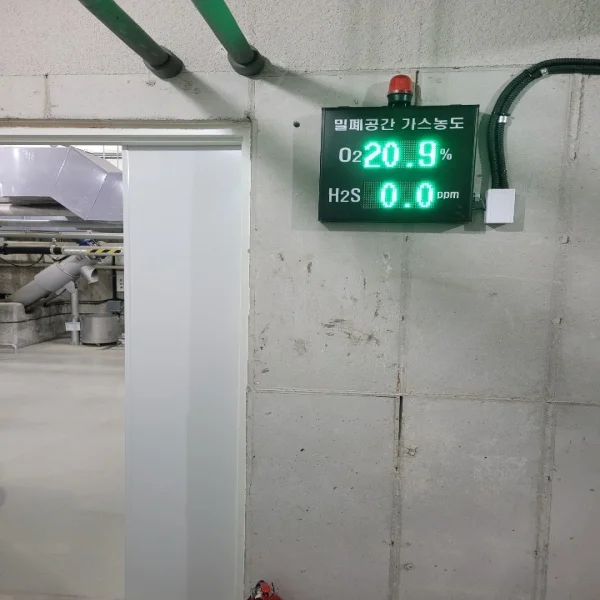
Most wastewater treatment facilities are accessed either via a half-flight of stairs or through an antechamber. When configuring the gas detector and display board for a wastewater room, the display board is mounted on the door leading into the room. In particular, if the wastewater room itself is opened frequently, the display board should be installed on the outer door leading into the antechamber rather than the inner door, so that workers can safely check the gas concentration in advance and enter the treatment room without a gas-related incident.
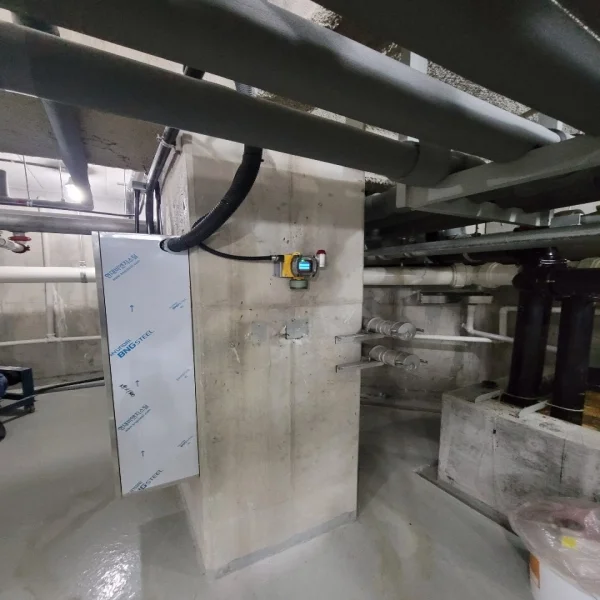
Once the display board location has been decided, the next step is selecting the right location for the detector itself.
Rather than an outer wall, a column near where water from the storage or septic tank flows is generally the best location for the detector. Because wastewater from various sources mixes and undergoes chemical reactions that generate hazardous gases, it is often more important to install a single detector correctly in the right spot than to install multiple units.
We have ten years of experience and know-how in selecting the right detector location and the proper way to operate the system.
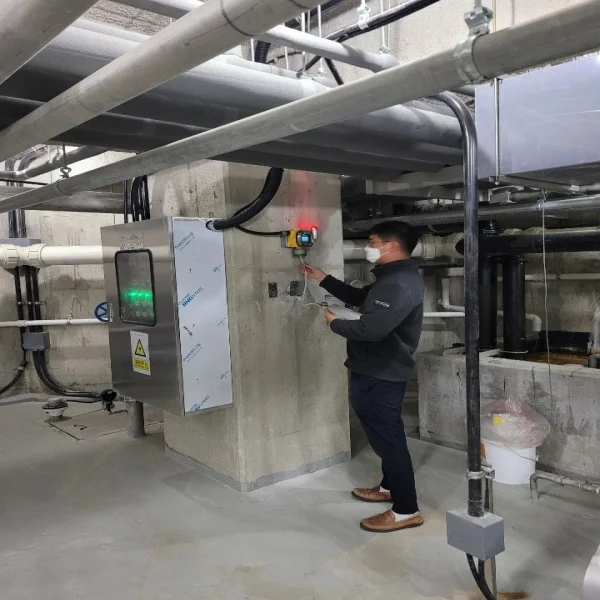
The most important step after installation is commissioning and testing.
After power is applied, the first essential check is whether the detector and display board are receiving power correctly and operating as expected.
Second, using an actual gas sample, it must be verified that the detector responds correctly and that the display board updates in real time in sync with the measured values.
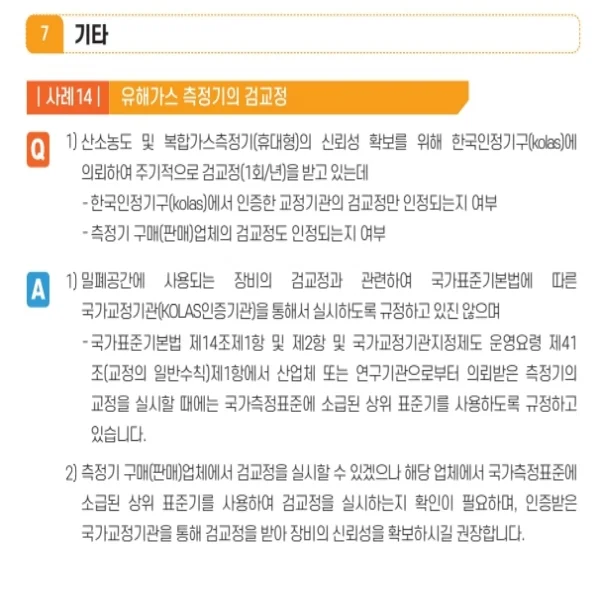
Today, we'd like to answer one of the most common questions: how installed detectors should be calibrated and operated.
This guidance is based on material published by KOSHA regarding calibration and operating standards for gas detectors. Calibrating a gas detector is not a legal requirement, but it is advisable to do so at least once every one to two years. Calibration does not need to be performed by a KOLAS-accredited body — calibration by the manufacturer is also acceptable, provided the manufacturer injects genuine standard gas and follows the correct calibration procedure.
We carry out gas calibration using certified-grade standard gas and MFC (mass flow controller) equipment, equivalent to that used by accredited calibration bodies.
This concludes our introduction to this gas detector installation case for a wastewater treatment room.
We are committed to providing everything from a free on-site survey and tailored solutions to installation, along with dependable after-sales service and support, as a specialist in gas detector sales and installation.
Thank you.
Frequently Asked Questions (FAQ)
Why are wastewater treatment facilities classified as confined spaces?
Even though they may be physically open, wastewater facilities have many different gas-generating factors, so KOSHA classifies them as confined spaces — and this risk is greater when the facility is located in a basement level.
Where should the display board be installed?
It should be installed at the door leading into the wastewater room, ideally on the outer door into the antechamber, so workers can check the gas concentration before entering.
Where is the best place to install the gas detector itself?
Rather than an outer wall, a column near where water from the storage or septic tank flows is generally the best location, and it is often better to install a single detector correctly in the right spot than to install multiple units.
What should be checked during commissioning after installation?
First confirm that the detector and display board are receiving power and operating correctly, then verify that the detector responds correctly to an actual gas sample and that the display board updates in real time.
How often should the gas detector be calibrated?
Calibration is not legally mandatory, but it is recommended at least once every one to two years. Calibration performed by the manufacturer using genuine standard gas and a proper method is acceptable even without KOLAS accreditation.
#WANDI#GasDetector#ConfinedSpaceSafety#WastewaterTreatment#OxygenDetector#H2SDetector#GasCalibration#IndustrialSafety#FacilitySafety#OccupationalSafety