📌 3 Key Takeaways
- A heat-index meter reads far above air temperature — 40–60°C — because it absorbs not only air heat but also radiant heat (sun, heated structures) and conductive heat (floors, equipment).
- The fix is shade and wind. Shade blocks radiant heat; wind disperses heat (convection) and speeds sweat evaporation, cutting the real heat load.
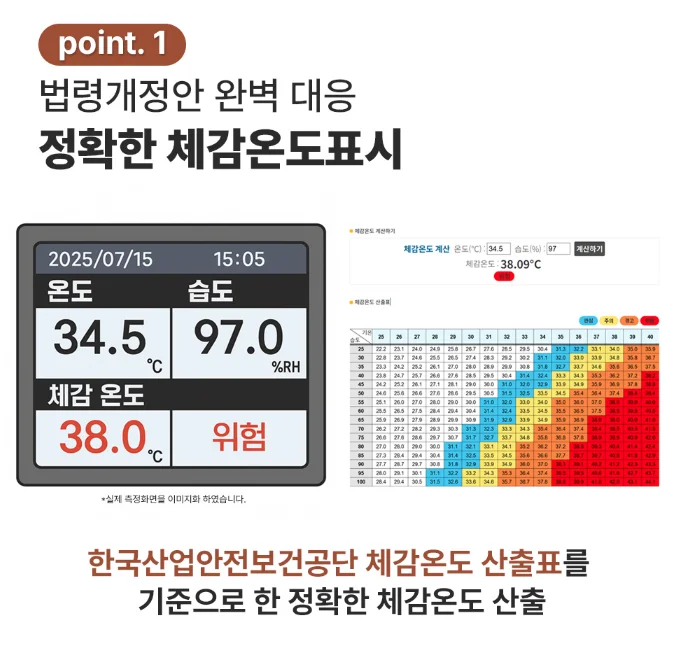
- Korea's 2025 safety-rule revision defines "heatwave work" as a felt temperature of 31°C or higher and mandates temperature/humidity logging. The WANDI FIX800 heat-index meter answers this with 5-stage alarms and automatic data logging.
Turn on a heat-index meter at a summer worksite and it may show 40°C — sometimes near 60°C. "But the air is only 34°C — why so high?" The number is not a fault; it accurately reflects the heat the human body actually receives. The key is that felt temperature measures not just air temperature but also radiant and conductive heat. This article explains why a heat-index meter soars to 40–60°C, how shade and wind lower the load, and how the WANDI FIX800 heat-index meter manages heatwave work.
Why a Heat-Index Meter Rises to 40–60°C — Radiant & Conductive Heat
In short, a heat-index meter (especially its globe sensor) absorbs two extra forms of heat beyond air temperature, so it reads much higher than the thermometer. Heat reaches the body three ways; in summer, radiant and conductive heat are decisive.
| Heat transfer | How it reaches you | Summer worksite examples |
|---|---|---|
| Radiant | Infrared from the sun and hot objects heats the body directly | Direct sun; heated steel, concrete, asphalt; furnaces, drying ovens |
| Conductive | Direct contact with a hot object transfers heat | Hot floors and steel plates, hot equipment and piping, asphalt underfoot |
| Convective | Hot air flowing around the body heats it | Muggy interiors, stagnant heat in confined spaces |
The meter's black globe sensor measures temperature inside a black sphere; because black absorbs nearly all radiant heat, under direct sun it can read 10–25°C above air temperature. Add conductive heat rising from hot floors and equipment, and even at 34°C air temperature the sensor approaches 40°C, 50°C, or nearly 60°C. So "40–60°C" is not exaggeration — it is the real heat load on the worker standing there.
A plain thermometer or hygrometer cannot measure this radiant and conductive heat. The moment someone thinks "it's only 34°C, we're fine," a worker's body may already be absorbing over 40°C of heat. That is why heat accidents keep happening even on "seemingly mild" days.
The Fix — Cut Radiant & Conductive Heat with Shade and Wind
The most immediate way to lower felt temperature is to reduce interference from radiant and conductive heat — that is, secure shade and wind. Even at outdoor sites without air conditioning, these two alone can sharply cut felt temperature.
- Shade — block radiant heat: Canopies and shade tents stop direct sun and radiant heat from heated structures reaching the body. Globe temperature drops immediately, so felt temperature falls quickly. Rest areas must always be shaded.
- Wind — convection + sweat evaporation: Fans and blowers move air, dispersing stagnant hot air (convective heat) and speeding sweat evaporation to cool the body. The higher the humidity, the more wind matters, since sweat evaporates poorly.
- Block conductive heat: Insulating mats over hot floors and steel plates, and less direct contact with hot equipment and piping, reduce heat entering through feet and hands.
In short: shade (block radiant) + wind (convection/evaporation) + insulation (block conductive). But whether these measures actually work must be confirmed by measuring felt temperature. Rather than assuming "we're in the shade, it's fine," compare felt temperature before and after the measures to objectively confirm you've left the danger zone.
Felt-Temperature (WBGT) Risk Levels & Actions
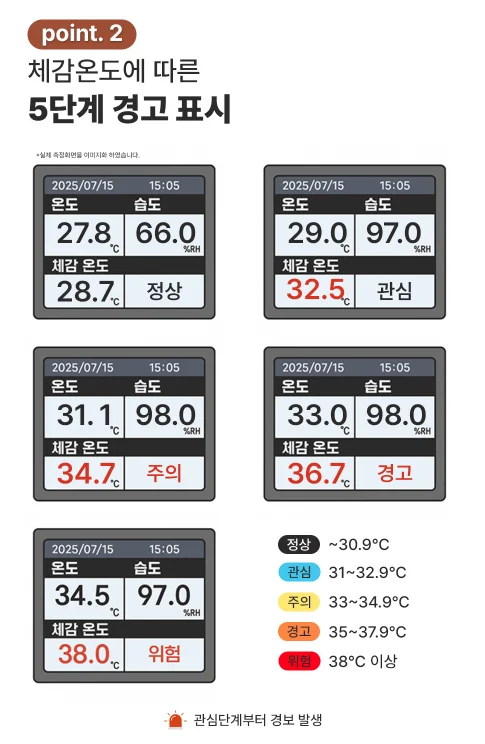
Felt temperature is computed on Korea Occupational Safety and Health Agency (KOSHA) charts. Risk levels and actions are as follows.
| Felt temp. | Level | Effect / recommended action |
|---|---|---|
| ~30.9°C | Normal | Normal work; hydrate regularly |
| 31–32.9°C | Attention | "Heatwave work" begins — regular rest/hydration, temperature-humidity logging |
| 33–34.9°C | Caution | At least 20 min rest per 2 hours; secure shade and wind |
| 35–37.9°C | Warning | Cut work intensity/time; restrict vulnerable workers |
| 38°C+ | Danger | Consider work suspension; immediate cooling/evacuation; emergency readiness |
※ Based on KOSHA felt-temperature charts and heatwave response guidelines. The FIX800 auto-computes felt temperature and displays it in these five stages.
Heatwave Work Is Now a Legal Duty — 31°C Is the Line
Korea's 2025 revision of the Rules on Occupational Safety and Health Standards turned heatwave response from recommendation into obligation:
- "Heatwave work" defined — long work at a location where felt temperature reaches 31°C or higher (source: Safety1st News, 2025).
- At 31°C+ — provide temperature/humidity meters and keep records; take at least one of heat-reduction measures or periodic rest; provide drinks and heat-illness training.
- At 33°C+ — grant at least 20 minutes of rest per 2 hours (source: Kim & Chang newsletter, 2025).
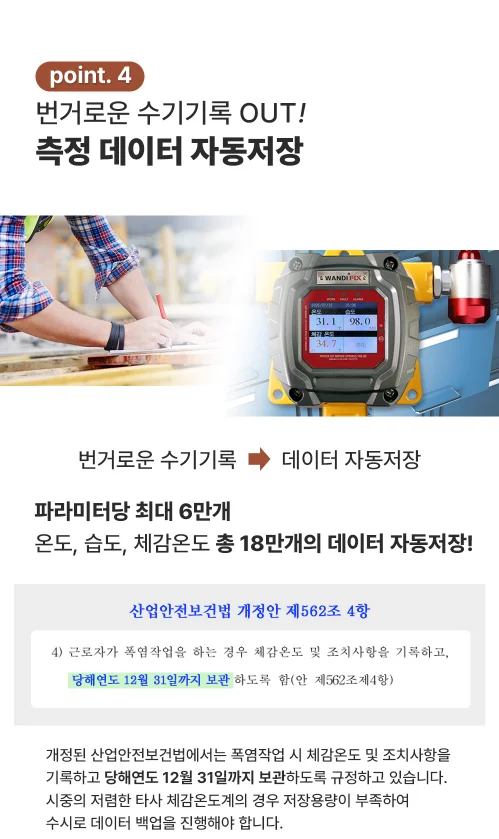
- Record retention — felt temperature and actions during heatwave work must be logged and kept until December 31 of that year (per revised Article 562).
In effect, a device that can measure, display and log felt temperature is now essential on site. Because a heat-illness death is a serious industrial accident under the Serious Accident Punishment Act, felt-temperature records serve as objective evidence that the employer recognized the risk and acted.
Real Heat-Illness Accidents — Recurring Again in Summer 2025
- May 15–July 30, 2025, nationwide — Korea's KDCA heat-illness surveillance recorded 2,884 patients and 16 presumed deaths (source: Korea.kr Policy Briefing, 2025).
- Construction fatalities — a worker in his 60s in Busan, a foreign worker in his 20s at an apartment site, and a worker in his 50s doing outdoor surveying all died of heat stroke; construction heat-illness casualties reached 13 cases this year (source: Safety News, 2025).
What these share: air temperature alone could not signal the danger. Direct sun and radiant heat from heated structures, plus conductive heat underfoot, had already pushed felt temperature into the danger zone. With a device showing felt temperature in real time, shade/wind measures and work suspension could have been decided before the danger level.
FIX800 Heat-Index Meter — Managing Real Heat Load Including Radiant & Conductive Heat
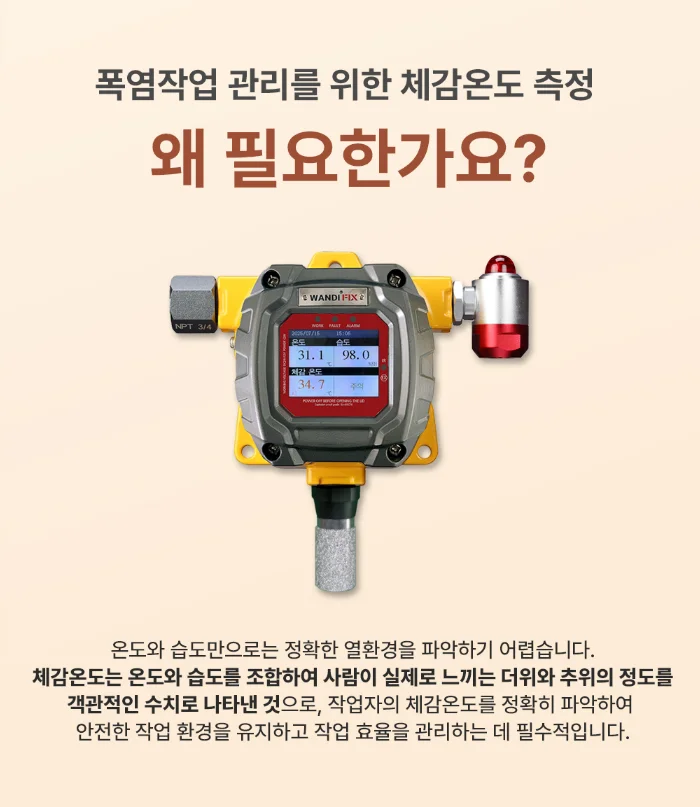
The WANDI FIX800 heat-index meter adds a radiant-heat factor to temperature and humidity, auto-computes felt temperature per KOSHA charts, and shows the risk level at a glance — a fixed-mount instrument.
- 5-stage alarm display — Normal/Attention/Caution/Warning/Danger with color coding for instant judgment
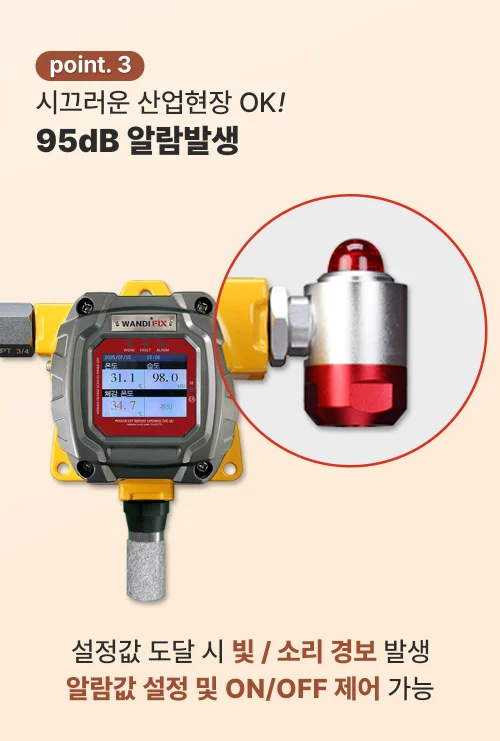
- 95 dB light & sound alarm — strobe and buzzer at set thresholds; adjustable set point and ON/OFF (for noisy sites)
- Automatic data logging — up to 60,000 records per parameter, 180,000 total for temperature/humidity/felt temperature → meets record-keeping duty
- RS485 signal output — links to display boards and control systems to show felt temperature across large sites
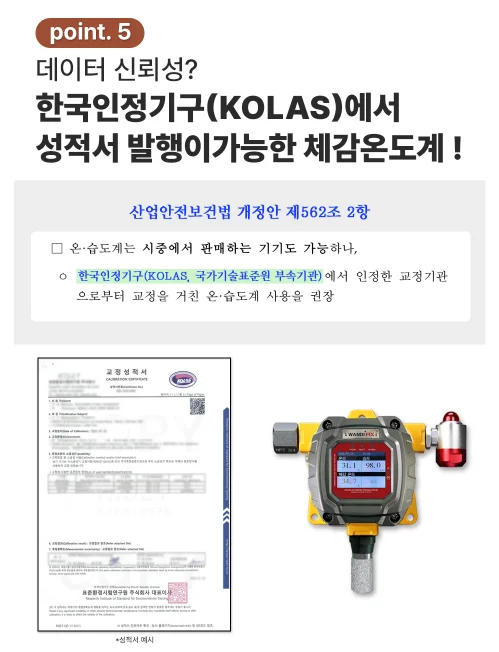
- KOLAS certificate available — calibration certificates from a KOLAS-accredited lab for data reliability
- Rugged aluminum housing — durable for outdoor, hot, humid and dusty environments
Standard Hygrometer vs FIX800 Heat-Index Meter
| Feature | Standard hygrometer | FIX800 heat-index meter |
|---|---|---|
| Measures | Temp. + humidity | Temp. + humidity + felt-temp. computation |
| Radiant/conductive heat | ❌ No | ✅ Reflected via felt temperature |
| Risk alarm | None | 5-stage alarm + 95 dB light/sound |
| Data logging | Limited/none | 180,000 records auto-saved (record-keeping) |
| External linkage | ❌ | RS485 output (display board/control) |
| Reliability | Varies | KOLAS certificate available |
Closing
A heat-index meter reading 40–60°C is not an error — it is a warning showing the worker's real bodily heat state, radiant and conductive heat included. Reducing that heat with shade and wind, and confirming the effect through felt-temperature readings, is the surest way to prevent heat accidents. Contact WANDI (+82-31-340-6952) for FIX800 heat-index meter inquiries and on-site surveys — we will propose the right mounting locations and configuration for your site.
Frequently Asked Questions (FAQ)
Q1. Why does a heat-index meter read far above air temperature — 40 to 60°C?
Because its black globe sensor absorbs not only air heat but also radiant heat (sun, heated structures) and conductive heat (floors, equipment). The black globe absorbs nearly all radiant heat, so under direct sun it can read 10–25°C above air temperature — the real heat load on the worker.
Q2. What is the surest way to lower felt temperature?
Shade and wind. Shade (canopies, tents) blocks radiant heat and immediately lowers globe temperature; wind (fans, blowers) disperses stagnant hot air by convection and speeds sweat evaporation. Insulating mats on hot floors also block conductive heat for even greater effect.
Q3. At what felt temperature must work be managed as heatwave work?
Korea's 2025 revised safety-standard rules define a felt temperature of 31°C or higher as "heatwave work." At 31°C+, temperature/humidity meters, records and rest measures are mandatory; at 33°C+, at least 20 minutes of rest must be granted every 2 hours.
Q4. How does a standard hygrometer differ from the FIX800 heat-index meter?
A standard hygrometer measures only temperature and humidity, while the FIX800 adds a radiant-heat factor to compute the felt temperature the body actually receives, plus 5-stage alarms, automatic logging and RS485 linkage. Under direct sun, radiant heat is decisive, so a heat-index meter is needed.
Q5. Which worksites need the FIX800 heat-index meter?
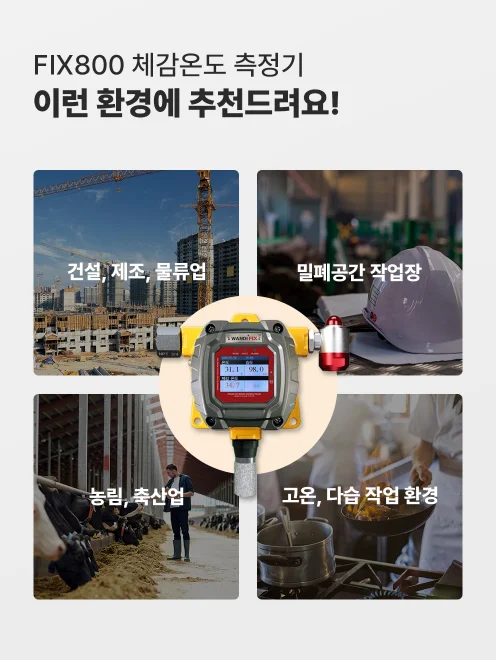
Outdoor construction, manufacturing and logistics sites; kilns and confined spaces; farming and livestock sites; and hot-humid workplaces such as steel, foundry, laundry and food processing. Any heatwave worksite where radiant and conductive heat concentrate from direct sun or heated equipment is a target.
Q6. Why are felt-temperature records important?
The revised rules require logging felt temperature and actions during heatwave work and keeping them until December 31 of that year. A heat-illness death is a serious industrial accident under the Serious Accident Punishment Act, so records serve as objective evidence that the employer recognized and acted on the risk. The FIX800 logs data automatically to meet this duty.
Q7. Does the FIX800 link to display boards or control systems?
Yes. It provides RS485 signal output to link with display boards, status panels and control systems, so felt temperature can be checked from a distance across large sites for easier management.
Q8. How do I get a quote?
Contact us via the WANDI website quote-request page or by phone (+82-31-340-6952). Configuration and display-board linkage vary by site environment and mounting location, so we provide a tailored quote after an on-site survey.