Applied Markets
Project Details
Hello.
Summer conditions at manufacturing and steel plants can make the heat workers experience significantly greater than the outdoor temperature alone, due to the additional heat generated by equipment and processes.
Steel processing environments in particular often require more careful management of heat-related illness than typical manufacturing sites.
This post introduces an installation case for a WANDI FIX800TH heat-index meter and heat-index display board at an actual steel company site, along with an explanation of why heat index should be measured at industrial sites and the occupational safety and health standards that currently apply.
Heat Index Is Not the Same as Simple "Current Temperature"
When managing a site in summer, it is common to check only the thermometer mounted on a wall.
However, the heat workers actually experience is not determined by air temperature alone.
Korea's occupational safety and health standards also use "heat index" rather than simple air temperature to determine whether work qualifies as heat-wave work.
Under the current Rules on Occupational Safety and Health Standards, work performed for an extended period at a workplace where the heat index reaches 31°C or higher due to a heat wave is defined as "heat-wave work."
This means that at summer industrial sites, the more important question is not simply "What is today's temperature?" but "What is the heat index at the exact location where workers are performing their tasks?"
Is a Heat-Index Meter Mandatory On Site?
This point needs to be clarified precisely.
The law does not specify a particular product or method, stating that "a heat-index meter such as the FIX800TH must be installed."
However, Article 562 of the Rules on Occupational Safety and Health Standards requires employers to take the following measures to prevent health hazards from heat-wave work:
- First, workplaces where heat-wave work is expected must be equipped at all times with a device capable of measuring temperature and humidity, such as a thermo-hygrometer.
- Second, when heat-wave work is performed, the heat index measured at that workplace and the measures taken must be recorded on a daily basis.
- Third, these records must be kept until December 31 of the year in which the heat-wave work took place.
The Ministry of Employment and Labor also distributes a separate heat-index measurement log and heat-index calculation table for use at workplaces.
In practice, it is possible to check a simple thermo-hygrometer and calculate the heat index separately, but applying a fixed installation that can display temperature, humidity, and heat index directly on site makes management considerably more convenient.
Where Should a Heat-Index Meter Be Installed?
Installation location also matters.
Appendix 13-2 of the Occupational Safety and Health Standards specifies that heat index should be measured at a height of approximately 1.2–1.5 m from the floor of the workplace where employees are working.
However, where on-site measurement is difficult — such as for outdoor mobile work — the heat index published by the Korea Meteorological Administration may be used instead.
Therefore, when installing a heat-index meter, the goal should not simply be to choose a location that is convenient for wiring, but to consider where workers are actually exposed to heat during their tasks and their typical movement patterns.
This Steel Company Site Was Configured with a FIX800TH and a Large Display Board
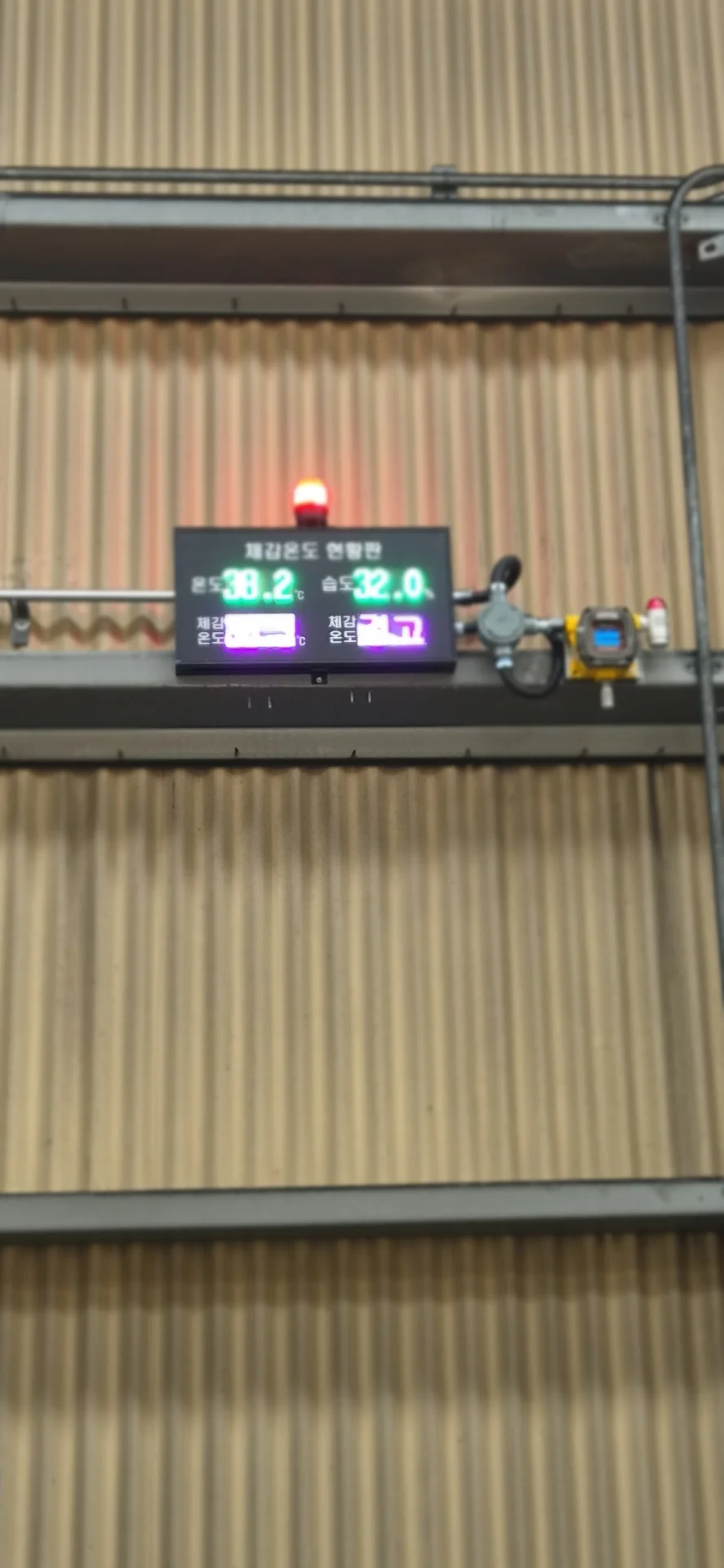
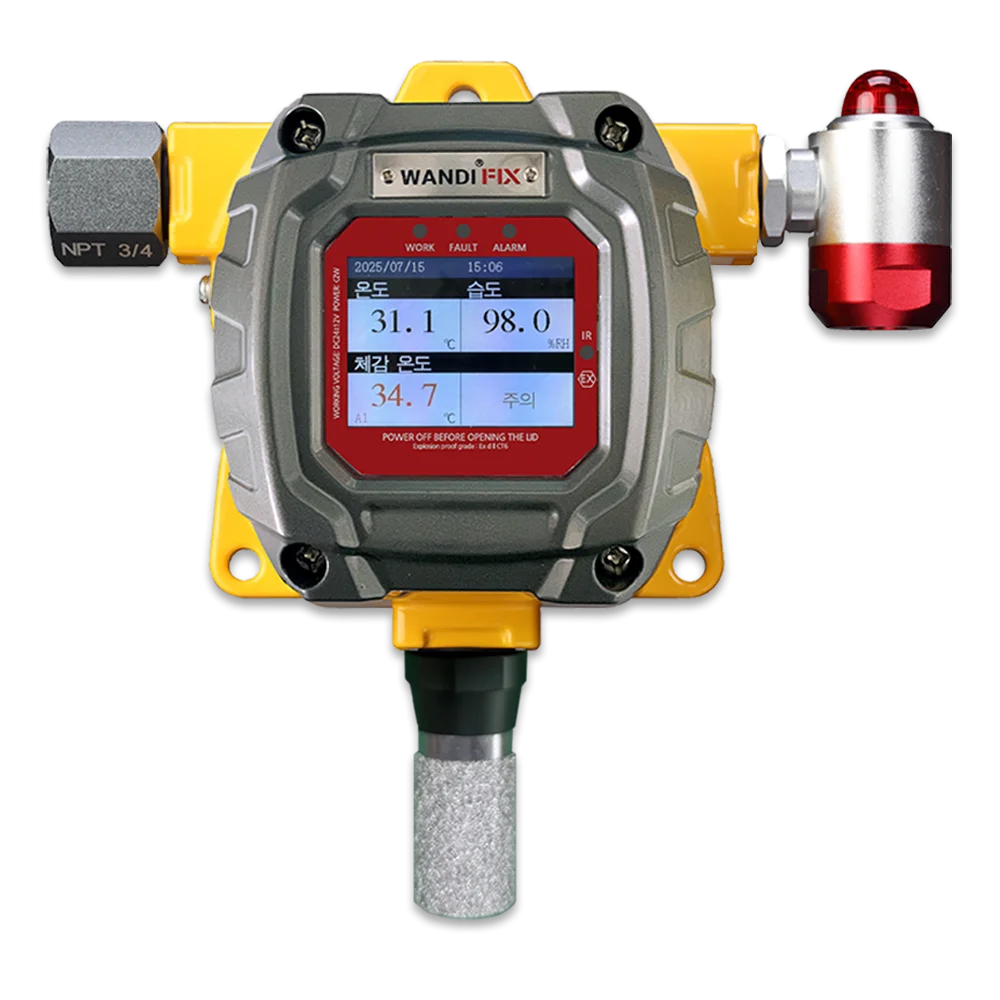
At this site, a WANDI FIX800TH heat-index meter was configured together with a large heat-index display board.
The manufacturer describes the FIX800TH as an industrial fixed-installation device that can be used to measure and record heat index at heat-wave work sites.
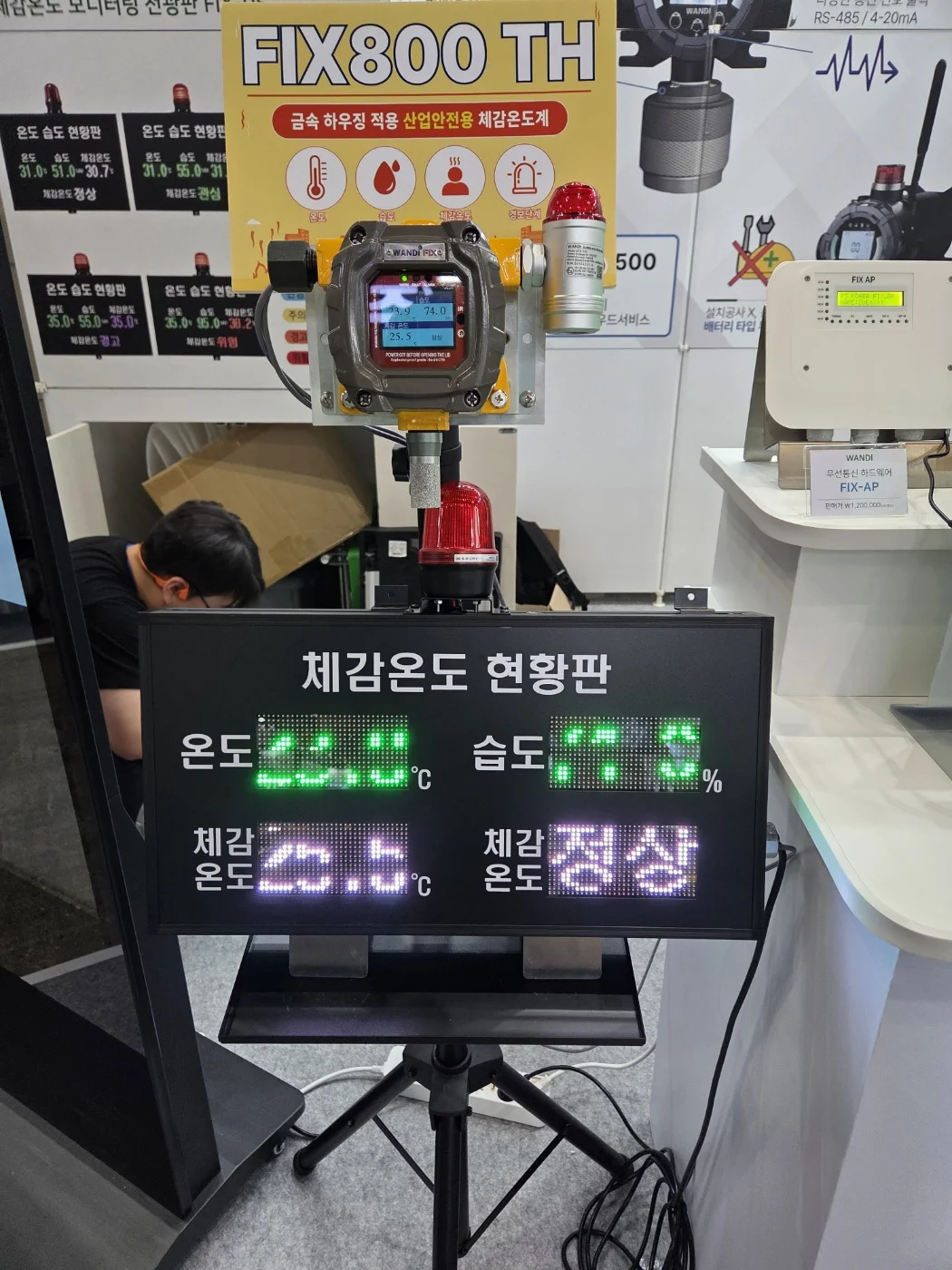
On site, a separate large display board was configured so that workers could check the information from the meter without having to approach it directly.
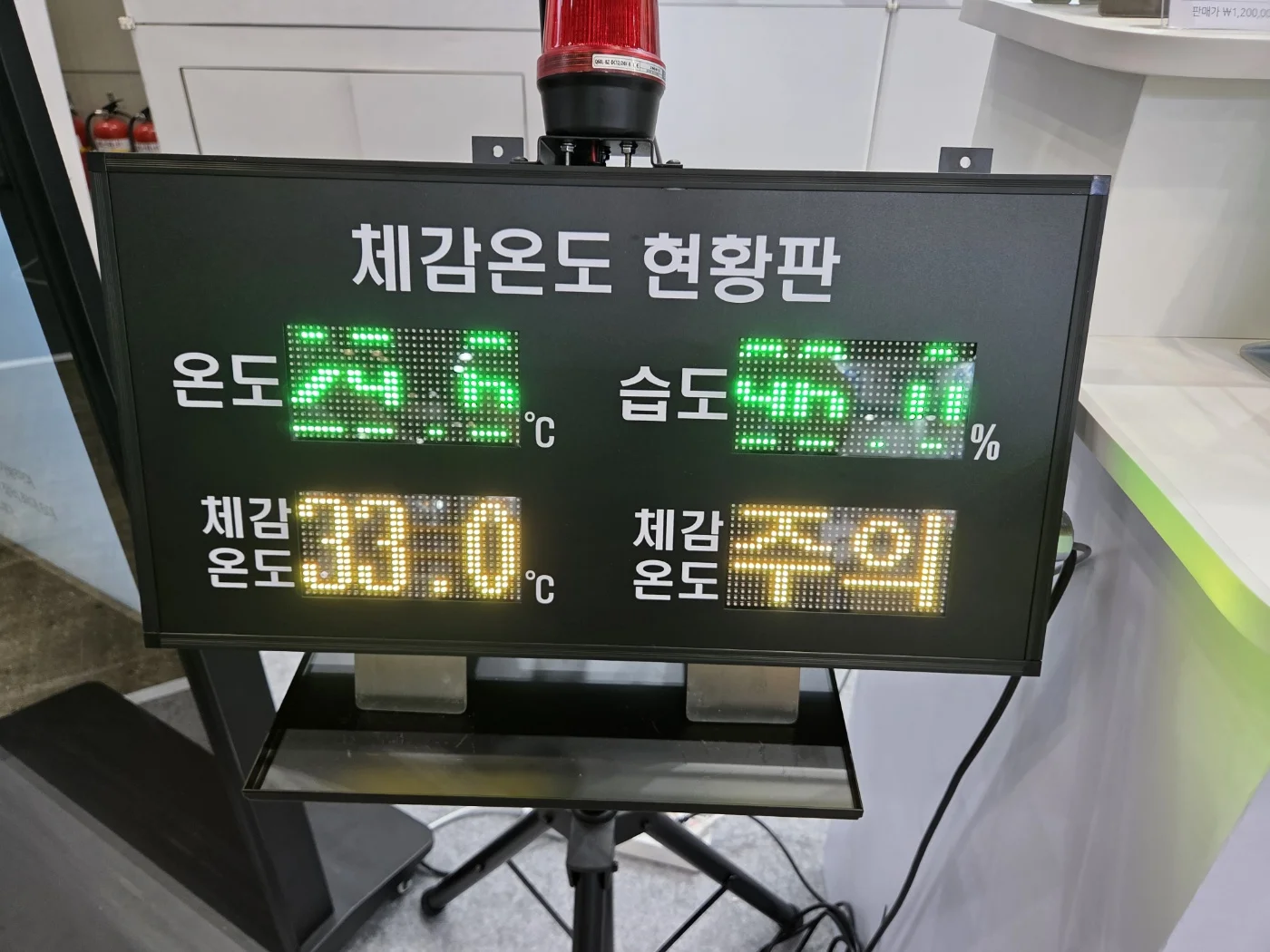
As shown in the photos, the display board shows temperature / humidity / heat index / heat-index status so that workers can check the information at a glance.
There Is a Difference Between Installing Only a Meter and Installing a Meter with a Display Board
The heat-index meter's own screen also shows the measured values.
However, in a large steel plant, not every worker passes directly in front of the meter.
That is why, as in this installation, adding a large LED display board makes it easier for workers to check the current status from a distance.
In particular, the purpose on site is not simply to "collect" measurement data. Workers need to be able to immediately recognize the current working environment, and managers need to be able to judge what action is needed.
For this reason, in large facilities such as factories, warehouses, and production lines where workers move across a wide area, combining a heat-index meter with a large display board is worth considering.
So Why Install a Display Board?
A heat-index display board itself is not a legally mandated facility.
However, in practice it serves a very useful role on site.
Workers can easily check the current temperature, humidity, and heat-index status without having to look for a small meter screen each time, and safety managers can more easily decide on measures such as rest breaks, cooling, or ventilation based on current conditions.
In particular, at noisy, large-scale steel and manufacturing sites, sharing the current status using large numbers is more effective than a small screen in terms of on-site visibility.
In the actual installation photos, you can see the heat-index display board installed in a location that is easily visible to workers inside the plant.
A short video of the installed alarm in operation was also recorded; it shows the FIX800TH heat-index monitoring system currently in operation at an actual steel company site.
The numbers on the display board are much more intuitive to read in person than in photos. The installation location was chosen to ensure visibility within the work area, so workers can immediately check the current temperature, humidity, and heat index.
What to Check Before Introducing a Heat-Index Meter
Installing a heat-index meter does not automatically complete heat-wave management.
What matters on site is building a management system that includes the following:
- Measure at the actual location where employees are working
- Continuously check temperature, humidity, and heat index
- Check whether the heat index reaches 31°C or higher
- Record the heat index and any measures taken on a daily basis during heat-wave work
- Implement measures such as cooling, ventilation, adjusted work hours, and rest breaks when necessary
- Check the statutory rest requirements for heat-wave work where the heat index reaches 33°C or higher
- Regularly maintain the meter's condition and measurement accuracy
Ultimately, what matters is not simply "having installed a meter," but building a management cycle that runs from measurement → monitoring → sharing → action → recording.
Comprehensive Heat-Index Management for Steel and Manufacturing Sites
As with this steel company site, in large industrial facilities it is often difficult for all workers to share awareness of the current environment using a single small thermo-hygrometer.
Combining a FIX800TH with a heat-index display board creates a system that conveys temperature, humidity, and heat-index information to workers more intuitively.
Consultation is available on heat-index meter selection / display board configuration / installation-location review / on-site installation / and KOLAS-accredited calibration according to site conditions.
If you are considering a heat-index monitoring system for heat-wave-work management at a steel plant, metal processing plant, logistics center, production facility, or similar site, the right configuration can be recommended after reviewing your site conditions and display requirements.
Frequently Asked Questions (FAQ)
What is a heat-index meter used for at industrial sites?
It measures temperature, humidity, and heat index together so that employers can determine whether "heat-wave work," as defined under Korea's occupational safety and health standards, is occurring at a given workplace.
What heat index qualifies as "heat-wave work" under Korean regulation?
Under the Rules on Occupational Safety and Health Standards, work performed for an extended period at a location where the heat index reaches 31°C or higher due to a heat wave is defined as heat-wave work.
Where should the heat-index meter be installed?
Appendix 13-2 of the standards specifies measuring heat index at a height of about 1.2–1.5 m from the floor at the location where employees are actually working, so the installation position should reflect real work positions and movement patterns.
Why add a large display board in addition to the meter?
In large facilities where workers are spread across a wide area, a large LED display board lets workers check the current temperature, humidity, and heat-index status from a distance, without needing to approach the meter directly.
What should be checked in addition to installing the equipment?
Employers should continue to measure heat index at actual work locations, record it daily during heat-wave work along with any measures taken, take action such as cooling or adjusted work hours when needed, and regularly maintain the equipment's accuracy.
#WANDI#FIX800TH#HeatIndexMeter#HeatIndexMonitoring#HeatWaveSafety#IndustrialSafety#OccupationalSafety#WorkplaceSafety#SteelIndustry#ManufacturingSafety