What Is Hydrogen Sulfide (H2S) and Why Is It One of the Most Dangerous Industrial Gases?
Hydrogen sulfide (H2S) is a colorless gas with a characteristic rotten-egg odor, generated in sewage treatment plants, oil refineries, pulp mills, livestock farms, and wastewater treatment facilities. The critical danger is that above 10 ppm, H2S paralyzes olfactory receptors, making workers unable to detect the gas by smell — precisely why fatal exposures often occur without warning.
💡 Key Point
H2S is heavier than air and accumulates at the bottom of manholes, pits, and underground spaces. Gas measurement is mandatory before entering any confined space.
H2S Health Effects by Concentration
| Concentration (ppm) | Symptoms | Risk Level |
|---|---|---|
| 0.5–1 | Detectable rotten-egg odor | ⬜ Safe |
| 2–5 | Headache and nausea with prolonged exposure | 🟡 Caution |
| 10 | Eye/nose/throat irritation; olfactory fatigue begins | 🟠 Alert |
| 50–100 | Conjunctivitis, pulmonary edema within 1 hour | 🔴 Dangerous |
| 150–200 | Complete olfactory paralysis — no odor detected | 🔴 Very Dangerous |
| 300–500 | Pulmonary edema and loss of consciousness within 30–60 min | ☠️ Life-threatening |
| 700–1000 | Respiratory arrest and death within minutes | ☠️ Immediately fatal |
Real Incident Cases
Case 1: Fatal H2S Asphyxiation at Sewage Treatment Manhole (2019, Gyeonggi-do)
Two workers collapsed inside a manhole during pump inspection at a sewage treatment plant in Gyeonggi-do. A colleague who entered to rescue them was also affected, resulting in three hospitalizations and two fatalities. Estimated H2S concentration exceeded 300 ppm; no pre-entry gas measurement had been conducted. (Source: Ministry of Employment and Labor — Major Industrial Accident Cases, 2019)
Case 2: H2S Poisoning During Manure Tank Cleaning (2021, South Jeolla Province)
A worker lost consciousness during manure storage tank cleaning at a pig farm in South Jeolla Province after a sudden surge of H2S. Swift reporting by a colleague enabled timely rescue, but the worker required weeks of hospital treatment. Investigation confirmed that H2S was produced in large quantities from accumulated sludge. (Source: KOSHA Industrial Accident Case Database, 2021)

How WANDI EDW500 Prevents H2S Accidents
EDW500 — IECEx-Certified 5-Gas Portable Detector
The WANDI EDW500 holds IECEx TPS 25.0057X international explosion-proof certification (Ex da ia IIC T4 Ga, Zone 0) and can simultaneously detect up to 5 gases: H2S, EX (combustible), CO, O2, and VOC (PID) — providing comprehensive monitoring in complex gas environments with a single device.
TPS 25.0057X
Simultaneous Detection
EPL Ga Certified
Prevention Scenario — If EDW500 Had Been Present
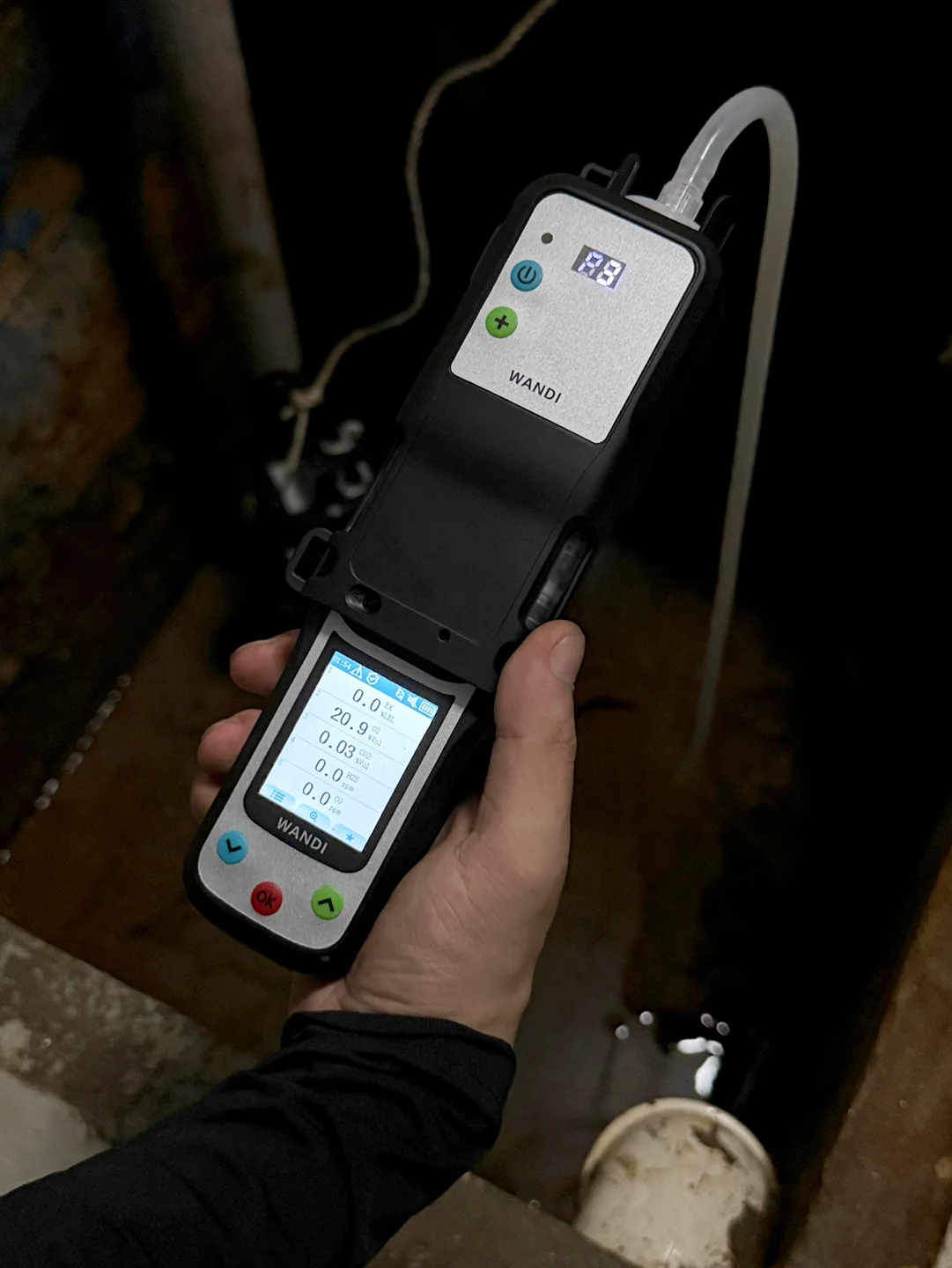
- 1Pre-entry Measurement: Lower the EDW500 into the manhole/tank by rope to measure air quality at the bottom before entry.
- 2Instant Alarm: When H2S exceeds the setpoint (e.g., 10 ppm), triple alarms (sound 95dB+, vibration, LED) trigger immediately for evacuation.
- 3Continuous On-body Monitoring: Worker wears the EDW500 throughout the job. Even with olfactory paralysis, the alarm detects danger.
- 4Data Logging: Automatic measurement history storage for post-incident analysis and legal documentation.
EDW500 Specifications (H2S Measurement)
| Specification | Details |
|---|---|
| Model | EDW500 / EDW500a |
| Detectable Gases | H2S, EX (combustible), CO, O2, VOC (PID) — up to 5 simultaneously |
| H2S Range | 0–100 ppm |
| H2S Alarm Setpoints | Low: 10 ppm / High: 20 ppm (user-configurable) |
| Ex Certification | IECEx TPS 25.0057X / Ex da ia IIC T4 Ga / Zone 0 |
| Alarm Type | Audible (≥95 dB) + Vibration + LED Flash (triple alarm) |
| Battery | Rechargeable Li-Ion, 12+ hours continuous use |
| IP Rating | IP67 |
A Closer Look at the WANDI EDW500
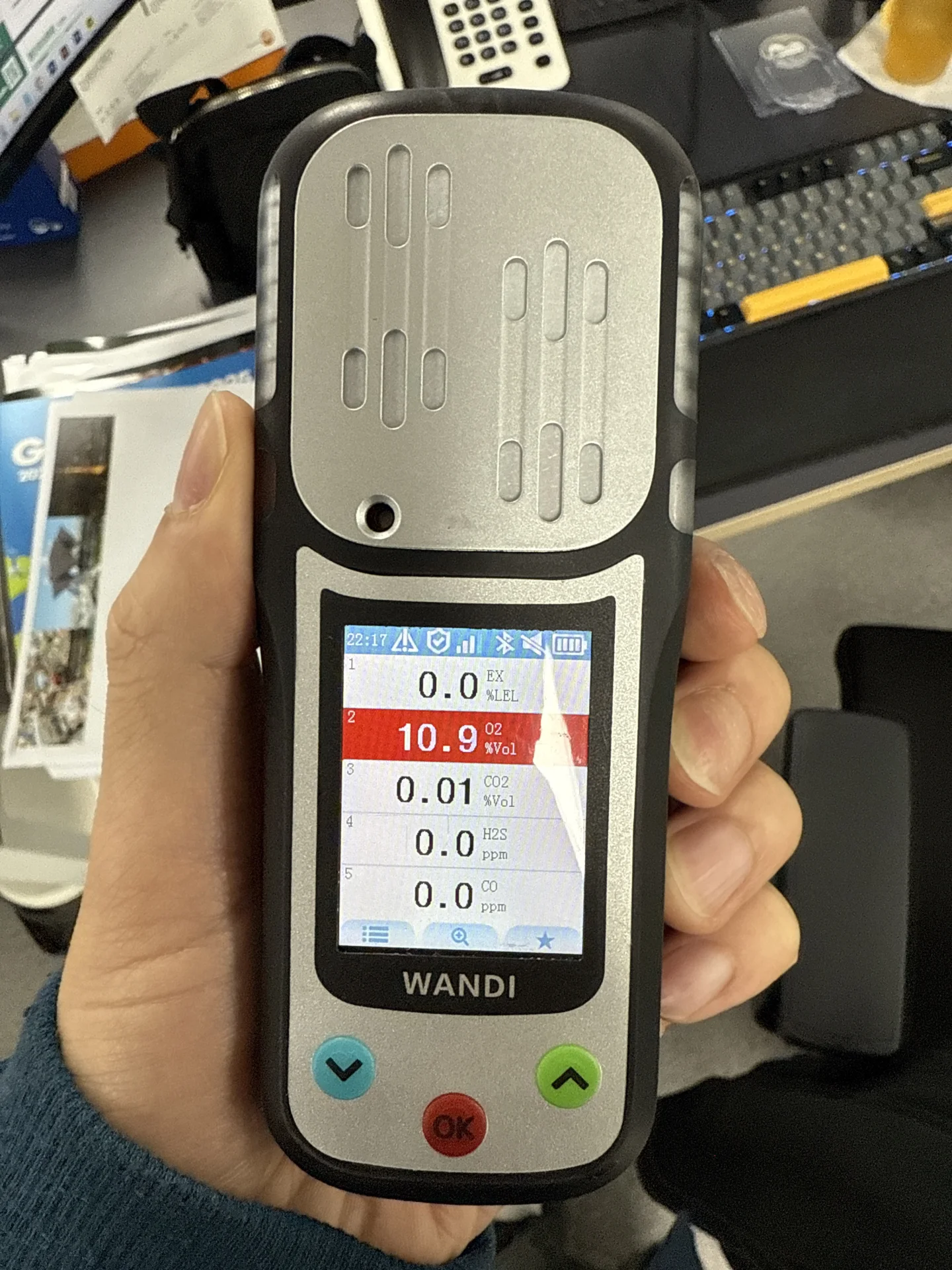
Below are real photos of the WANDI EDW500 portable multi-gas detector.