📌 3 Key Takeaways
- Cold storage warehouses that handle dry ice can be exposed to oxygen-deficiency and asphyxiation risk from CO2 released as dry ice sublimates and from refrigerant gas leaks.
- A cold storage warehouse in Yongin installed WANDI's FIX800 fixed gas detector configured with both O2 (oxygen) and CO2 (carbon dioxide) sensors, mounted close to the floor to match the relative weight of these gases.
- A gas concentration display board was added next to the existing temperature display board, letting staff check indoor air quality from the entrance in real time without opening the warehouse door.
Most of us have seen the white mist rising from an ice cream delivery box. That mist comes from dry ice. But this familiar material tells a very different story inside a sealed cold storage warehouse. The moment it's exposed to room temperature, it sublimates from solid to gas — and in doing so, displaces the oxygen around it. This case study covers a cold storage warehouse in Yongin, Gyeonggi-do that handles dry ice, and how this invisible hazard was turned into a continuously monitored system using WANDI's FIX800 fixed gas detector.
Why Dry Ice Is Dangerous Inside a Cold Storage Warehouse
Korea's Occupational Safety and Health Agency (KOSHA) explains dry ice as follows: "Dry ice is solid carbon dioxide. When exposed to normal temperature and pressure, it sublimates into CO2 gas, absorbing heat from its surroundings — which is why it is widely used for cooling. However, it can become a problem when used temporarily in facilities or warehouses that lack a cooling system capable of sustaining low temperatures over long periods." In other words, dry ice itself isn't a toxic substance, but the CO2 it releases as it sublimates can accumulate in a poorly ventilated, sealed space, relatively lowering the oxygen concentration and creating an asphyxiation risk.
This particular site had one more hazard to manage: refrigerant gas leaks. Cold storage warehouses run refrigeration piping throughout the space to maintain low temperatures, and if refrigerant gas leaks from that piping, it can flow into the warehouse along with the cold air. Depending on the capacity of the refrigeration unit, a large leak carries a real risk of asphyxiation. This warehouse therefore had to manage two separate asphyxiation pathways at once — CO2 buildup from dry ice, and oxygen deficiency from refrigerant leaks.
The On-Site Dilemma — A Door That Couldn't Be Opened Often
An added complication came from the nature of cold storage itself. Maintaining temperature is critical, so the warehouse stays locked at all times. If the door were opened and the temperature rose, it could mean both wasted electricity and damage to stored goods. That meant supervisors couldn't simply open the door whenever they wondered whether something might be wrong inside. Checking safety required opening the door — but opening the door meant a loss in temperature control. What this site needed was a continuous monitoring system that could confirm indoor air conditions without ever opening the door.
The Solution — Installing O2 and CO2 Together on the FIX800, and the Logic Behind Placement
WANDI's partner Raymond Korea installed a FIX800 fixed multi-gas detector configured with both an O2 (oxygen) sensor and a CO2 (carbon dioxide) sensor at this warehouse. The O2 sensor handles general oxygen-deficiency monitoring, while the CO2 sensor specifically watches for CO2 buildup from dry ice — splitting the two hazards between two dedicated sensors.
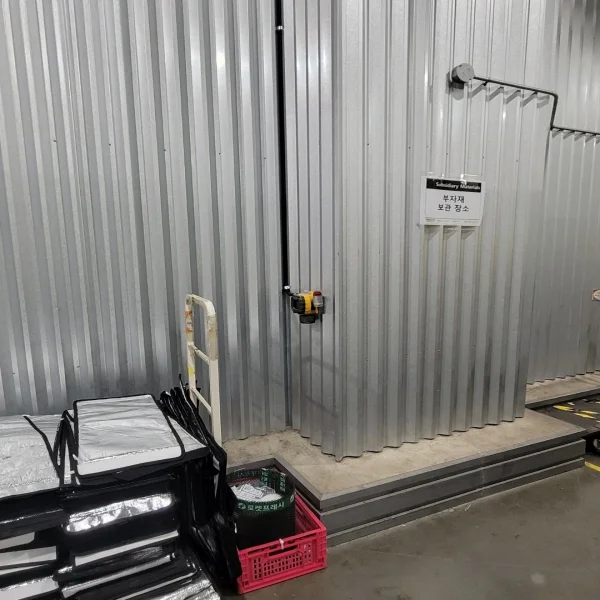
There was also a principle behind where the detector was placed. Gases move differently after a leak depending on their weight relative to air: a gas heavier than air, like CO2, gradually sinks toward the floor, while a lighter gas, like H2 (hydrogen), gradually rises toward the ceiling. Since both CO2 and O2 conditions at this site were best detected near floor level, the detector was mounted close to the ground.
Why the Door No Longer Needs to Be Opened — The Gas Concentration Display Board
The most practical improvement was the display board. This warehouse already had a temperature display board mounted outside so staff could check the internal temperature without opening the door — and a gas concentration display board was installed right alongside it.
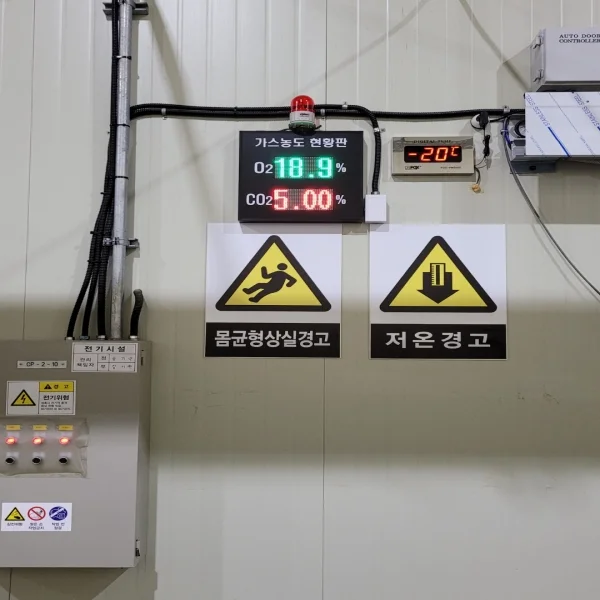
Now supervisors can stand at the entrance and check both temperature and gas concentration at the same time, without ever opening the door. The warehouse keeps its locked state for temperature control, while indoor air quality abnormalities can still be caught in real time.
Self-Check Checklist for Gas Safety in Cold Storage and Similar Spaces
- Is a CO2 (or relevant gas) detector installed in any storage space handling sublimating or vaporizing materials such as dry ice or liquid nitrogen?
- Is a dedicated oxygen detector installed in any space where refrigeration units or refrigerant piping run?
- Was the detector's installation position chosen based on the target gas's density relative to air (heavier or lighter)?
- Is there a display (such as a board) that lets staff check indoor gas concentration and air quality without opening the door?
- Is there a predefined response procedure — who responds and how — for when an alarm triggers?
- Is the gas detector inspected and calibrated on a regular schedule?
Closing
Dry ice may be a familiar sight in an ice cream box, but inside a sealed, poorly ventilated storage space, it can become a real threat to oxygen levels. This case at a Yongin cold storage warehouse didn't leave that risk to chance — it turned it into a concrete, continuous monitoring system built around a combined O2/CO2 gas detector and a gas concentration display board. If you need a gas safety review or a FIX800 fixed gas detector for a cold storage warehouse, low-temperature storage facility, or any space handling dry ice or liquefied gas, contact WANDI (+82-31-340-6952) — we'll help configure the right setup for your site conditions.