Applied Markets
Installed Gases
Project Details
FIX800 5-Gas Fixed Detector with LED Display Board — Confined-Space Safety Installation at a Government Facility (Location Confidential)
This is a delivery to a government-affiliated facility. Location details are kept confidential. Following successful performance verification of the portable GasTiger 2000 already in use at the site, a FIX800 fixed detector and LED display board were added for continuous monitoring in compliance with the revised Occupational Safety and Health Act (5-gas requirements).
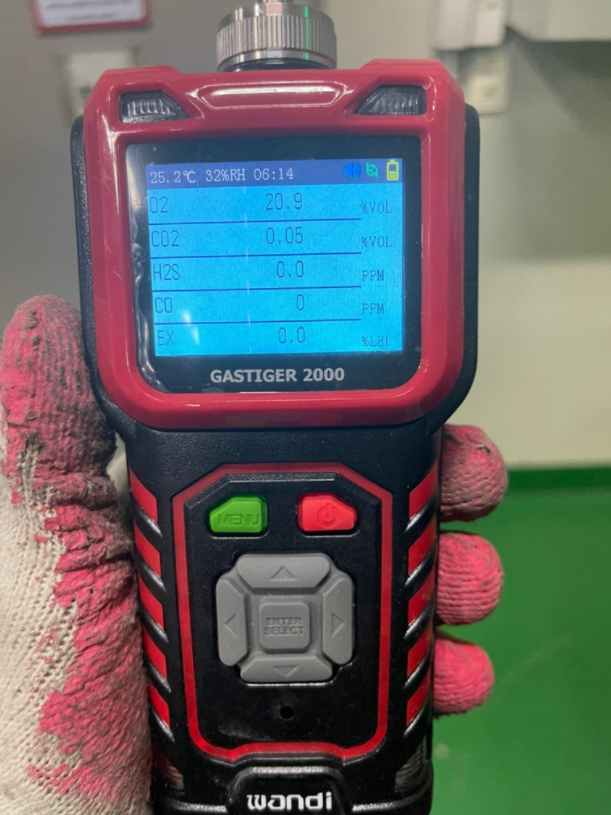
Custom Manufacturing — Coordinated Production, Delivery, and Installation
Both the detector and display board are custom-manufactured products, with production, shipping preparation, and installation scheduled in close coordination to meet the delivery deadline.
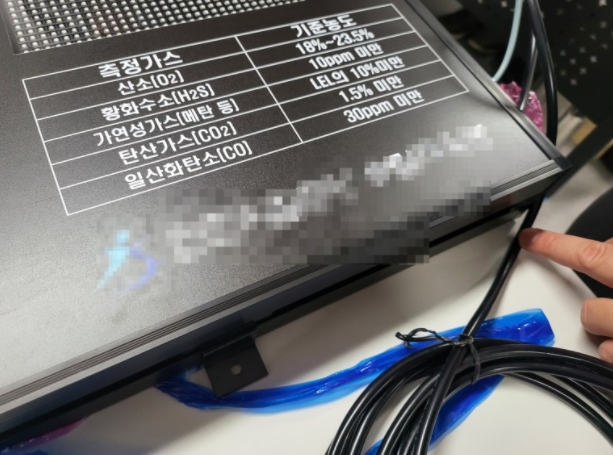
The display board supports custom text insertion — any text elements such as facility name, warning messages, or logo can be incorporated if an editable design file is provided.
Pre-Shipment Commissioning — Sensor Responsiveness Verification

Pre-shipment commissioning is mandatory. Each sensor's response was verified using calibration gas before the units left the facility. Photographs showing personnel are not published for confidentiality reasons.
Installation and Wiring — Power Supplied from Display Board to Detector
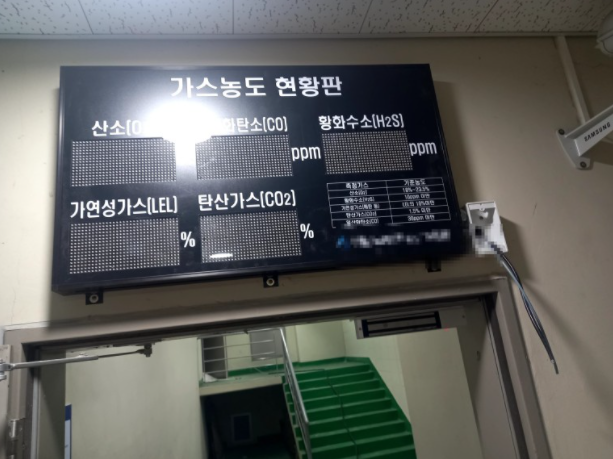
The display board is powered at 220V and supplies the detector via a 4-wire connection — two wires for 24V power and two for RS-485 communication. The proximity of a power source to the installation point significantly affects construction complexity and time.
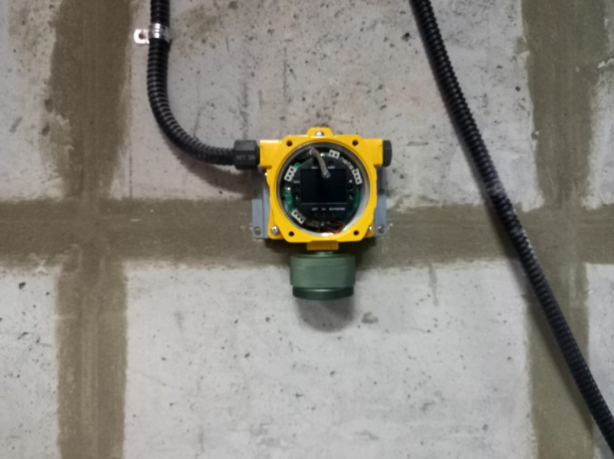
After mounting the detector at the agreed point, wiring is completed and protected with waterproof flexible conduit.
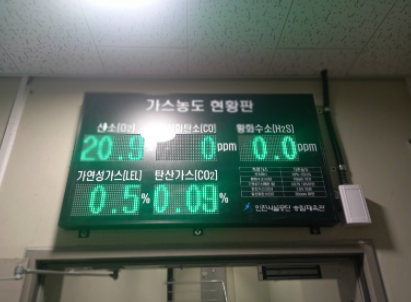
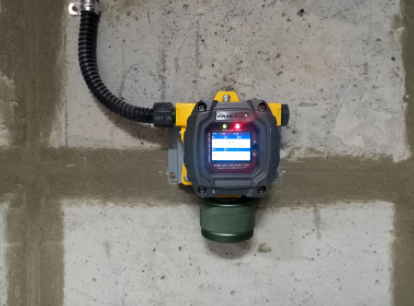
With the display board powered, the detector activates simultaneously. Real-time readings are displayed on the board, allowing internal gas conditions to be monitored from outside the confined space — eliminating the need for workers to enter to check levels.
Installation Summary
- Crew: 4 personnel
- Duration: 1 day
- Materials used: approximately 200 m of conduit, cable, and related materials
Demand for fixed monitoring installations continues to grow across construction sites, septic tank rooms, water storage facilities, and water treatment plants — any environment with elevated risk of toxic gas generation.
Frequently Asked Questions
Q1. Why did the revised OSHA mandate 5-gas measurement in confined spaces?
The revision strengthened requirements following repeated asphyxiation fatalities in confined spaces. Monitoring is now required for O₂, CO, CO₂, H₂S, and EX — covering the three principal hazard categories simultaneously. Sites previously relying on portable instruments alone are increasingly adding fixed monitoring systems to meet the enhanced requirements.
Q2. Why add a fixed FIX800 when portable detectors are already in use?
Portable instruments provide a point-in-time pre-entry check. They cannot continuously monitor gas concentrations during work. The FIX800 provides 24-hour continuous monitoring and immediately triggers alarms if concentrations change during operations — protecting workers from sudden gas releases that portable instruments would miss. The two approaches are complementary.
Q3. Is custom text on the display board supported?
Yes. If an editable design file (AI, PDF, or equivalent) is provided, facility name, warning text, and logos can be incorporated into the custom display board. This is commonly requested by government facilities and large corporations where visual consistency with institutional branding is required.
Q4. Why does power source location affect installation complexity?
Display boards require 220V power. Where an existing outlet or panel is nearby, wiring is straightforward. When the power source is distant or penetrating concrete walls is required, additional drilling, conduit installation, and labor extend both the time and cost of the work significantly.
Q5. Why is CO₂ included in the 5-gas configuration?
CO₂ is generated in confined spaces by organic decomposition, fermentation, and combustion. At sufficient concentration it displaces oxygen, causing asphyxiation — and unlike CO or H₂S, it has no distinct odor as a warning. Its inclusion in the revised 5-gas standard reflects its role as a primary asphyxiant in septic tanks, fermentation vessels, and underground spaces.
#ConfinedSpace5GasDetector #FIX800 #OccupationalSafetyAct #FixedGasDetector #GasDisplayBoard #GovernmentFacility #CustomGasDetector #RSKorea #WANDI #Confidential
![[레이먼드] 오,폐수 처리실 유해가스 모니터링](https://wandi.co.kr/storage/construction-cases/YxFUQVBZ8Unnk7pJzzfsmezr6xNe0LZvQRDmt7TL.jpg)
![[브이피이코리아] 종합병원 지하 밀폐공간 가스 측정기 설치_FIX800 & FIX-DS](https://wandi.co.kr/storage/construction-cases/gNOA28xSlEy5uU3AOxyHDRH5UfAe0TpMTgAt4Uag.jpg)

