Installed Gases
Project Details
FIX800 Fixed Oxygen Detector with Dual LED Display Boards — Gas Storage Confined Space (Jeonju)
This case covers a FIX800 oxygen detector and LED display board installation in a gas storage confined space in Jeonju.
Customer Requirements
- ① Installation within 30 days → Approximately 30 days including custom manufacturing lead time — fully achievable.
- ② Power outlet in gas storage is an explosion-proof receptacle → Once the receptacle specification is confirmed, a compatible plug can be prepared.
- ③ Display board on the outer wall of the gas storage room, plus same readings accessible in the 2nd-floor office → Additional product and installation cost, but no technical obstacles.
Installation Process
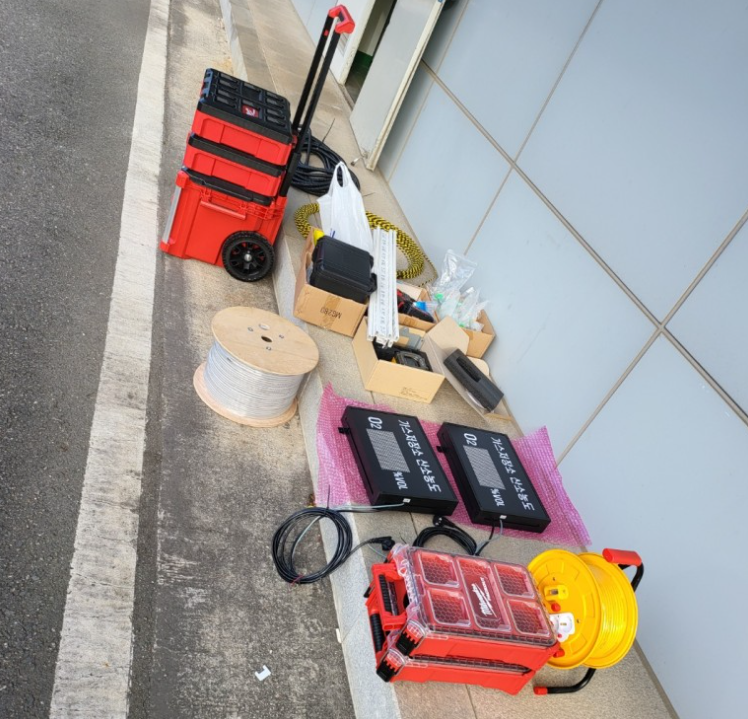
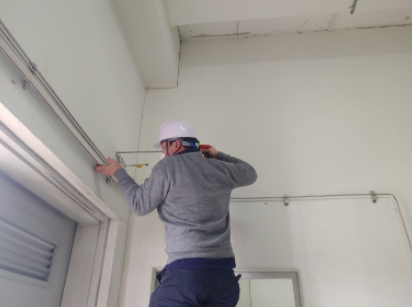
Tools and materials laid out for efficient access during installation.
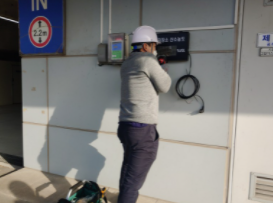
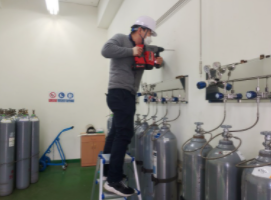
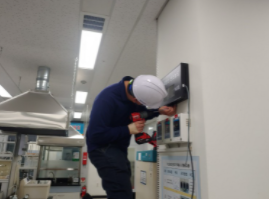
Detector and display boards installed at the agreed mounting points before wiring begins.

Wiring — One Detector Driving Two Display Boards
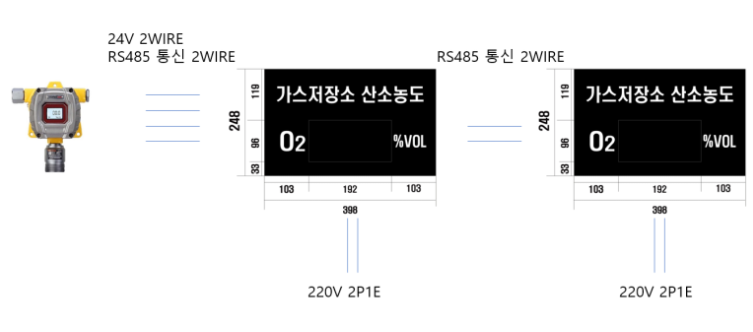
The detector receives 24V power via the display board. However, each display board requires its own 220V supply. Identifying available power sources near each board location before installation is essential for planning.
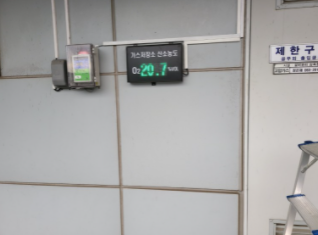
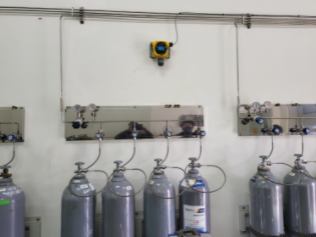
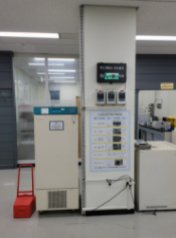
After installation, a full functional test confirmed that all three units — one detector and two display boards — shared power and readings correctly.
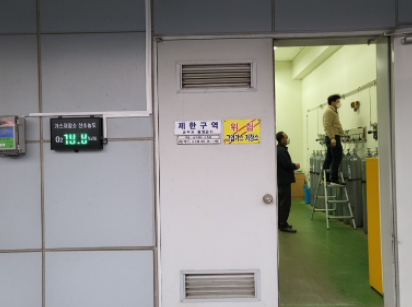
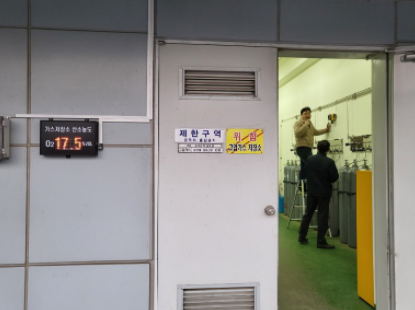
The facility manager was present for product demonstration and training. Injection of calibration gas confirmed that the oxygen reading dropped correctly and both display boards updated in real time.
Installation Summary
- Crew: 3 personnel
- Duration: 10:00–17:00 (extended due to on-site variables)
- Materials: approximately 30 m of communication cable, waterproof conduit, and power cable
- Special features: explosion-proof receptacle power connection; one detector driving two display boards
Frequently Asked Questions
Q1. Why is a gas storage room classified as a confined space?
Gas storage rooms house fire suppression agents, refrigerants, or industrial gas cylinders. Ventilation is typically restricted, and a leak can cause rapid oxygen displacement. As a space not regularly occupied where hazardous gases can accumulate, it is classified as a confined space under Korea's OSHA.
Q2. What should be checked before using an explosion-proof receptacle for power?
Explosion-proof receptacles are rated to specific standards (KS, IECEx, ATEX, etc.) with defined compatible plug types. Confirming the receptacle's protection rating and thread specification before the installation visit allows a compatible plug to be brought on the day — eliminating the need for separate power wiring.
Q3. How does one detector drive two display boards simultaneously?
RS-485 supports multi-drop topology — multiple devices on a single communication bus. With one FIX800 as the source, two display boards connected to the same RS-485 line will both display identical readings in real time. Each board requires its own 220V power supply.
Q4. Why did the installation take longer than planned?
On-site variables — unexpected structural obstacles, explosion-proof receptacle handling, and routing cable to the second floor — can extend timelines. A preliminary site visit reduces surprises, but unforeseen conditions during construction sometimes require additional time to maintain quality and safety standards.
Q5. Why is post-installation site cleanup so important?
Leftover drilling dust, cable trim fragments, and tool marks significantly affect customer satisfaction. In sensitive environments like gas storage rooms and laboratories, leaving no visible trace of the work is a basic standard of professional installation practice.
#GasStorageOxygenDetector #FIX800 #ConfinedSpaceGasDetector #GasDisplayBoard #ExplosionProofReceptacle #FixedOxygenDetector #RS485MultiDisplay #RSKorea #WANDI #Jeonju
![[레이먼드] 오,폐수 처리실 유해가스 모니터링](https://wandi.co.kr/storage/construction-cases/YxFUQVBZ8Unnk7pJzzfsmezr6xNe0LZvQRDmt7TL.jpg)
![[브이피이코리아] 종합병원 지하 밀폐공간 가스 측정기 설치_FIX800 & FIX-DS](https://wandi.co.kr/storage/construction-cases/gNOA28xSlEy5uU3AOxyHDRH5UfAe0TpMTgAt4Uag.jpg)

