Applied Markets
Installed Gases
Project Details
FIX800 Fixed Gas Detector Installation — Public Water Treatment Plant, NH₃/O₃/H₂S/CO, Part 2 (Seogwipo, Jeju)
This is Part 2, continuing from the Jeju installation covered in Part 1. The product configuration — FIX800 with NH₃, O₃, H₂S, and CO sensors — is a standard specification applied across all nationwide branch facilities of this public institution, not just the two Jeju Island sites.
Installation Specification
- Sensors: NH₃, O₃, H₂S, CO
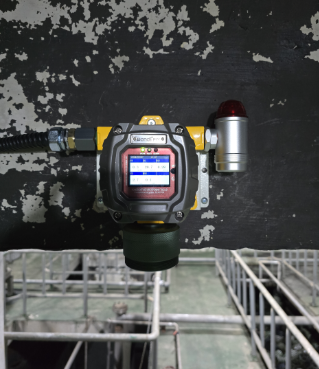
- Options: Weatherproof enclosure / pump + sampling line / LED display board + beacon alarm
- Crew: 4 personnel
Installation Notes
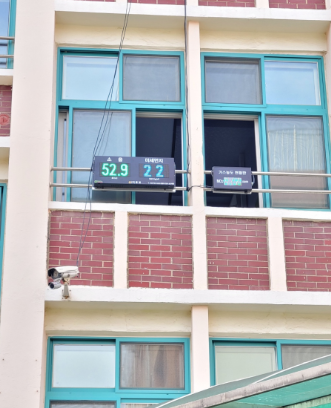
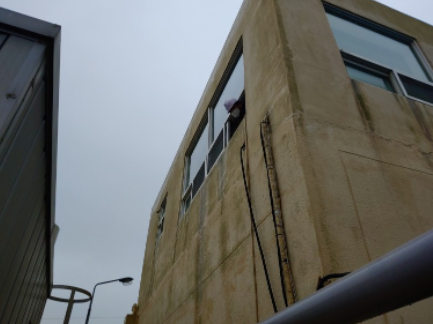
- Detector (process area) and monitoring location (office) are separate buildings — wall penetration and elevated work required
- Pump and sampling line required due to distance between detector mounting and gas generation point
- Exterior wall drilling and work around existing structural elements
On-Site Work
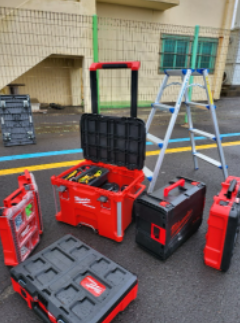
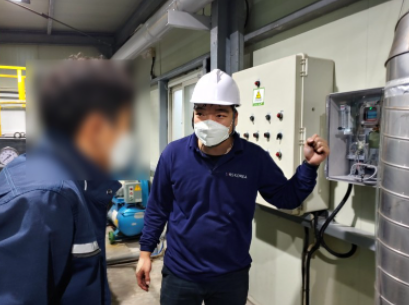
The crew arrived at approximately 2:00 PM, deployed tools and materials quickly, and assessed the installation environment.
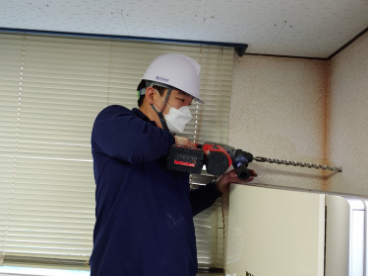
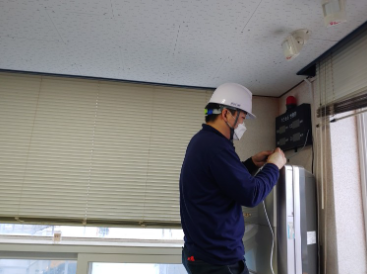
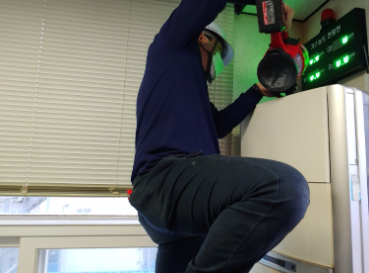
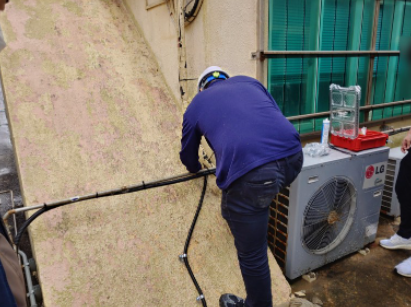
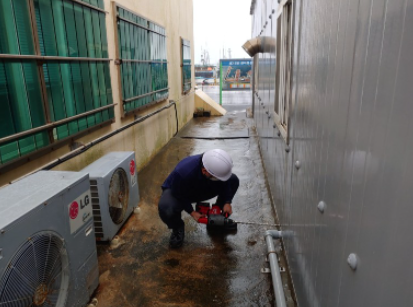
Wall penetrations were drilled, the detector mounted, and the surrounding area cleaned. Cables were routed along existing conduit paths.
Functional Testing and Operator Training
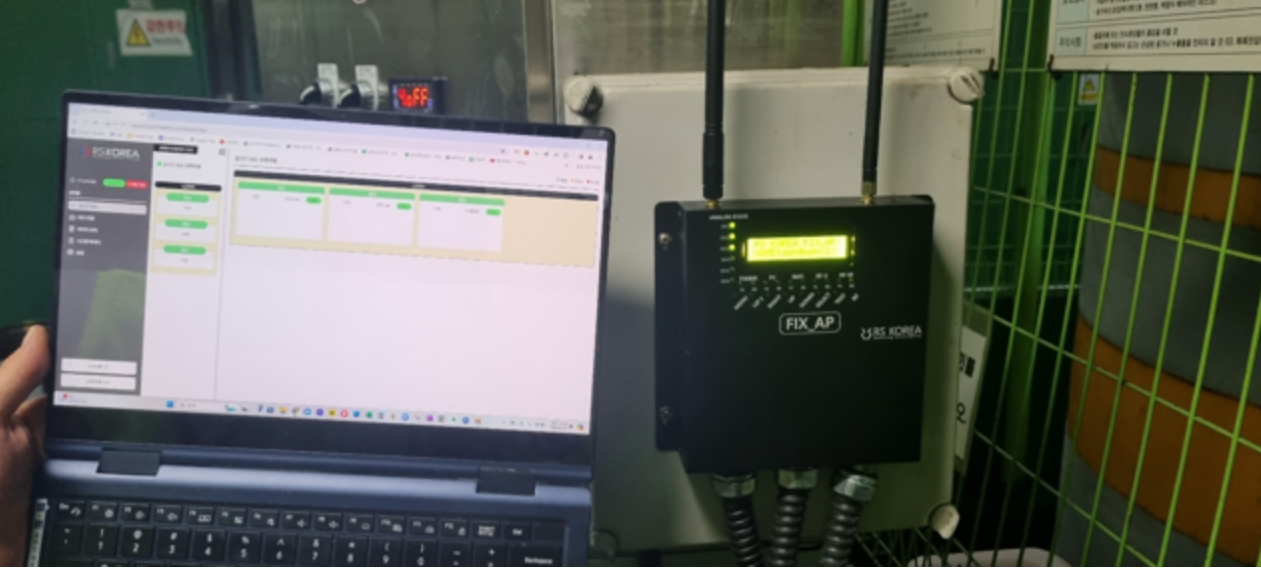
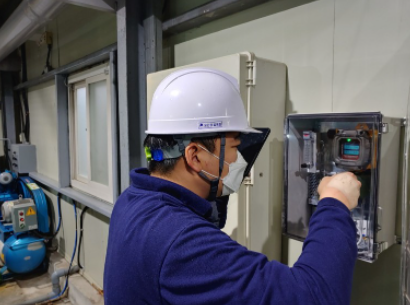
The remote control was used to operate the detector while a team member at the display board confirmed readings by phone. Following the same workflow established in Part 1, installation time was shortened compared to the Jeju site. With the full team's cooperation, two days' planned work was completed in a single day.
Installation Summary
- Crew: 4 personnel
- Duration: approximately 3 hours (14:00–15:00)
- Materials: approximately 100 m of waterproof flexible conduit, communication cable, and power cable
Frequently Asked Questions
Q1. Why was the NH₃/O₃/H₂S/CO combination selected for this facility?
Water treatment sumps continuously generate H₂S and NH₃ from organic decomposition. Ozone injection is used to reduce odor — requiring post-injection O₃ monitoring to confirm residual levels are within safe limits. CO is included as a standard confined-space safety measurement. The combination covers all major hazards specific to this type of facility.
Q2. Why does repeating the same installation process reduce time?
After completing the Jeju site, the team had already established the optimal drilling path, cable routing sequence, and wiring approach. Reduced decision time and optimized task allocation allowed the Seogwipo installation to be completed roughly one hour faster than the first site.
Q3. What are the advantages of standardizing equipment specifications across all nationwide branches?
A single standard configuration simplifies operator training, calibration procedures, and maintenance — personnel at any site can follow the same protocol. Sensor replacement parts can be consolidated into a single SKU, reducing inventory complexity and procurement cost.
Q4. What is the cost-benefit rationale for adding a pump and sampling line?
Without a pump, the detector must be positioned directly at the gas generation point — exposing it to the corrosive, high-humidity environment and shortening its service life. A pump configuration allows the detector to be installed in a protected indoor location while accurately measuring gases at a distant process point, reducing long-term maintenance costs.
Q5. What were the practical differences between the Part 1 (Jeju) and Part 2 (Seogwipo) installations?
Jeju took approximately 4 hours; Seogwipo was completed in approximately 3 hours using the same workflow. Seogwipo involved exterior wall drilling and routing around existing structural elements, but utilizing pre-existing conduit paths allowed this to be handled efficiently within the shortened schedule.
#WaterTreatmentGasDetector #FIX800 #AmmoniaOzoneMonitor #H2SDetector #PublicWaterTreatment #GasDisplayBoard #NationwideStandard #RSKorea #WANDI #Seogwipo
![설치] 원주 국토5호선 신림~판부간 터널공사 밀폐공간 안전용 가스측정기 FIX800 4GAS O2 CO CO2 LEL 설치!](https://wandi.co.kr/storage/construction-cases/Ekn7PulFgplHqjZgJUfOsevvzH0Kawa1G0h9NlH8.png)
![설치] 약품 폐수탱크 수위계와 인디게이터 설치 그리고 무선 모니터링까지 MP + SUP1100 + FIX-AP](https://wandi.co.kr/storage/construction-cases/UjHcHl5kWktnCXlnvMIgk6eQhh7pqwuf3u65iKLO.png)