Applied Markets
Installed Gases
Project Details
Hello, this is RS Korea. Today we are sharing an installation we carried out aboard a very large vessel. We had not previously installed equipment inside a ship's hull, and there were many factors to check along the way, so we wanted to document the process here.
Site survey stage
The environment was extremely dusty, so a mask was needed just to conduct the site survey. Given the height involved, the detector needed to be installed at the bottom level of the coal storage room, with a display board at the entrance for an at-a-glance view. Because the vessel moves with the waves, the installation needed to withstand that motion, and since the display board would be mounted outdoors, it also needed to be waterproof. Given the urgency of the request, we traveled to Yeosu right away for the site survey.
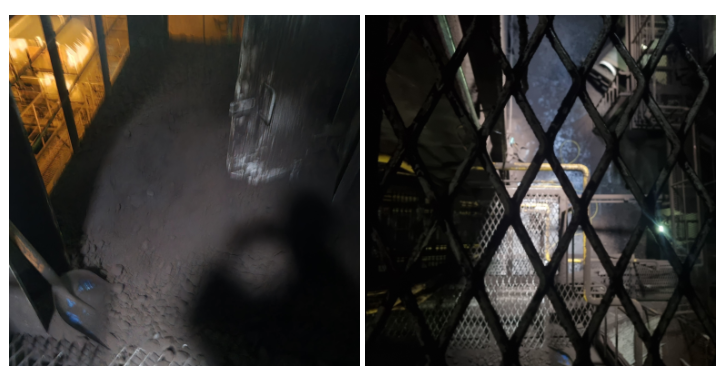
We were told a mask was essential due to the dust, and we brought one, but the coal dust was blowing around so heavily that a standard mask was not sufficient — the crew provided us with a proper dust mask, allowing the survey to proceed safely. We had also considered adding pre-treatment (dust removal) equipment to the FIX800 given the dusty conditions, but as the photos show, the coal dust was both heavily settled and heavily airborne. We judged that a dust-removal filter and pump on the pre-treatment equipment would risk having the intake clogged by coal dust, so we proposed an open diffusion-type configuration instead.
Additional configuration: a 4-channel display board.
Coal storage room: FIX800 fixed-type gas detector installed inside.
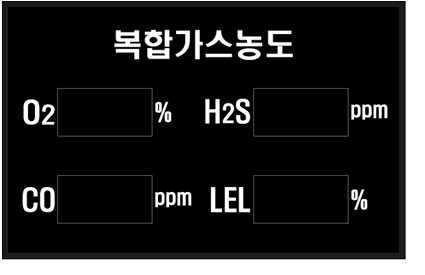
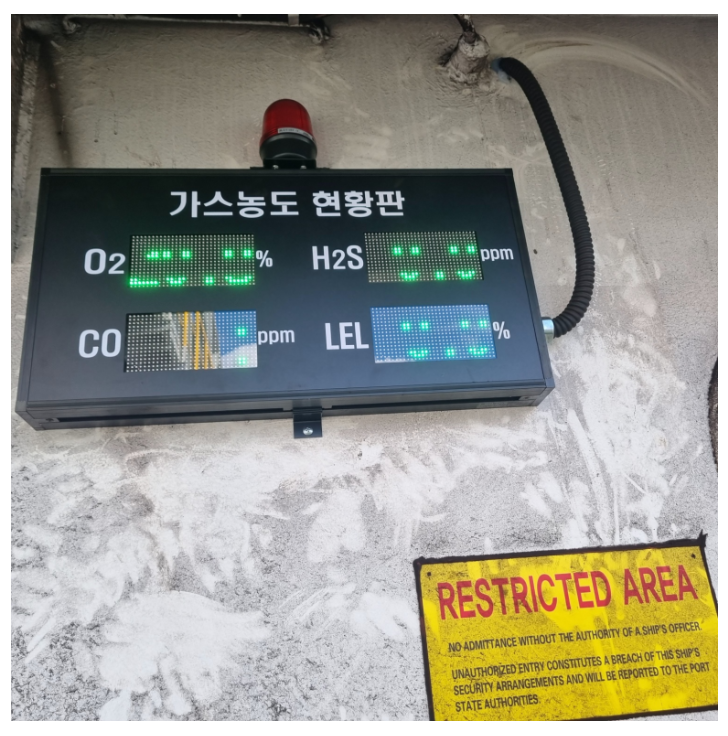
Coal storage room entrance: display board installed so that workers can check the internal gas concentration before descending into the room.
Why a detector was needed in the coal storage room
The coal storage room is itself a confined space. Workers already needed to wear dust masks because of the coal dust, and the internal temperature reached 30–32°C even with ventilation — a hot, humid environment where entering without properly checking gas levels first could quickly become dangerous. The intended use was for the space to be sufficiently ventilated and the gas concentration checked before any worker entry. During the survey, sweat had soaked through the dust mask to the point that breathing was already difficult — a clear reminder of how serious the risk would be if oxygen levels were also insufficient in that situation.
Installation
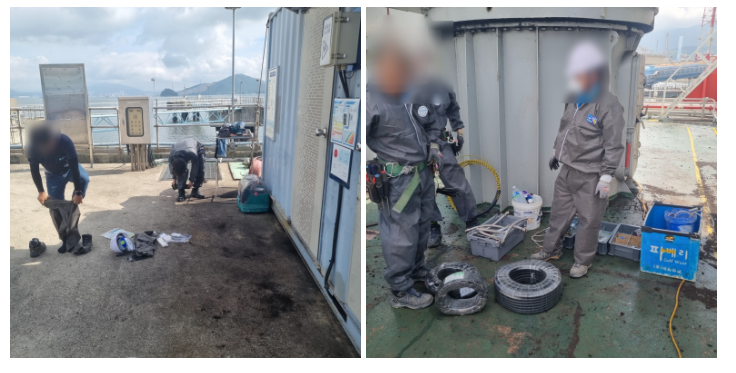
All the necessary checks had been completed beforehand. Thanks to the chief engineer's on-site guidance throughout, the installation proceeded smoothly. The large vessel visible in the distance was the site for the day's work.

Since everyone had been affected by coal dust during the earlier site survey, the team came prepared with protective suits for this installation. Wearing a protective suit together with a dust mask, in a role that already involves a lot of physical effort, turned out to be a demanding combination — a good lesson for future visits.
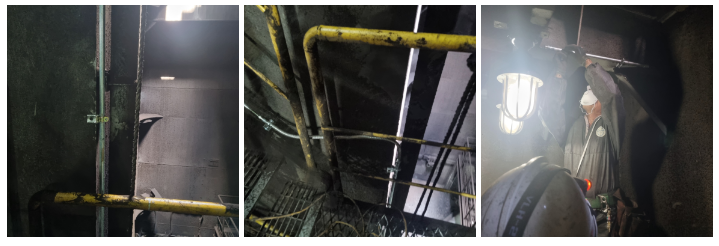
To position the FIX800 detector, steel conduit was first secured with clips to route the power and communication lines.
Here the team is pulling the cable together to connect 220V power to the display board as part of its installation.
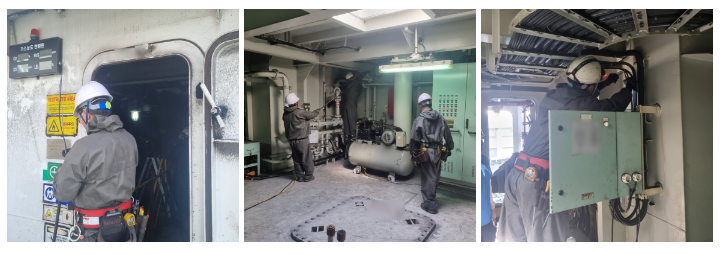
Once the 24V power supply and RS-485 communication line from the display board were connected to the detector, the wiring work was complete. Because the detector requires a 60-second warm-up period once powered on, the display initially showed all readings at zero (O2: 0 / CO: 0 / H2S: 0 / LEL: 0). After the warm-up period, normal readings were confirmed on the display.
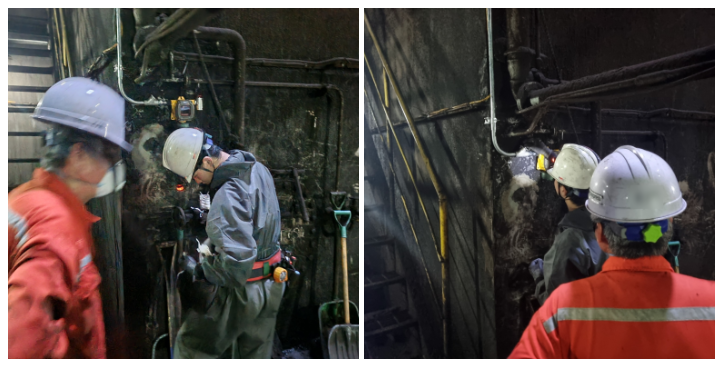
After confirming with the chief engineer that it was safe to release calibration gas inside the coal storage room, our technician descended alone with the standard gas cylinder to test the system.
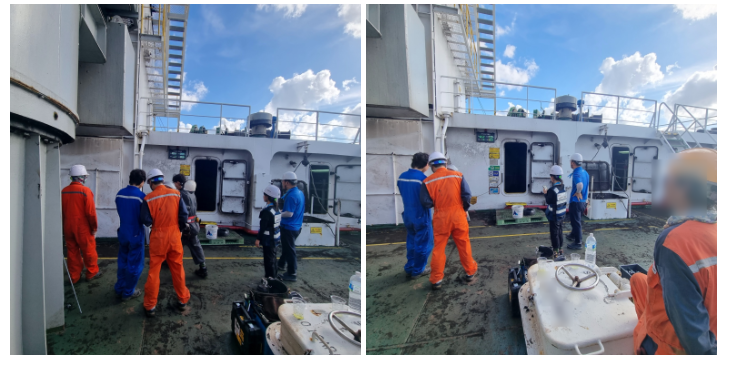
While explaining the display board to curious crew members, the warning light switch was accidentally pressed during the first test, so the alarm was tested a second time to confirm that all four gas channels responded correctly and that the warning light activated properly.
From roughly 20 meters below deck, our technician could hear the crew's cheers from above once the successful test was confirmed, marking the completion of the installation.
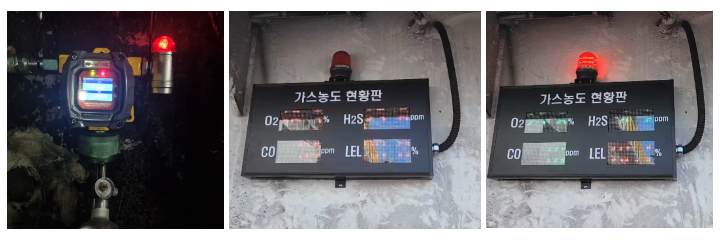
Points to check for shipboard installations
When installing equipment inside a vessel, it is essential to confirm in advance whether drilling is permitted, and to look for routes using existing cable trays or wiring paths wherever possible to minimize new drilling. Because a ship is inherently subject to wave motion, mounting locations must be chosen carefully to prevent equipment from coming loose or being poorly secured — a location the customer prefers may not always be structurally suitable for secure mounting. Close cooperation with the ship's chief engineer, who best understands the vessel's internal layout, is essential, since any drilling or caulking work aboard a ship requires prior confirmation of what lies behind the wall being drilled into.

This marked our first gas detector installation inside a vessel's hull, completed successfully. Thank you for reading.
Frequently Asked Questions (FAQ)
Q1. Why was an open diffusion-type configuration chosen instead of a pump-based pre-treatment system?
Given how heavily the coal dust had settled and how much was airborne, a dust-removal filter and pump risked having the intake clogged by coal dust. An open diffusion-type configuration was proposed instead to avoid this risk.
Q2. What gases does the detector monitor in the coal storage room?
The FIX800 fixed-type detector was configured for four gases: oxygen (O2), carbon monoxide (CO), hydrogen sulfide (H2S), and combustible gas (LEL), with a 4-channel display board installed at the entrance.
Q3. Why is gas monitoring important in this coal storage room?
The coal storage room is a confined space with elevated temperatures (30–32°C) even when ventilated, along with heavy coal dust. Entering without first confirming safe gas levels could quickly put a worker at serious risk, so ventilation and gas checks are required before anyone enters.
Q4. What special considerations apply to installations aboard a vessel?
Drilling permissions must be confirmed in advance, existing cable trays or wiring routes should be used wherever possible, and mounting locations must account for the vessel's constant motion at sea. Close coordination with the ship's chief engineer is essential throughout.
Q5. How was the display board and detector wiring tested after installation?
After a 60-second warm-up period, the detector's readings were confirmed on the display board, and the alarm and warning light were tested twice on-site — using a standard calibration gas cylinder — to confirm that all four gas channels and the alarm system were functioning correctly.
#WANDI#FIX800#GasDetector#ConfinedSpaceSafety#MarineInstallation#CoalStorage#CombustibleGasDetector#H2SDetector#IndustrialSafety#RSKorea
![[레이먼드] 오,폐수 처리실 유해가스 모니터링](https://wandi.co.kr/storage/construction-cases/YxFUQVBZ8Unnk7pJzzfsmezr6xNe0LZvQRDmt7TL.jpg)
![[브이피이코리아] 종합병원 지하 밀폐공간 가스 측정기 설치_FIX800 & FIX-DS](https://wandi.co.kr/storage/construction-cases/gNOA28xSlEy5uU3AOxyHDRH5UfAe0TpMTgAt4Uag.jpg)

