Applied Markets
Installed Gases
Project Details
Hello, this is RS Korea's Technical Sales Team.
If you search "Nowon-gu" on our blog, you will find several similar posts, since our products have been installed throughout this tunnel construction section.
The following key points are common to the installations at this site: preparation for dust generated during blasting and construction work; protection of the equipment from rainwater; a magnetic enclosure for easy relocation; and 5–6 spare wires at each site to allow for future relocation. All sites were built using the same system.
Today we visited the site to carry out a relocation request in line with the progress of the excavation work. The relocation sites were as follows:
● Station 113: 266 Hagye-dong, Nowon-gu, Seoul (in front of Kia Motors)
● Ventilation Shaft 112E: 266 Hagye-dong, Nowon-gu, Seoul (in front of the Korea Transportation Safety Authority Nowon Inspection Center)
● Ventilation Shaft 111E: 271-7 Hagye-dong, Nowon-gu, Seoul (in front of Hagye 5-danji Apartments)
● Ventilation Shaft 109E: 311-20 Jangwi-dong, Seongbuk-gu, Seoul (in front of Jangwol SH-ville Complex 1)
Cable routing and equipment relocation were straightforward at each site, so we will simply share the work photos along with a few notes. The work sequence was the same at every location: power down the detector and the wired display board, relocate the detector, re-route the power and communication wiring, then confirm normal operation.
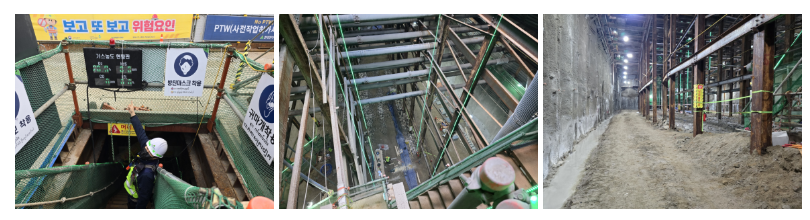
Station 113
The detector was still measuring gas normally before work began. Although the plan was to secure the unit to the steel structure with magnets, it had to be mounted onto a cured concrete wall instead due to the movement of work vehicles and personnel — a reminder that every site has its own variables. Additional tools were needed on site.
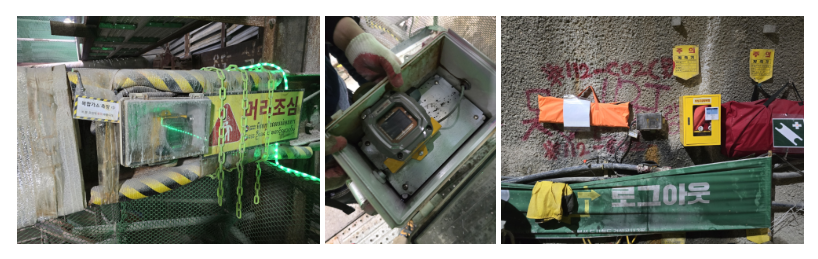
Ventilation Shaft 112E
After powering down and removing the unit, some water and debris were found to have accumulated inside the enclosure. This appears to have resulted from water running down inside the H-beam, worsened by the added protective tape and the unit's position on the inner face of the beam rather than the outer face. After cleaning the interior and restoring power, the unit operated normally. When installing equipment on site, it is best to choose a location where water cannot pool, in addition to keeping it out of direct rain. The unit was reinstalled at the entrance of the horizontal tunnel section and confirmed to be working normally, as with Station 113.
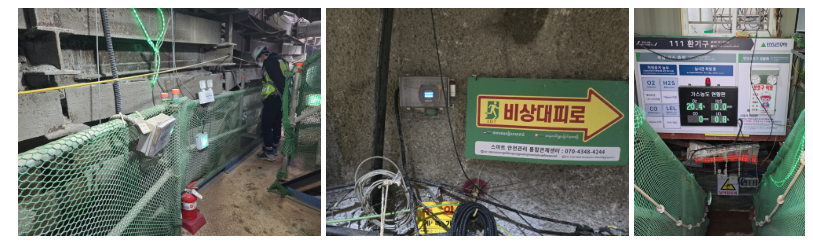
Ventilation Shaft 111E
Beyond the challenging working conditions, none of the ventilation shafts were deep enough to accommodate a hoist, so climbing up and down the temporary stairs was demanding work. The detector at this site also appeared to have been relocated once during the concrete curing process; it was removed, reinstalled, and confirmed to be measuring normally.
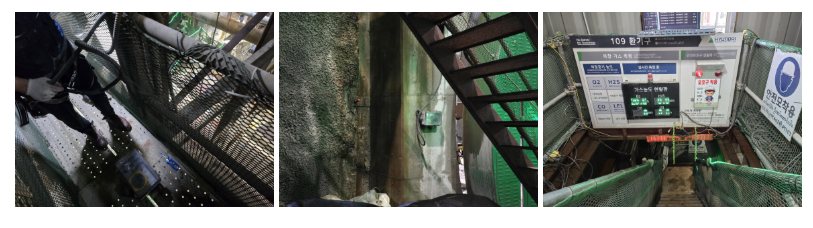
Ventilation Shaft 109E
This was the final site, and the cleanest of the four in terms of working space, although the stairs were still no easier to climb. Since this location had a proper column rather than a roughly cured concrete wall, securing the unit was much easier. The magnetic brackets originally installed for portability were removed at all four sites, and the units were reinstalled on the walls using concrete anchors, which required carrying additional tools.
RS Korea supports our customers not only with product selection and application guidance, but throughout installation, commissioning, after-sales service, and relocation — staying involved until the work at each site is complete. Wherever gas measurement is needed, we are ready to respond.
Frequently Asked Questions (FAQ)
Q1. Why did the gas detectors need to be relocated?
As the tunnel excavation work progressed, the previously installed FIX800 gas detectors had to be relocated to keep pace with the ongoing construction at each station and ventilation shaft.
Q2. What gases does the FIX800 detector measure at this site?
The detectors measure four gases relevant to confined-space tunnel safety: oxygen (O2), carbon monoxide (CO), hydrogen sulfide (H2S), and combustible gas (EX).
Q3. What issue was found at Ventilation Shaft 112E, and how was it resolved?
Water and debris had accumulated inside the detector enclosure due to water running down inside the H-beam. The unit was cleaned and powered back on, restoring normal operation. For future installations, choosing a location where water cannot pool is recommended.
Q4. How was the equipment mounted at each site?
Magnetic enclosures were originally used for portability, but at several sites the units were remounted onto cured concrete walls or columns using concrete anchors due to on-site conditions such as vehicle and personnel movement.
Q5. Does RS Korea provide ongoing support after installation?
Yes. RS Korea supports customers from product selection and installation through commissioning, after-sales service, and relocation, remaining involved until the work at the site is complete.
#WANDI#FIX800#GasDetector#TunnelConstruction#ConfinedSpaceSafety#GasDetectorRelocation#OxygenMonitoring#CombustibleGasDetector#ConstructionSafety#RSKorea
![[레이먼드] 오,폐수 처리실 유해가스 모니터링](https://wandi.co.kr/storage/construction-cases/YxFUQVBZ8Unnk7pJzzfsmezr6xNe0LZvQRDmt7TL.jpg)
![[브이피이코리아] 종합병원 지하 밀폐공간 가스 측정기 설치_FIX800 & FIX-DS](https://wandi.co.kr/storage/construction-cases/gNOA28xSlEy5uU3AOxyHDRH5UfAe0TpMTgAt4Uag.jpg)

