Applied Markets
Installed Gases
Project Details
Hello, this is RS Korea's technical department. Today's post covers the on-site sensor replacement and calibration of a FIX800 O2 detector installed in an AR gas storage room used for welding at a semiconductor parts production plant in Anseong-si.

For repair or inspection requests, portable detectors — or units managed in small quantities — can typically be sent in by courier along with a brief note describing the symptoms. However, fixed-type detectors, larger quantities, or units registered as corporate assets are difficult to ship, so these are handled through an on-site visit. Calibration follows the same process. The on-site inspection, calibration, and repair procedure is: inquiry, quotation, scheduling a visit date, and the site visit itself. Travel costs vary by region depending on the details of each case.
Repair item
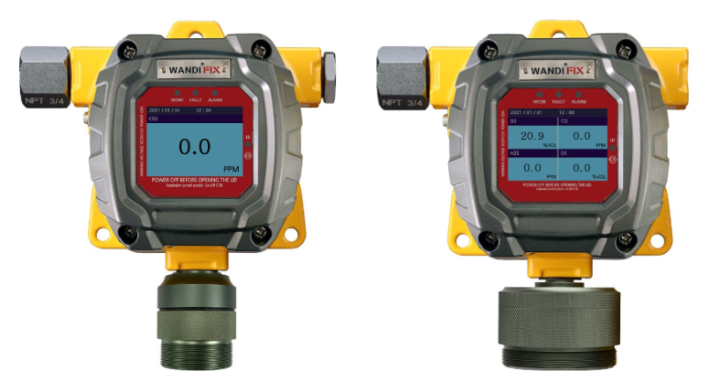
This is the WANDI FIX800 fixed-type gas detector (left: single-gas version / right: multi-gas version). WANDI is a brand specializing in gas detection instruments, and the FIX800 provides four sensor slots, allowing two or more gases to be measured simultaneously. Among roughly 40 gas types available for the FIX800, configurations range from a single sensor up to five simultaneous safety-related gases in line with Korea's Occupational Safety and Health Act, with all gas concentrations displayed in real time.
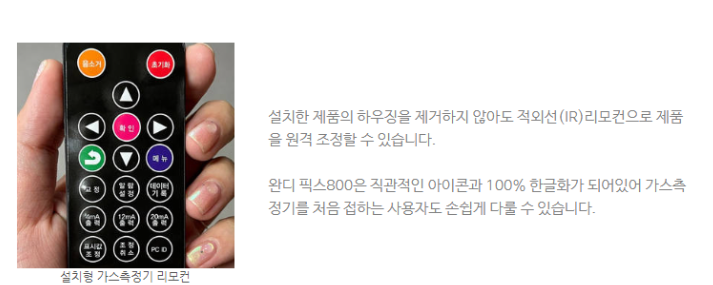
Readings can be checked and managed remotely by connecting the unit to an electronic display board or a PLC via RS-485 communication. In addition, the newer FIX-AP IoT communication module enables real-time monitoring from a PC or mobile device.
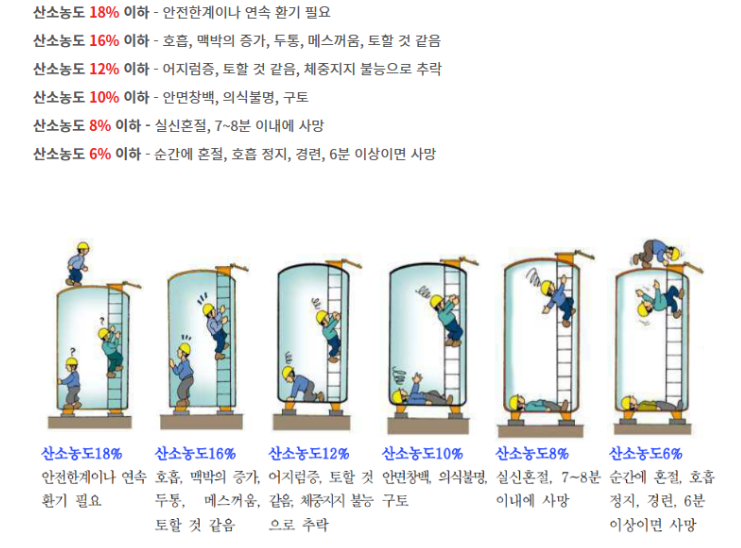
Regarding the installation purpose and environment: inert gases such as CO2 and argon (AR) are widely used in welding. The reason inert gas is used is to prevent oxidation caused by the gases generated during the welding process — gases such as ozone, nitrogen oxides, and carbon monoxide can oxidize the welded metal during welding and reduce its mechanical properties. Using inert gas during welding helps prevent this oxidation. The facility visited in this case uses AR gas during welding, and the detector was installed to prevent worker asphyxiation accidents caused by a drop in oxygen concentration from AR gas leaking out of the storage room.
The unit was originally installed around October 2022. It had continued to operate normally, but the sensor had reached the end of its expected service life and required replacement.
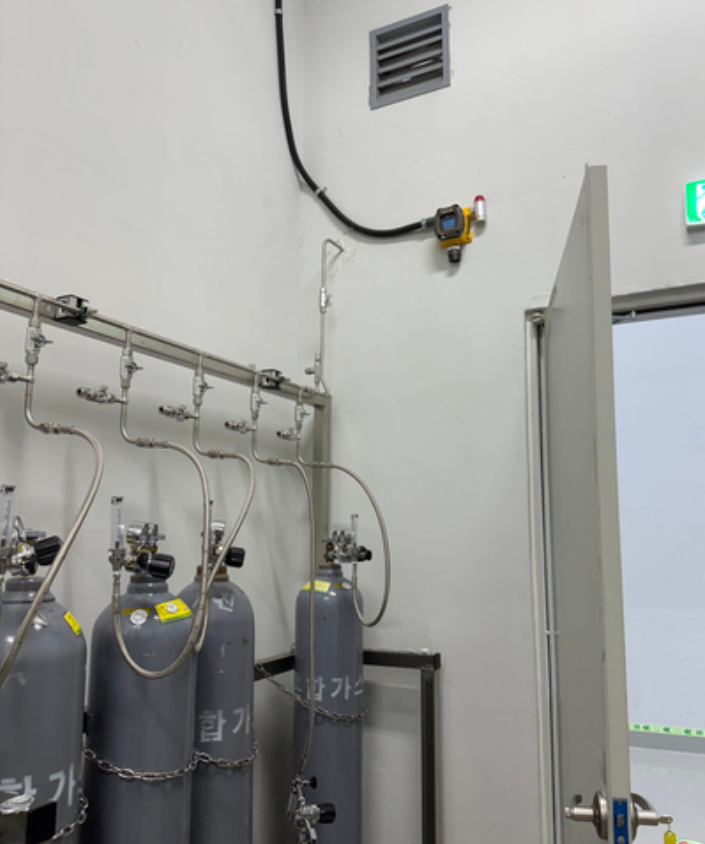
Repair and calibration
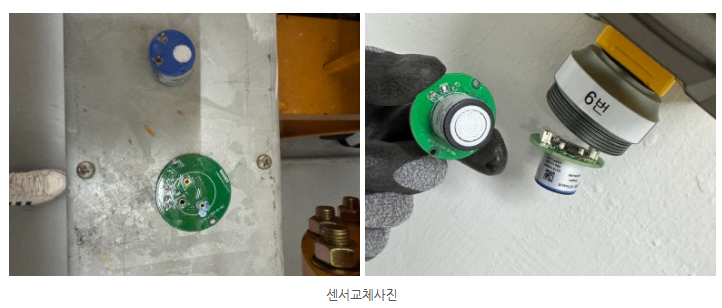
Because this site experiences fairly high humidity during summer, the sensor board itself had also corroded, so the sensor board was replaced along with the sensor.
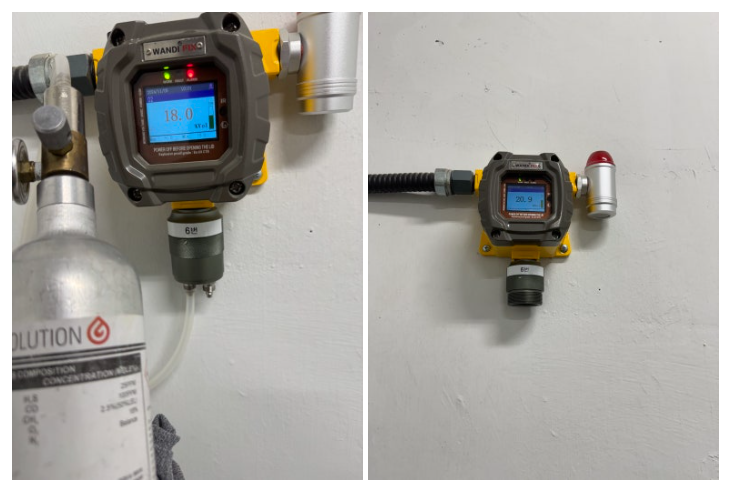
After replacement, it takes about 5–10 minutes for the reading to stabilize. Once stabilized, calibration is performed using 18% O2 calibration gas, repeated 2–3 times. After confirming the calibration reading is correct, the process concludes by verifying that the unit reads approximately 21% O2 in ambient air. Because measurement error increases more than a year after installation and calibration, we recommend calibrating on a yearly basis. With that, this repair was completed.
In a gas measurement environment, when the generated gas is unknown, or when the gas is known but its exact concentration can't be confirmed, it's difficult to make a purchasing decision with confidence. The safest approach is to select a detector with the correct measurement range only after thorough consultation with specialists, taking into account environmental factors, the gas involved, its frequency, and its concentration. Beyond simply selling products, RS Korea specializes in gas measurement services — self-calibration, domestic repair (A/S), custom manufacturing, and installation work. Drawing on experience across demonstrations, site surveys, deliveries, repairs, and installations in a wide range of environments, we provide one-to-one customized solutions for gas measurement needs.
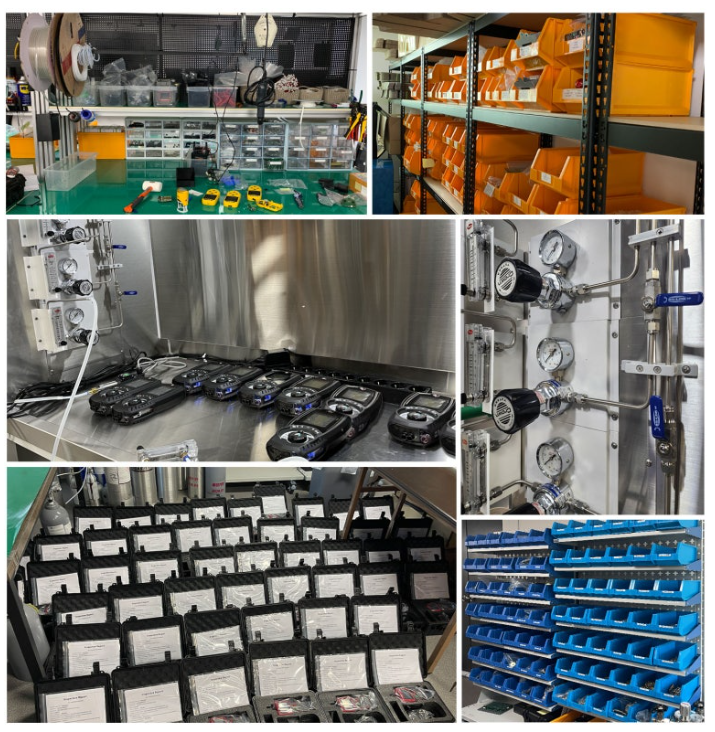
Repair item: FIX800 O2 sensor replacement and calibration. Additional note: the measurement itself showed no issue, but since the unit was installed in May 2022, only about three months of sensor life remained, which is why the sensor was replaced and recalibrated. This concludes the FIX800 O2 sensor replacement and calibration report.

Frequently Asked Questions (FAQ)
Why is on-site service used instead of shipping the detector in for repair?
Portable detectors managed in small numbers can usually be sent in by courier. However, fixed-type detectors, larger quantities, or units registered as corporate assets are difficult to ship, so inspection, calibration, and repair are carried out through an on-site visit instead.
Why is an oxygen (O2) detector installed in an AR gas storage room?
Inert gases such as argon (AR) and CO2 are commonly used in welding to prevent oxidation of the welded metal. If AR gas leaks from the storage room, however, it can displace oxygen in the air, creating an asphyxiation risk for workers — which is why an O2 detector is installed as a safety measure.
How often should a fixed-type O2 detector be calibrated?
Measurement error tends to increase after more than a year has passed since installation or the last calibration, so annual calibration is recommended.
What does the FIX800 calibration process involve?
After sensor replacement, the reading is allowed to stabilize for about 5–10 minutes. Calibration is then performed using 18% O2 calibration gas, repeated 2–3 times, and completed once the unit reads approximately 21% O2 in ambient air.
How many gases can the FIX800 measure at once?
The FIX800 provides four sensor slots and can be configured with a single gas up to five simultaneous safety-related gases (with dual sensors), selected from around 40 supported gas types, in line with Korea's Occupational Safety and Health Act.
#FIX800 #WANDI #OxygenDetector #GasDetectorRepair #SensorCalibration #FixedGasDetector #WeldingSafety #ArgonGas #SemiconductorSafety #IndustrialSafety
![[레이먼드] 오,폐수 처리실 유해가스 모니터링](https://wandi.co.kr/storage/construction-cases/YxFUQVBZ8Unnk7pJzzfsmezr6xNe0LZvQRDmt7TL.jpg)
![[브이피이코리아] 종합병원 지하 밀폐공간 가스 측정기 설치_FIX800 & FIX-DS](https://wandi.co.kr/storage/construction-cases/gNOA28xSlEy5uU3AOxyHDRH5UfAe0TpMTgAt4Uag.jpg)

