Applied Markets
Installed Gases
Project Details
Hello, this is RS Korea. Today's post covers a site we visited in Dongducheon — another wireless data communication installation. We used to post only about FIX800 installations, but since launching FIX-AP (our wireless IoT communication hardware), we've been out in the field building up content to help promote it. Our experience from an earlier project — a water level gauge plus wireless data communication installation in Gwacheon — proved helpful here in Dongducheon: since some facilities rename their 2.4GHz WiFi networks, we called ahead to the communications room to confirm the network name, which let us move quickly through the connection work.
■ Installed items
An ultrasonic water level gauge, an indicator display so workers can check the reading without climbing to the roof, and the FIX-AP wireless communication unit. Even though the chemical tanks sit on an elevated, open-air rooftop, the installation went smoothly with no issues.
■ Reason for installation
These tanks hold chemicals used at a textile dyeing factory — hydrogen peroxide and sodium hydroxide — so the water level needs to be checked continuously. An analog level gauge was already in place, but climbing to the roof every time was inconvenient, and the customer wanted to confirm the analog gauge's readings were accurate, so they requested this installation to compare the two.
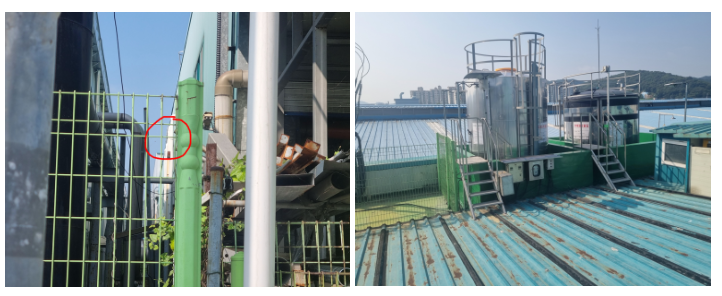
Here are the steps for connecting the two chemical tanks. Given how ultrasonic level gauges work, each one is mounted dead-center over the tank, with the communication and power line running down the wall to an indicator on the ground floor where the workers are stationed — so they can check the water level directly without ever climbing to the roof.
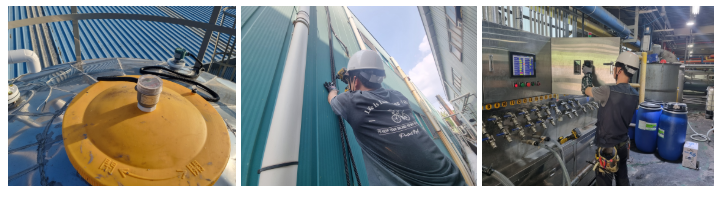
After repeating that process for both tanks, the last step is simply installing the FIX-AP wherever WiFi reception is strongest.
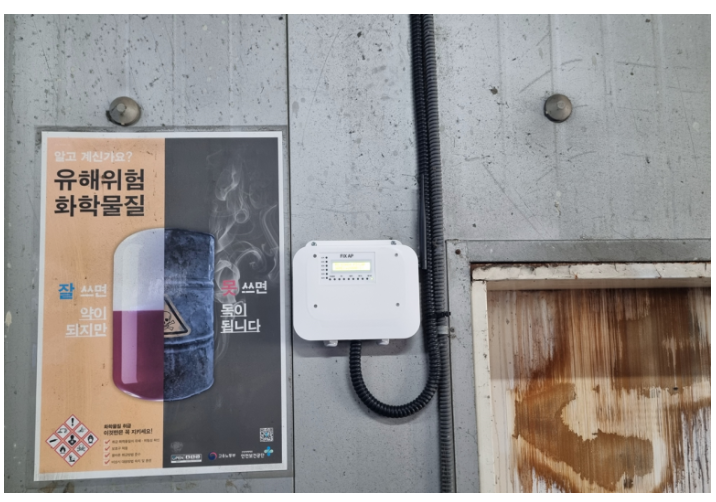
Our FIX-AP posts tend to be fairly short, and that's by design: we run the full connection test before the unit ever leaves our facility, so the only thing left to do on site is connect it to the local WiFi network.
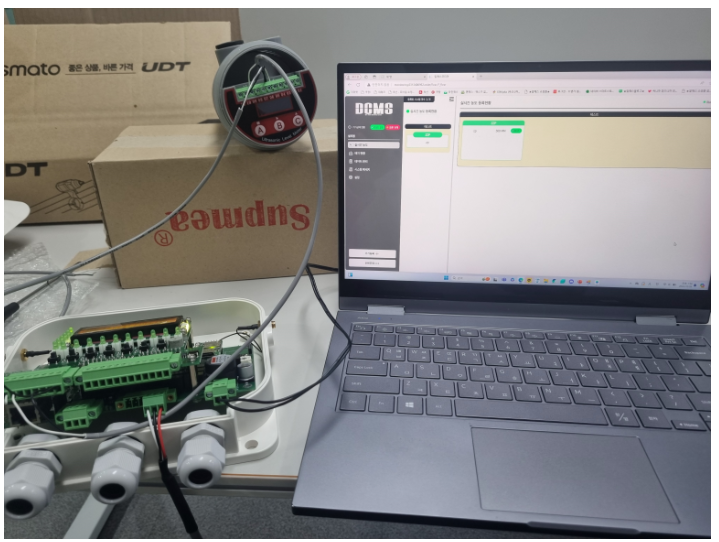
Testing the FIX-AP before installation. Once you look at how the FIX-AP wiring connects to the device it's paired with, it's really not complicated — it just needs a power supply and a connection to the communication line in use. The accompanying software can feel unfamiliar the first time around, but if you give us a call, we'll walk you through both the wiring and the software setup. Recently, a customer who purchased just the FIX-AP and set it up themselves was very happy after we sent wiring photos and talked them through the software configuration step by step over the phone — they were up and running in no time. In our earlier post about the Gwacheon chemical tank project, we emphasized how convenient this setup is for the end user; this time, we wanted to highlight just how easy the FIX-AP itself is to set up. That wraps up this post on the wireless IoT data communication installation in Dongducheon.

Frequently Asked Questions (FAQ)
Q1. Why use an ultrasonic level gauge instead of relying on the existing analog gauge?
A1. It lets workers check the water level from an indicator on the ground floor instead of climbing to the rooftop tank every time, and it also provides an independent reading to confirm that the analog gauge is measuring accurately.
Q2. Where should the FIX-AP unit itself be installed?
A2. Wherever WiFi reception is strongest at the site, since it connects to the local wireless network to transmit data to the cloud.
Q3. Why are FIX-AP installation posts typically shorter than other installation posts?
A3. Because the full connection and communication setup is tested and configured before the unit ships, the only on-site task is connecting it to the facility's WiFi network.
Q4. Is the FIX-AP difficult to wire and configure for someone doing it themselves?
A4. Not especially — it just needs a power connection and a link to the communication line in use. The software can feel unfamiliar at first, but RS Korea provides phone support to walk customers through both the wiring and the software setup.
Q5. Can chemicals like hydrogen peroxide and sodium hydroxide be safely monitored this way?
A5. Yes — the ultrasonic gauge measures the level without direct contact with the chemical, and routing the display to a ground-floor indicator means workers don't need to approach the tank directly just to check the reading.
#FIXAP#WaterLevelGauge#WirelessIoT#ChemicalTankMonitoring#RemoteMonitoring#IndustrialSafety#RSKorea#UltrasonicSensor#DongducheonInstallation#TextileDyeingFactory
![[레이먼드] 오,폐수 처리실 유해가스 모니터링](https://wandi.co.kr/storage/construction-cases/YxFUQVBZ8Unnk7pJzzfsmezr6xNe0LZvQRDmt7TL.jpg)
![[브이피이코리아] 종합병원 지하 밀폐공간 가스 측정기 설치_FIX800 & FIX-DS](https://wandi.co.kr/storage/construction-cases/gNOA28xSlEy5uU3AOxyHDRH5UfAe0TpMTgAt4Uag.jpg)

