Project Details
This post covers high-temperature, high-humidity measurement, continuing a research project previously covered in two earlier posts. As the final installment, it introduces a product line RS Korea does not typically handle. Here is a recap of the story so far for those who have not read the earlier posts.
Part 1
1. A research institute was studying a method of injecting CO2 into curing concrete to increase its hardness.
2. A FIX800 unit was applied to measure the amount of CO2 injected and retained.
3. Condensation generated while creating the temperature and humidity conditions caused equipment failures.
4. The issue was resolved using a sampling device developed by RS Korea, restoring normal measurement.
Part 2
Building on the success of Part 1, a larger chamber was built to run the same experiment. Because the chamber was custom-built to non-standard dimensions, the controller and temperature/humidity sensors used in the original chamber could no longer be used. Through further discussion, RS Korea agreed to supply the instrumentation for the new chamber: a CO2 detector, a data logger and controller, and temperature/humidity measurement equipment were configured as a set and delivered and installed.
Part 3
This final installment covers the remaining details that could not fit into the previous post. As explained in Part 2, the core of this project is concrete curing strength as a function of CO2 injection volume, temperature, and humidity. Accordingly, RS Korea's configuration consists of a CO2 sensor, a temperature sensor, a humidity sensor, and a data logger/controller to manage all of this data.
Temperature and humidity sensors themselves are widely available online without needing a specialist. However, high-temperature, high-humidity environments are a different story — and here is why.
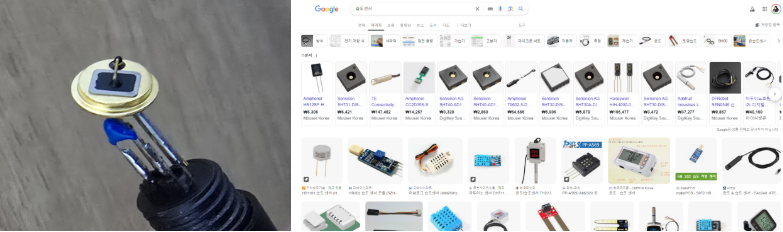
Most humidity sensors used across industrial instrumentation are based on the capacitive sensing principle, with the sensing element exposed on the outside and typically fitted with a guard to prevent physical damage. A quick search for "humidity sensor" shows that most sensor designs look broadly similar.
Exposed sensors offer decent response speed and measurement accuracy, but because the electronic circuitry is exposed, they are vulnerable to moisture (note that humidity and moisture/condensation are not the same thing).
Manufacturers often specify a measurement range of 0–99% RH, but in practice, once relative humidity exceeds roughly 80% RH, the air is humid enough that water droplets could almost form by simply reaching a hand into it (this year's summer felt close to that level). In such high-humidity conditions, water droplets landing on the circuit board can cause measurement errors or electrical short-circuit failures.
This is exactly why a humidity sensor built for high-humidity environments is needed, as noted in the title. Let us introduce it: the TESTO 6681 environmental transmitter from Testo.
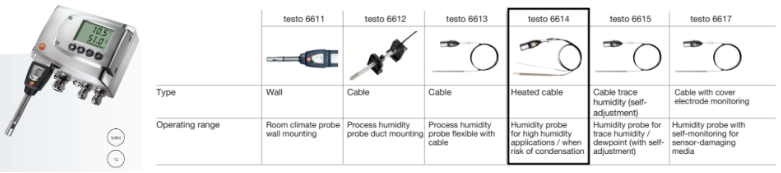
The TESTO 6681 is an environmental transmitter capable of measuring a variety of parameters depending on the probe installed. While several brands offer environmental transmitters, few models support a probe rated for high-humidity temperature/humidity sensing. The probe selected here is the 6614 probe.
Listing detailed specifications is not really our style, so let's walk through it using photos from the field instead.
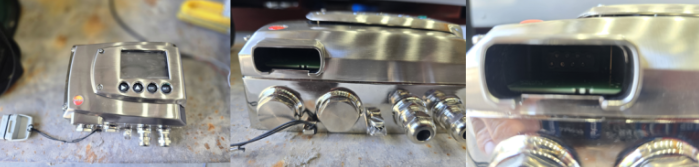
This is the TESTO 6681, an elegantly designed unit. It is made of stainless steel and is fairly heavy. The bottom of the unit has a cable gland for wiring and a dedicated connector for the sensor probe. It may not be very visible in the photo, but the connector pins are recessed inside.
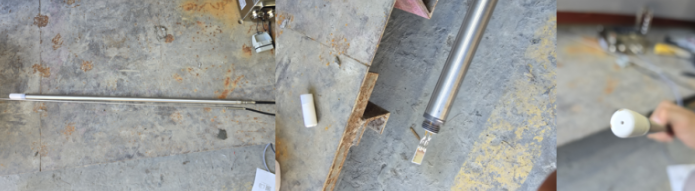
This is the key sensor for this project. The thicker element at the top is the humidity sensor, and the thinner one below is the temperature sensor. It resembles the sensor design shown earlier, but with a dedicated protective cap. The humidity sensor is thicker because it contains an internal heating element: when the environment becomes humid enough for moisture to condense on the sensor, this internal heater activates to prevent condensation.
Some brands offer a single sensor that measures both temperature and humidity, but this has a serious drawback: the heating element that activates to prevent condensation can temporarily interfere with the temperature reading. In an application that requires tracking rapidly changing trends, any such data gap makes it difficult to manage meaningful data.
That may have sounded like a lot, but that covers everything worth mentioning. Now let's walk through the installation process and the remaining details.
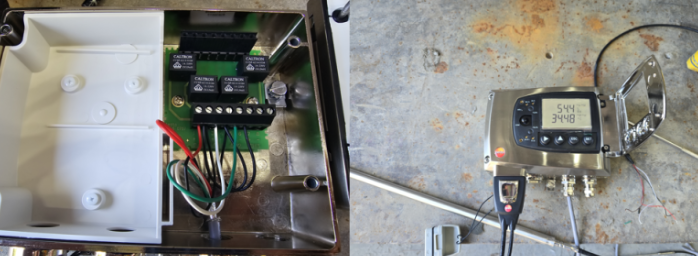
Opening the case according to the manual reveals a very intuitively laid-out set of components. The unit is powered externally and outputs a current signal. The empty space on the left side of the unit appears to be reserved for an additional module if other parameters, such as pressure, are required.
After connecting power and the dedicated probe, the unit recognized it immediately — it was simple enough that there is not much else to explain.
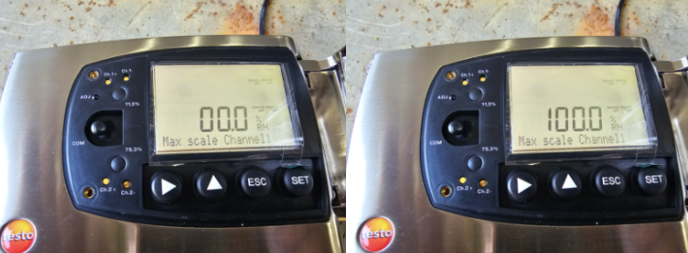
Since the sensor is recognized as soon as it is plugged in, there is little else to say about that step. The next step is to check and configure the 4–20 mA output range to match the environment the user needs. True to form, the team pressed the buttons first without reading the manual, but ran into no difficulty at all — simply select the parameter for each channel (temperature, humidity, pressure, etc.), choose the matching unit, and set the 4–20 mA output range.
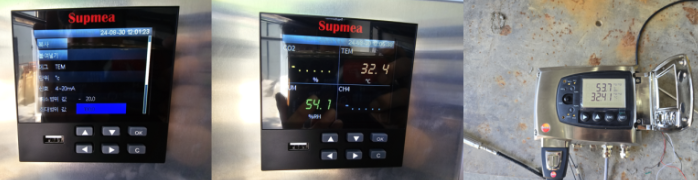
The receiving equipment's range is then set to match the configured output range — an industry term for this is "mapping." The data logger and transmitter readings were found to match almost exactly, though some minor deviation should be expected given the nature of analog signals. Next, the unit is mounted into the chamber.
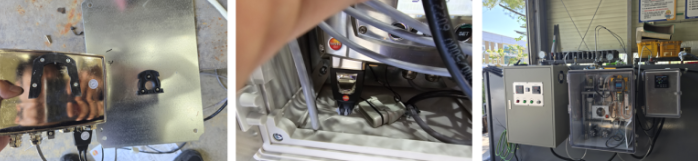
The back of the unit comes with a basic mounting bracket. It is removed, pre-fixed to the metal panel of the control box, and then the unit is fitted back in. The sensor fit perfectly into the pre-machined opening in the high box — an impressively precise fit. With the temperature/humidity transmitter now housed inside the control box, the exterior appearance matches the earlier setup.
Commissioning begins.

Before injecting CO2, the team raised the temperature to around 65°C by adjusting the hot air line. Contrary to the researchers' expectations, the humidity — which had been around 55% RH in ambient air — began to drop instead of rise. Even though the chamber had been filled with water to ensure sufficient humidity, the humidity was not increasing, which puzzled the research team.
The team explained that, since the operating temperature was around 65°C, even accounting for latent heat, moisture from the water had not yet begun to evaporate into the air at that stage — if anything, the interior was behaving like it was being dried out, similar to a hair dryer.
Based on the results of extended testing, RS Korea recommended keeping the temperature range as it was and instead adding a separate device to boil water in order to generate the humidity needed, rather than adjusting the temperature settings.
Closing
This wraps up a long series of three posts covering the meetings, installation, and results related to CO2 curing of concrete. In summary:
- A moisture/humidity-related failure that occurred in the field was resolved by developing a dedicated sampling system.
- The problem-solving ability and quick response built the trust needed to be invited to participate in the next phase of the project.
- The user's requirements were accurately understood and translated into the configuration they needed.
- RS Korea's capabilities now extend beyond stable gas measurement in high-temperature, high-humidity environments to also measuring and controlling temperature and humidity (and pressure, if required).
RS Korea welcomes inquiries from anyone in safety, production, research, or development who is facing a measurement challenge, and is ready to travel anywhere nationwide to provide the right solution.

![[레이먼드] 오,폐수 처리실 유해가스 모니터링](https://wandi.co.kr/storage/construction-cases/YxFUQVBZ8Unnk7pJzzfsmezr6xNe0LZvQRDmt7TL.jpg)
![[브이피이코리아] 종합병원 지하 밀폐공간 가스 측정기 설치_FIX800 & FIX-DS](https://wandi.co.kr/storage/construction-cases/gNOA28xSlEy5uU3AOxyHDRH5UfAe0TpMTgAt4Uag.jpg)

