Applied Markets
Installed Gases
Project Details
We provide comprehensive odor gas measurement equipment and on-site odor-reduction monitoring system solutions for a variety of environments where odor gases occur.
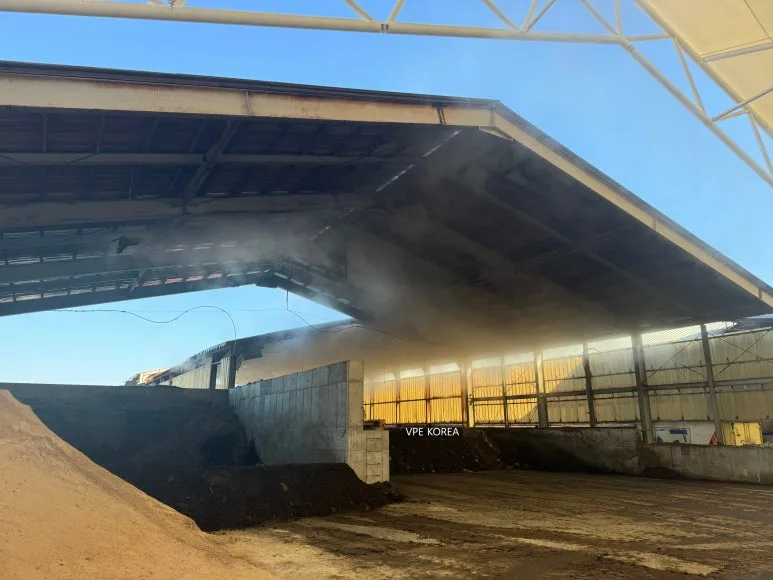
The site visited this time was a fertilizer plant that produces fertilizer by mixing poultry manure with eggshells. Even after visiting many livestock barns before, this was the first time an extremely unpleasant odor could be detected all the way from the entrance.
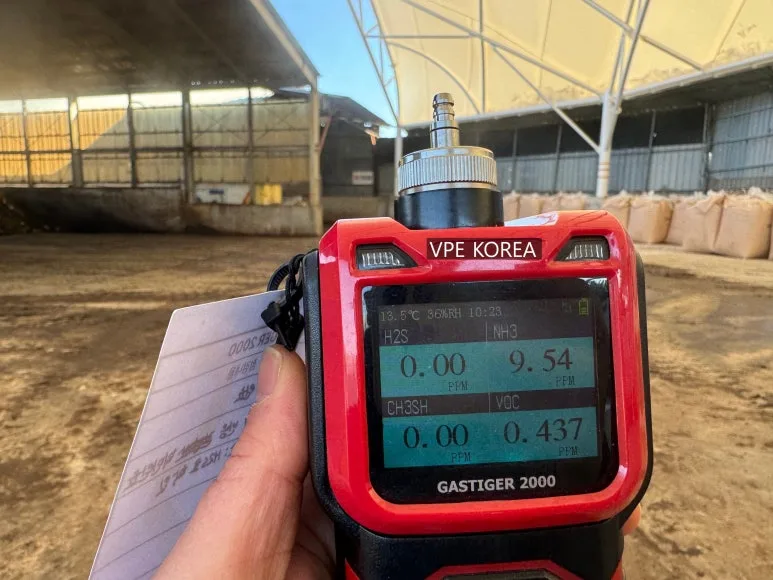
Before installing a fixed odor gas monitoring system, the site conditions were first checked using a portable instrument.
Instrument: GasTiger 2000. Measured items: ammonia (NH3), hydrogen sulfide (H2S), methyl mercaptan (CH3SH), and volatile organic compounds (VOC).
All four of these gases are designated by Korea's Ministry of Environment as major causes of malodor.
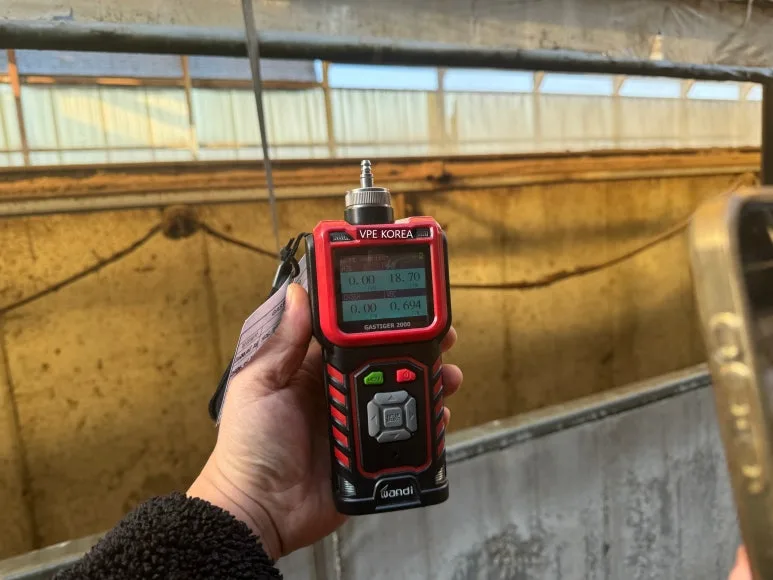
Even when measured near the mixer, a very high level of ammonia gas was detected. Even though atmospheric dispersion had lowered the concentration, there was still enough ammonia gas in the area to make breathing difficult.
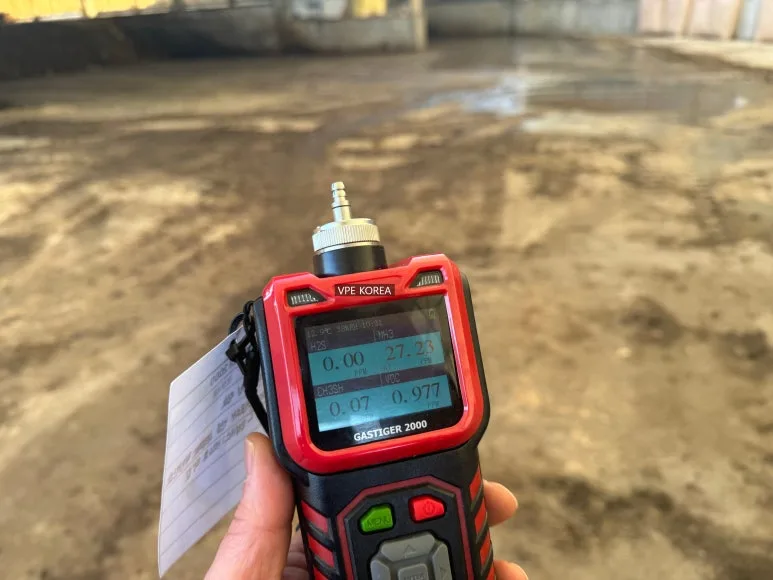
This shows the second measurement point, taken next to the fermentation process, where an even higher ammonia gas reading was measured than near the mixer.
Ammonia: 27 ppm or higher. Methyl mercaptan: 0.07 ppm or higher. Volatile organic compounds: 0.97 ppm or higher.
Monitoring this environment with a fixed installation is not a simple task given these conditions. A corrosion-resistant fixed gas detector will be installed along with remote web-based monitoring.
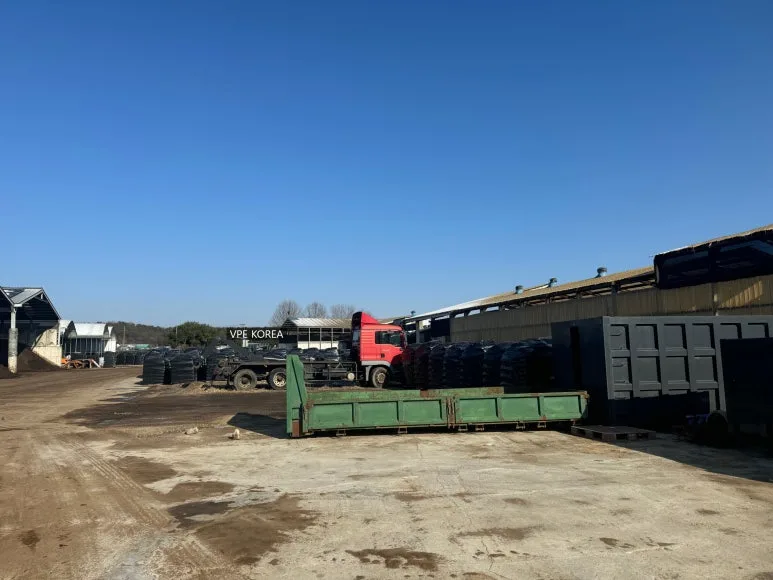
Although installation conditions are challenging, a monitoring system will be installed together with the odor-reduction equipment to check in real time how much the odor gas levels are reduced.
If you have any questions about odor gas measurement for fertilizer processes, please feel free to contact us.
Frequently Asked Questions (FAQ)
What instrument was used to measure the odor gases on site?
A GasTiger 2000 portable instrument was used to measure four gases: ammonia (NH3), hydrogen sulfide (H2S), methyl mercaptan (CH3SH), and volatile organic compounds (VOC).
What were the measured ammonia levels?
Near the fermentation process, readings of 27 ppm or higher for ammonia, 0.07 ppm or higher for methyl mercaptan, and 0.97 ppm or higher for VOCs were recorded.
Why are these four gases significant?
Ammonia, hydrogen sulfide, methyl mercaptan, and VOCs are all designated by Korea's Ministry of Environment as major causes of malodor.
What equipment is planned for future installation?
A corrosion-resistant fixed gas detector along with a remote web-based monitoring system will be installed, allowing real-time tracking of how effectively the odor-reduction equipment lowers gas levels.
What kind of facility is this case about?
It is a fertilizer plant that produces fertilizer by mixing poultry manure with eggshells, where strong odors occur near the mixer and fermentation process.
#WANDI#GasTiger2000#OdorMeasurement#AmmoniaDetection#FertilizerFacility#OdorReduction#VOCMonitoring#HydrogenSulfide#MethylMercaptan#EnvironmentalMonitoring
![[레이먼드] 오,폐수 처리실 유해가스 모니터링](https://wandi.co.kr/storage/construction-cases/YxFUQVBZ8Unnk7pJzzfsmezr6xNe0LZvQRDmt7TL.jpg)
![[브이피이코리아] 종합병원 지하 밀폐공간 가스 측정기 설치_FIX800 & FIX-DS](https://wandi.co.kr/storage/construction-cases/gNOA28xSlEy5uU3AOxyHDRH5UfAe0TpMTgAt4Uag.jpg)

