Applied Markets
Installed Gases
Project Details
Power Plant Wastewater Relay Pump Room — Gas Detector Application Case (Bundang)
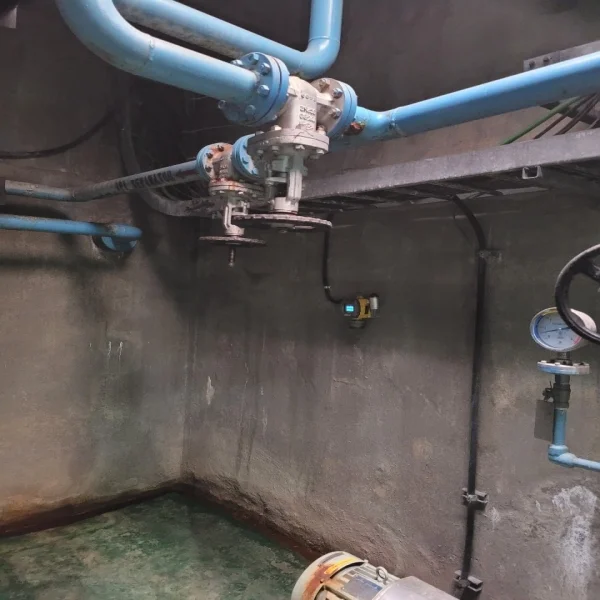
This case documents a gas detector application at a wastewater relay pump room within a power plant near Seoul, in the Bundang area. The pump room process involves drawing in wastewater and sewage, treating it, and discharging the purified water back through the pumping system in a continuous cycle.
As shown in the photos, corrosion is visible at pipe joints and flange connections. This corrosion is caused by corrosive substances generated from the wastewater and sewage flowing through the piping — specifically hydrogen sulfide (H₂S). If this corrosion accumulates over time, it can progress to the point where gas actually leaks inside the pump room.
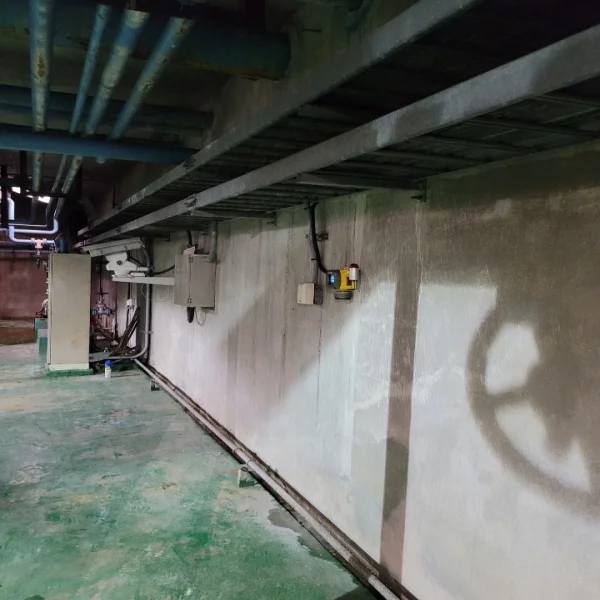
Pumps also operate at a set output level. Excessive wastewater flow can place additional load on the pump, and there is also a fire risk if the pump fails due to aging equipment.
If a pump malfunctions due to overload, carbon monoxide (CO) can be generated, and the presence of CO can also signal the onset of a fire. In most confined spaces, CO gas — aside from boiler rooms — tends to occur during a fire. If electrical equipment or high-output machinery is installed within a confined space, measuring carbon monoxide becomes an important consideration as well.
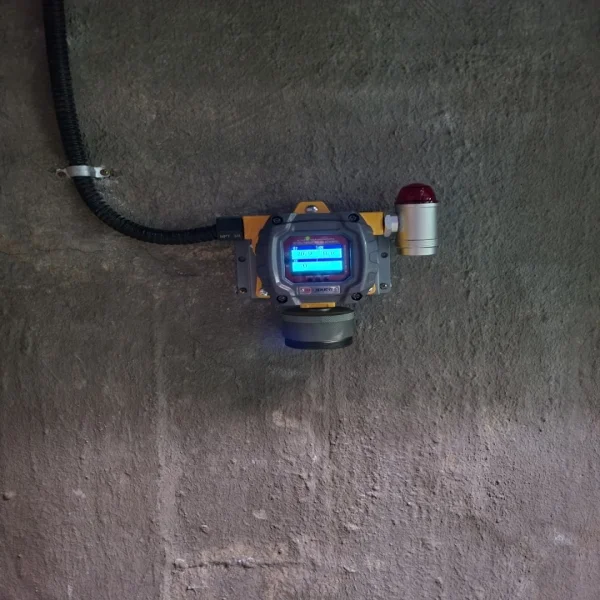
Detector Selection: FIX800 Multi-Gas Detector
Taking all of these factors into account, the customer determined that only three gases needed to be measured — O₂, CO, and H₂S — and our own consultation confirmed that this configuration was sufficient.
The advantage of the FIX800 multi-gas detector is that it allows only the necessary gases to be selected and configured. Purchasing a 4-gas or 5-gas configuration can help prevent unnecessary budget spending when there is evidence that certain gas components are not present at a given site.
Detector Placement Guidance
One of the most common questions is how many detectors should be installed per unit of floor area. In fact, since gas detectors are not suction (sampling) type devices, there is no fixed standard for the area a single unit can cover. For this reason, the most appropriate approach is to install one detector near each location where a gas-generating factor is present — one unit near a single source, or two units near two separate sources.
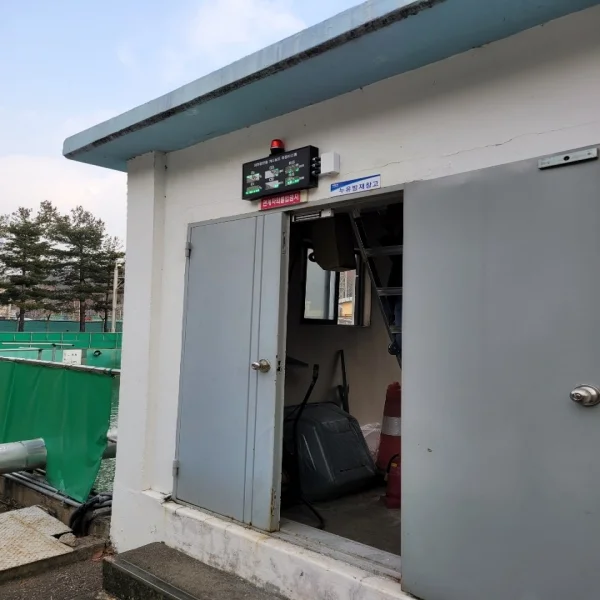
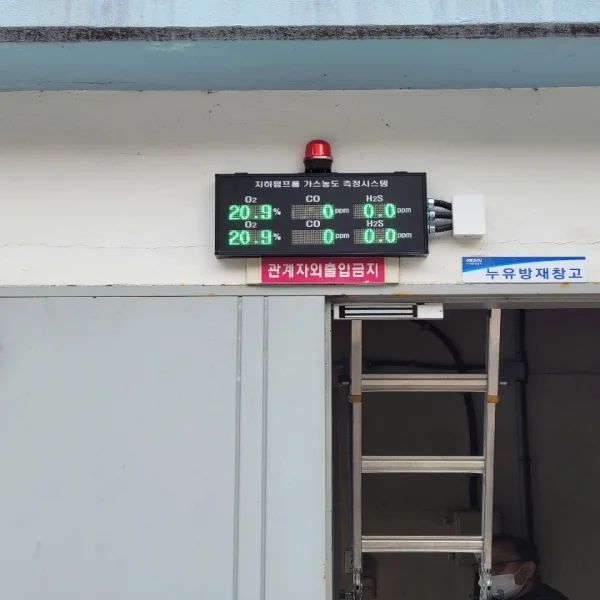
Entrance Gas Concentration Display Board
A gas concentration display board is installed at the entrance, allowing workers to check the internal gas concentration before entering the pump room. It serves as a first line of defense against gas-related incidents.
The display board can be custom manufactured in different sizes to fit narrow entrance spaces, with freely customizable header text, color-coded concentration ranges by segment, and the option to include a company logo. Depending on the installation location, indoor, outdoor, and pole-mounted design configurations are all available.
Installation Specifications
| Item | Details |
|---|---|
| Detector | FIX800 fixed multi-gas monitor |
| Sensor configuration | CO (carbon monoxide) + O₂ (oxygen) + H₂S (hydrogen sulfide) |
| Installation environment | Power plant wastewater relay pump room |
| Location | Bundang, Gyeonggi-do |
Power Plant Pump Room Gas Hazard Characteristics
- Wastewater and sewage pumping systems generate H₂S from organic matter decomposition, evident from the visible corrosion at pipe connections
- O₂ deficiency risk exists in confined pump room spaces with limited natural ventilation
- CO can be present from nearby combustion equipment or incomplete combustion processes within the power plant facility
- The corrosive nature of H₂S gas accelerates equipment degradation, as visibly demonstrated by the rusted pipe joints and flanges
Why Visible Corrosion Signals Gas Hazard Risk
- Rust and corrosion at pipe connections often indicate prolonged exposure to H₂S or other corrosive gases
- This physical evidence helps confirm the need for continuous gas monitoring at the affected location
- Identifying corrosion patterns during site assessment helps determine optimal detector placement near the highest-risk areas
Frequently Asked Questions
What does the visible corrosion at pipe joints indicate about the facility's gas environment?
Rust and corrosion at pipe connections typically indicate prolonged exposure to H₂S or similarly corrosive gases generated during wastewater treatment processes. This visible evidence is a useful indicator during site assessment for confirming gas hazard presence and guiding detector placement.
Why do power plant pump rooms require gas monitoring?
Pump rooms handling wastewater and sewage are confined spaces with limited ventilation, where organic matter decomposition generates H₂S and can lead to oxygen deficiency. Combined with potential CO exposure from nearby combustion equipment, continuous monitoring of all three gases is essential for worker safety.
How many detectors should be installed in a facility like this?
Because fixed gas detectors are not suction (sampling) type devices, there is no fixed area-coverage standard. The general approach is to install one detector near each location where a gas-generating factor is present.
What does a typical gas detector installation project include?
A typical project includes free on-site assessment and solution proposal, detector and display board installation configured for the specific gases present, and after-sales service and maintenance support.

#PowerPlantPumpRoomGasDetector #COO2H2SDetector #WastewaterRelayPumpRoom #CorrosiveGasEnvironment #BundangDelivery #FIX800GasDetector #GasDisplayBoard #WANDIKorea
![[레이먼드] 오,폐수 처리실 유해가스 모니터링](https://wandi.co.kr/storage/construction-cases/YxFUQVBZ8Unnk7pJzzfsmezr6xNe0LZvQRDmt7TL.jpg)
![[브이피이코리아] 종합병원 지하 밀폐공간 가스 측정기 설치_FIX800 & FIX-DS](https://wandi.co.kr/storage/construction-cases/gNOA28xSlEy5uU3AOxyHDRH5UfAe0TpMTgAt4Uag.jpg)

