Applied Markets
Installed Gases
Project Details
Hello.
Today's case covers the calibration and sensor replacement of the FIX800 oxygen (O2) detector installed in a CO2 automatic fire suppression room inside a department store.
Large facilities such as department stores, which serve tens of thousands of visitors every day, operate electrical rooms, server rooms, and mechanical rooms around the clock to keep the entire building running.
Because these spaces are densely packed with electrical equipment, they carry an inherent fire risk.
What happens if a fire is extinguished with a sprinkler or water?
Using water to extinguish a fire can damage electrical equipment or flood servers and control devices, increasing recovery costs.
For this reason, gas-based fire suppression systems that do not damage electrical equipment are used in critical spaces such as electrical rooms and server rooms.
These systems extinguish fires by releasing CO2 to lower the oxygen concentration in the space.
While effective at suppressing fires, the more enclosed the space, the more sharply the oxygen concentration drops, creating a risk of asphyxiation.
Since CO2 is present, it may seem logical to ask, "Shouldn't CO2 itself be measured?"
In practice, however, the most important criterion for judging a worker's safety is the oxygen (O2) concentration.
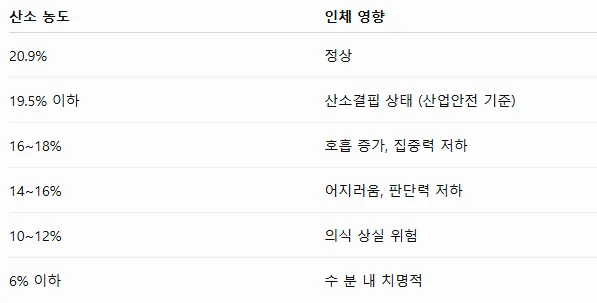
Why is CO2 used among the many available gases?
Combustion requires fuel, heat, and oxygen. When CO2 is instantly released inside a fire suppression room, the oxygen concentration in the space drops, creating an environment where combustion can no longer be sustained, and the fire is suppressed.
CO2 is also a non-conductive gas that does not carry electricity, and unlike water or powder agents, it leaves no residue after discharge, so it does not damage equipment.
Maintenance of a Department Store CO2 Fire Suppression Room
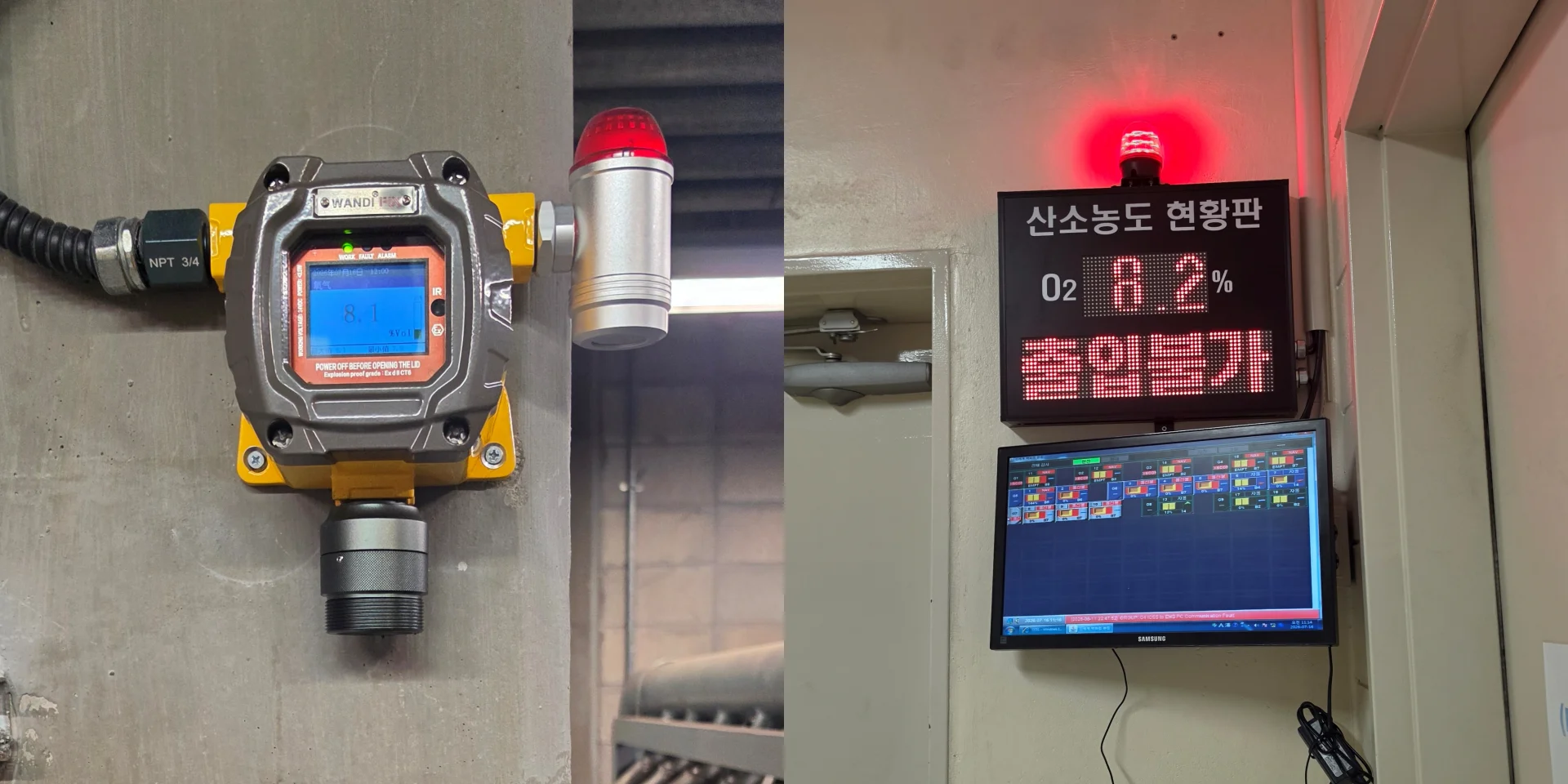
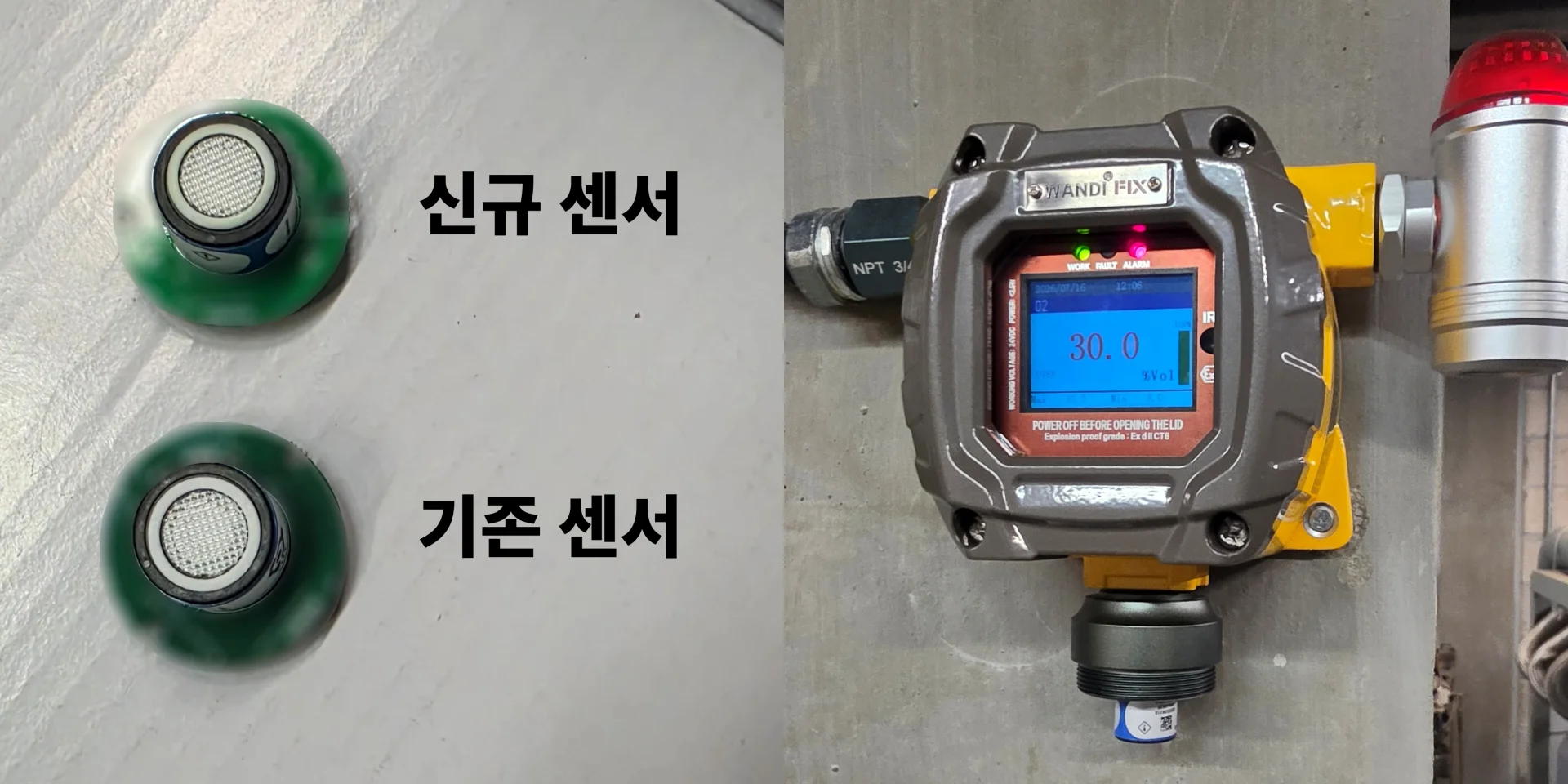
This site had been in operation for about two years since installation, so the oxygen sensor was replaced along with calibration.
Unlike portable gas detectors, fixed (installed) gas detectors operate continuously 24 hours a day and are constantly exposed to atmospheric oxygen, which causes the sensor's cumulative operating hours to accumulate quickly and results in a relatively short sensor replacement cycle.
The normal atmospheric oxygen concentration is approximately 20.9%. Since this unit was displaying a reading of 8.1%, lower than the actual concentration, it would have triggered an alarm and affected the worker's safety judgment, so the sensor was replaced.
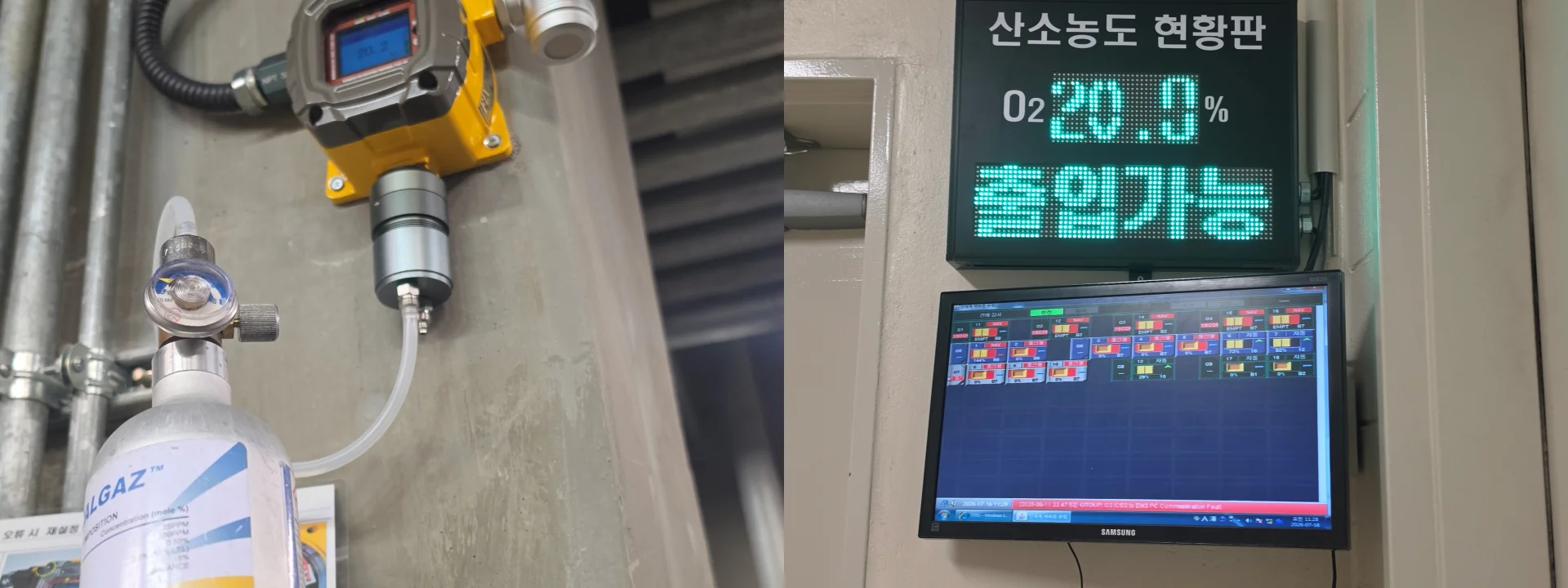
A newly installed sensor does not immediately read 20.9%. The reading changes for a period of time because the output characteristics and AD (Analog to Digital) values of the new sensor differ from those of the previous one.
Even sensors of the same gas type from the same manufacturer can vary slightly due to minor deviations, so a stabilization period is required after sensor replacement, and calibration should be performed after this period to achieve higher accuracy.
For gas detectors, maintenance after installation is even more important than the installation itself.
To ensure measurement accuracy, the sensor stabilization process, calibration, and final performance verification are carried out systematically.
We remain committed to protecting the safety of industrial sites through accurate measurement and reliable maintenance.
Frequently Asked Questions (FAQ)
Why is an O2 (oxygen) detector installed in a CO2 fire suppression room?
CO2 fire suppression systems extinguish fires by releasing carbon dioxide to lower the oxygen concentration in the space. An oxygen (O2) detector is installed and continuously monitored to check the asphyxiation risk for workers entering the enclosed space after discharge.
How often does the oxygen sensor need to be replaced?
Because fixed (installed) gas detectors react with atmospheric oxygen continuously, 24 hours a day, their sensors wear out faster than portable detectors. At this site, about two years after installation, the reading had dropped to 8.1%, well below the normal level of approximately 20.9%, so the sensor was replaced.
Can calibration be performed immediately after replacing the sensor?
No. A newly installed sensor has different AD (Analog to Digital) output characteristics from the previous sensor, so the reading does not stabilize immediately. A stabilization period is required, and calibration should be performed afterward to ensure higher accuracy.
What is the FIX800?
The FIX800 is a fixed (installed) gas detector. In this case, it was used for oxygen (O2) sensor calibration and replacement.
Where was this installation carried out?
The work was carried out on the FIX800 oxygen detector installed in the CO2 automatic fire suppression room of a department store in Seoul, including sensor replacement and calibration.
#FIX800#OxygenDetector#O2Sensor#GasDetector#Calibration#SensorReplacement#CO2FireSuppression#FixedGasDetector#DepartmentStoreSafety#WANDI
![[레이먼드] 오,폐수 처리실 유해가스 모니터링](https://wandi.co.kr/storage/construction-cases/YxFUQVBZ8Unnk7pJzzfsmezr6xNe0LZvQRDmt7TL.jpg)
![[브이피이코리아] 종합병원 지하 밀폐공간 가스 측정기 설치_FIX800 & FIX-DS](https://wandi.co.kr/storage/construction-cases/gNOA28xSlEy5uU3AOxyHDRH5UfAe0TpMTgAt4Uag.jpg)

