Project Details
Hello, this is our technical team. Today's post covers the installation of O2 detectors and CO2 detectors in fire suppression agent rooms.
We'll explain why O2, CO2, and refrigerant gas detectors should be installed in fire suppression agent rooms, and how to install them correctly.
1. Fire Suppression (Extinguishing) Gases
Fire suppression gases work by displacing oxygen or interfering with the chemical reaction of combustion to put out a fire. Several types exist; the main ones are described below.
① Carbon Dioxide (CO2)
Characteristics: extinguishes fire by diluting oxygen.
Applications: electrical fires, flammable liquid fires.
Advantages: non-conductive, safe for electronic equipment fires.
Disadvantages: risk of asphyxiation if used in an enclosed space.
② Halon Gas (now banned for environmental reasons)
Characteristics: extinguishes fire by interfering with the chemical reaction.
Applications: aircraft, military facilities, server rooms (historically).
Advantages: fast, powerful extinguishing effect.
Disadvantages: depletes the ozone layer; now replaced by alternatives.
③ HFC-Series Gases
Characteristics: similar to halon but less environmentally harmful.
Applications: server rooms, museums, medical facilities.
Advantages: fast extinguishing effect, harmless to electronics.
Disadvantages: higher cost.
④ IG-Series Gases (Inert Gases)
Types: IG-55, IG-100, IG-541 (mixtures of nitrogen, argon, and carbon dioxide).
Characteristics: extinguishes fire by lowering oxygen concentration.
Applications: data centers, power plants, security facilities.
Advantages: environmentally friendly, no ozone depletion.
Disadvantages: requires significant installation space as a high-pressure gas.
Because of these trade-offs, CO2 suppression gas is widely used, being relatively inexpensive and environmentally manageable.
A natural question follows: why not just use a cheaper, more accessible dry chemical (powder) extinguisher instead? One key advantage of CO2 gas is that it leaves no residue. Extinguishing a fire with powder leaves residue that requires costly and time-consuming cleanup, whereas CO2 leaves no residue, making post-fire recovery much easier.
2. CO2 Suppression vs. Other Extinguisher Types
CO2 extinguisher — Principle: oxygen displacement & cooling. Fire types: electrical, flammable liquid. Residue: none. Caution: risk of asphyxiation in enclosed spaces.
Dry chemical extinguisher — Principle: chemical reaction inhibition. Fire types: A (general), B (oil), C (electrical). Residue: yes. Caution: cleanup required after use.
Foam extinguisher — Principle: oxygen displacement. Fire types: B (oil), some A. Residue: yes. Caution: not suitable for electrical fires.
Water extinguisher — Principle: cooling. Fire types: A (general). Residue: yes. Caution: not suitable for electrical or oil fires.
Because it avoids damaging electronic equipment through residue, CO2 is widely used in server rooms, electrical rooms and substations, semiconductor production lines, aircraft, and other locations where protecting equipment and easy recovery are priorities.
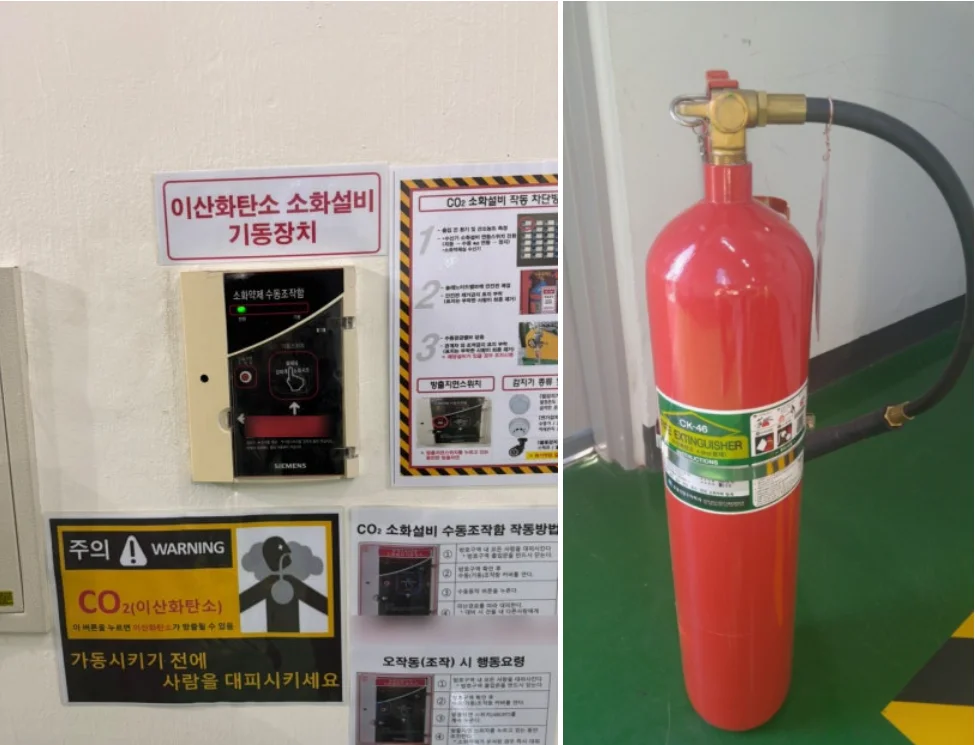
CO2 fire suppression system and CO2 extinguisher.
3. How CO2 Suppression Works
A CO2 extinguisher puts out fire in two ways.
① Oxygen displacement: sustained combustion requires oxygen (roughly 16% or higher). Because CO2 is heavier than air, it settles over the fire and lowers the oxygen concentration to suppress the flame.
② Cooling effect: CO2 is stored as a gas and expands rapidly when discharged, lowering the temperature. During this process it can form dry ice at temperatures as low as -79°C, rapidly cooling the flame.
Because of this oxygen-displacement effect, any site or fire suppression agent room using CO2 suppression gas should be equipped with O2 and CO2 detectors as a matter of course.
In the early stage of asphyxiation (roughly the first 1-2 minutes), a person may notice chest tightness or dizziness and can still recognize the danger. After about 2 minutes, judgment and concentration deteriorate significantly, making it harder to recognize the danger. After 4 minutes, a person is essentially unconscious and unable to respond.
Asphyxiation risk stages — 1-2 minutes: chest tightness, dizziness (self-aware). 2-4 minutes: reduced judgment and concentration (danger recognition becomes difficult). 4+ minutes: unconsciousness (emergency rescue required).
What is asphyxiation? A condition in which breathing becomes impossible due to a blocked airway or insufficient oxygen.
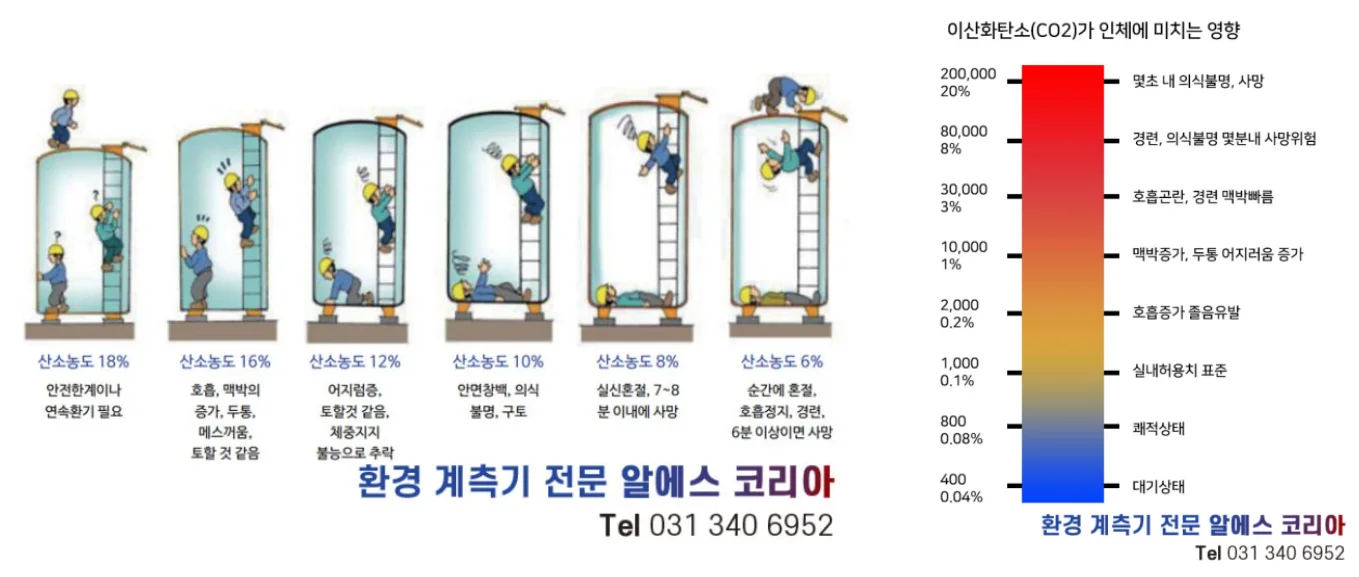
The best response when an asphyxiation incident occurs is to alert people outside the space immediately, so emergency services can be called and oxygen supply or CPR can be administered. A gas detector installed inside the room, combined with an external display board and wireless IoT communication, can alert people outside to the danger.
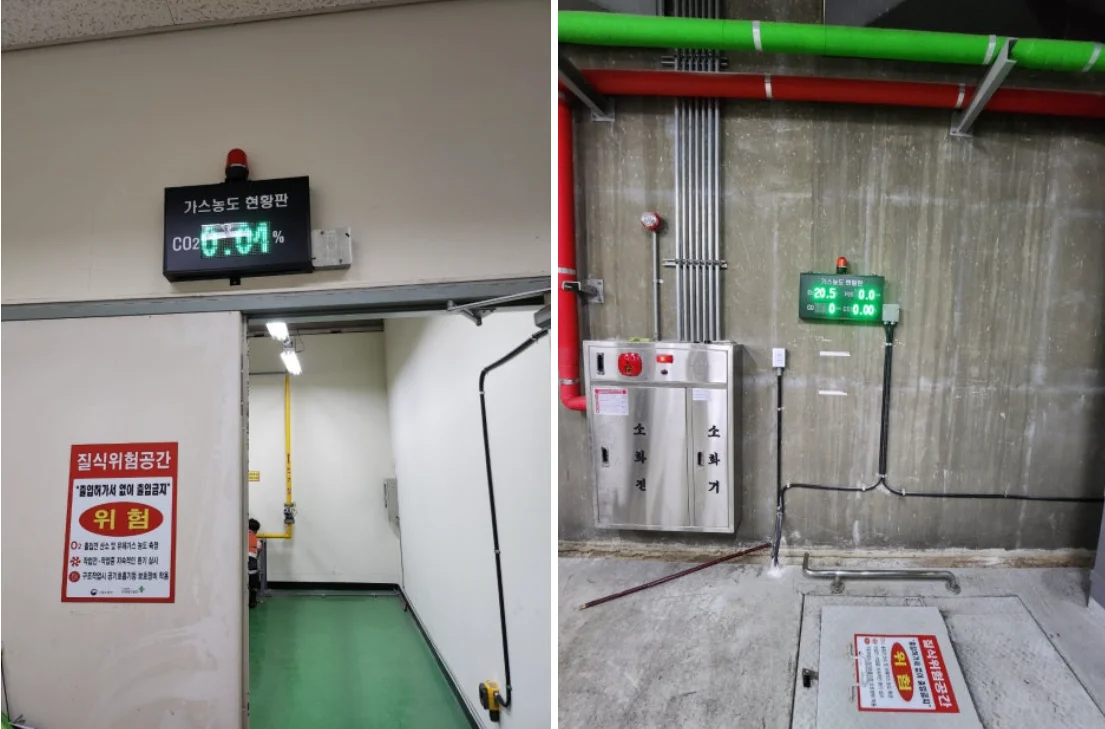
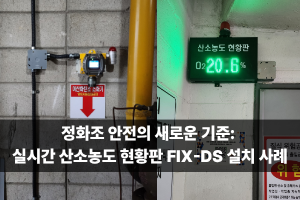
Photo of the display board.
4. Where to Install O2 and CO2 Detectors
Because CO2 is heavier than oxygen, it tends to collect near the floor. For a faster response, it is best to install the detector at around knee height.
O2 (oxygen molecule): 16.00 g/mol × 2 = 32.00 g/mol.
CO2 (carbon dioxide): 12.01 g/mol + (16.00 g/mol × 2) = 44.01 g/mol.
CO2 is about 1.38 times heavier than O2.
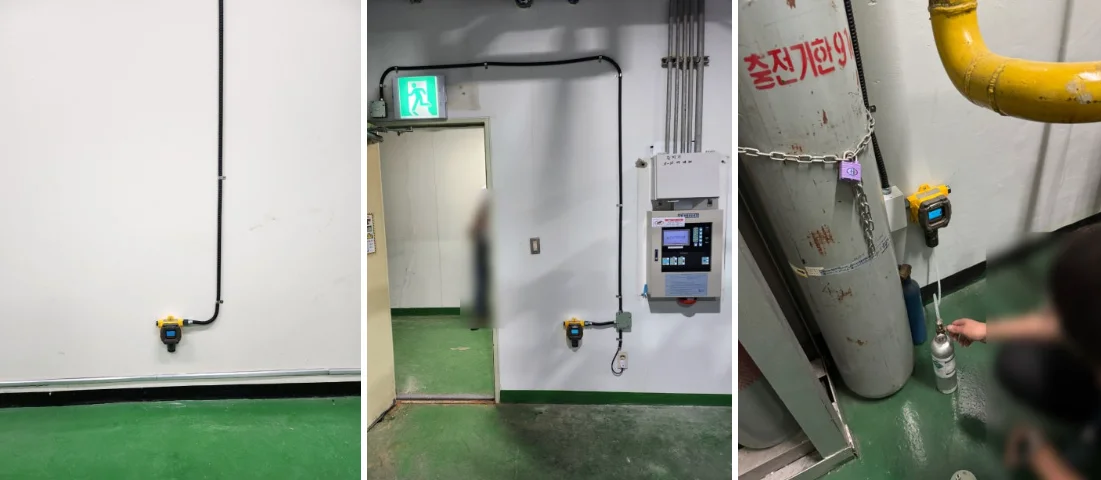
Photo of the FIX800 installation.
When installing a detector in a fire suppression agent room specifically to detect leaks from gas cylinders and piping, it is also a good idea to install it near locations where a leak is likely to occur.
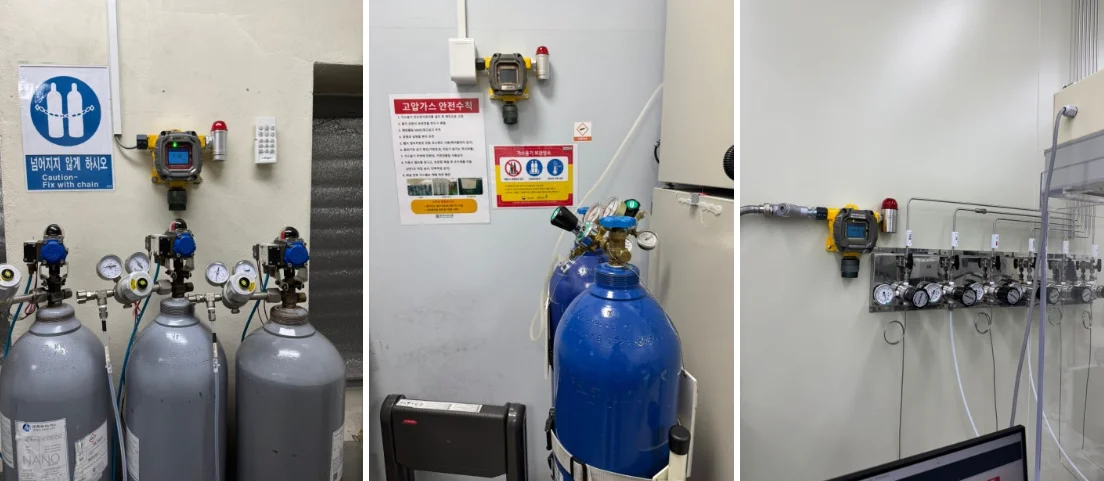
Photo of the FIX800 installation (2).
Even with a fixed detector installed on site, it is strongly recommended that each worker also carry a personal portable detector for accident prevention. For a portable detector, one with cloud connectivity for real-time readings and GPS tracking, such as the EDW-500, is recommended.
5. How to Respond in an Emergency
The most important step during an asphyxiation incident is immediate notification to people outside the space.
Inside: confirm via the O2/CO2 detector alarm.
Outside: confirm via IoT-based wireless communication for immediate warning monitoring.
Immediately call emergency services, provide oxygen, and perform CPR as needed.
6. Conclusion
Installing O2 and CO2 detectors is essential in any space using CO2 fire suppression gas.
Fixed detectors (FIX800 with wireless monitoring and a display board): gas leak detection and indoor concentration monitoring.
Portable detector (EDW-500): worker safety, real-time data, and real-time location tracking.
Gas detector accuracy can gradually decline over time with extended use. To prevent this, an annual inspection and calibration is recommended.
Safety is not optional — it is essential. To protect what matters most, be sure to install O2 and CO2 detectors, and if you already have them installed, have them inspected and calibrated once a year.
When it is unclear which gases may be present, or when the gases are known but the required measurement range is uncertain, choosing the right gas detector can be difficult without guidance. A thorough consultation that considers the environment, the gases involved, frequency, and concentration levels is the safest way to select a detector with the correct measurement range.
Beyond product sales, we provide in-house calibration, domestic repair service, custom manufacturing, and installation work, drawing on experience across many different measurement environments to offer tailored one-on-one solutions. Please feel free to reach out with any questions about gas detectors or other environmental measurement instruments.
Frequently Asked Questions (FAQ)
Q1. Why are O2 and CO2 detectors required in fire suppression agent rooms?
Because CO2 suppression gas extinguishes fire by displacing oxygen, any room using it carries an asphyxiation risk if the gas leaks or is discharged. O2 and CO2 detectors provide early warning before oxygen levels become dangerous.
Q2. Where should the detector be positioned inside the room?
Since CO2 is about 1.38 times heavier than O2 and tends to collect near the floor, installing the detector at around knee height allows for faster detection. For leak detection near cylinders or piping, placing a detector near likely leak points is also recommended.
Q3. What happens if a person is exposed to low oxygen for too long?
In the first 1-2 minutes, a person typically feels chest tightness or dizziness and can still recognize the danger. Between 2 and 4 minutes, judgment and concentration deteriorate sharply. Beyond 4 minutes, a person can become unconscious and unable to respond, requiring emergency rescue.
Q4. What is the recommended monitoring setup?
A fixed detector such as the FIX800 combined with a display board and wireless IoT monitoring lets people outside the room see the danger immediately, while workers should also carry a portable detector, such as the EDW-500, with cloud connectivity and GPS tracking for added protection.
Q5. How often should gas detectors be inspected?
Detector accuracy can decline gradually with extended use, so an annual inspection and calibration is recommended to keep readings reliable.
#CO2Detector #OxygenDetector #FireSuppressionSafety #GasDetector #FIX800 #EDW500 #IndustrialSafety #ConfinedSpaceSafety #GasLeakDetection #IoTMonitoring
![[레이먼드] 오,폐수 처리실 유해가스 모니터링](https://wandi.co.kr/storage/construction-cases/YxFUQVBZ8Unnk7pJzzfsmezr6xNe0LZvQRDmt7TL.jpg)
![[브이피이코리아] 종합병원 지하 밀폐공간 가스 측정기 설치_FIX800 & FIX-DS](https://wandi.co.kr/storage/construction-cases/gNOA28xSlEy5uU3AOxyHDRH5UfAe0TpMTgAt4Uag.jpg)

