Applied Markets
Project Details
Hello. In this case study, we'd like to share a recent installation project carried out in Dongducheon, Gyeonggi-do. As with previous wireless data communication installations, this project combines an ultrasonic level sensor with our wireless communication IoT hardware.
Where earlier case studies focused mainly on our FIX800 installations, this project made use of the newer FIX-AP wireless communication IoT hardware, which has been introduced more recently. Experience gained from an earlier project in Gwacheon (level sensor + wireless data communication) proved helpful for this installation as well.
One practical note from the field: at some sites, the on-site 2.4GHz Wi-Fi network name (SSID) had been changed from its default. Confirming the correct network name with the site's communication room in advance allowed the connection work to proceed quickly.
Items Installed
Ultrasonic level sensor: a SUPMEA ultrasonic level sensor (ZP series), used together with a SUPMEA SUP2100 digital indicator that is compatible with a variety of sensor types, so on-site workers can read tank levels quickly and conveniently.
Wireless communication hardware: FIX-AP, a wireless communication IoT hardware unit for measurement equipment.
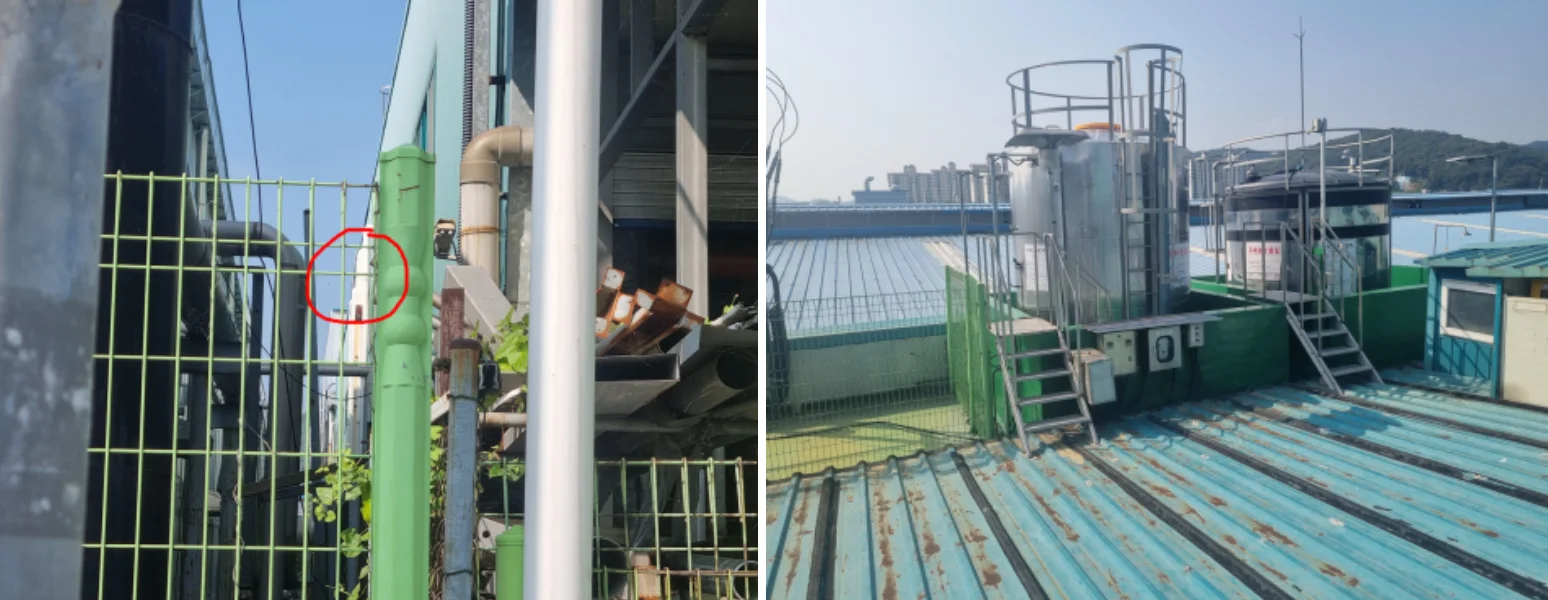
The installation location was somewhat elevated and fully exposed on the rooftop housing the chemical storage tanks, but the work proceeded without issues.
Reason for Installation
The tanks are used at a textile dyeing factory and store chemicals - hydrogen peroxide and sodium hydroxide - that require continuous level monitoring. The site already had analog level gauges, but checking them required repeated trips up to the roof, which was inconvenient. The customer also wanted to verify whether the existing analog gauges were reading correctly, which prompted the inquiry for this installation.
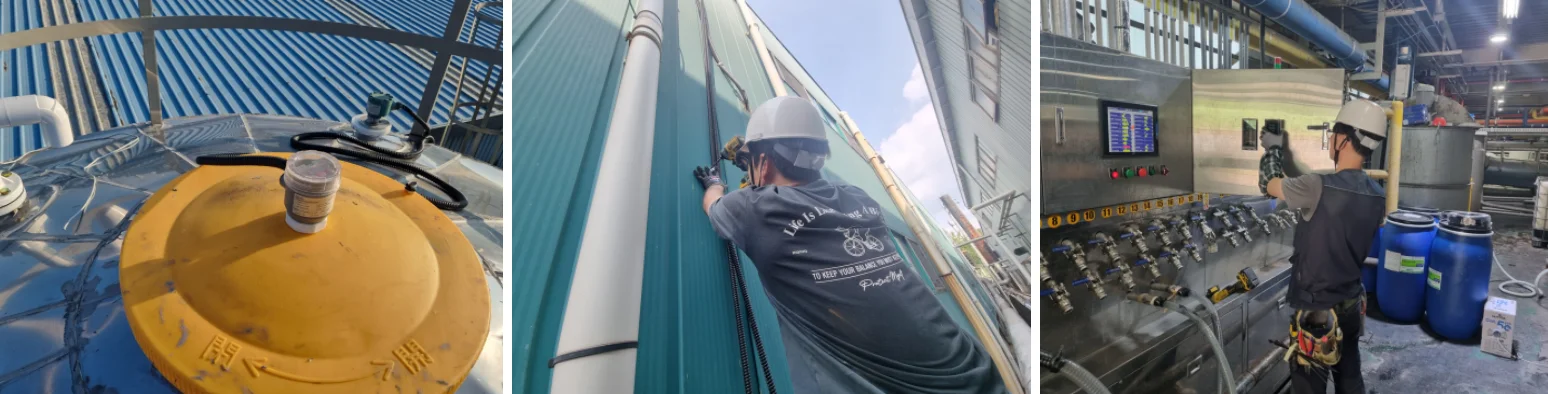
This shows the process of connecting the sensors to a total of two chemical tanks. Each ultrasonic level sensor is mounted at the center of its tank, and the communication and signal cable runs down along the wall to the digital indicator on the ground floor. This means workers can check the tank level directly from the indicator without needing to climb to the roof. The same steps were repeated for both tanks.
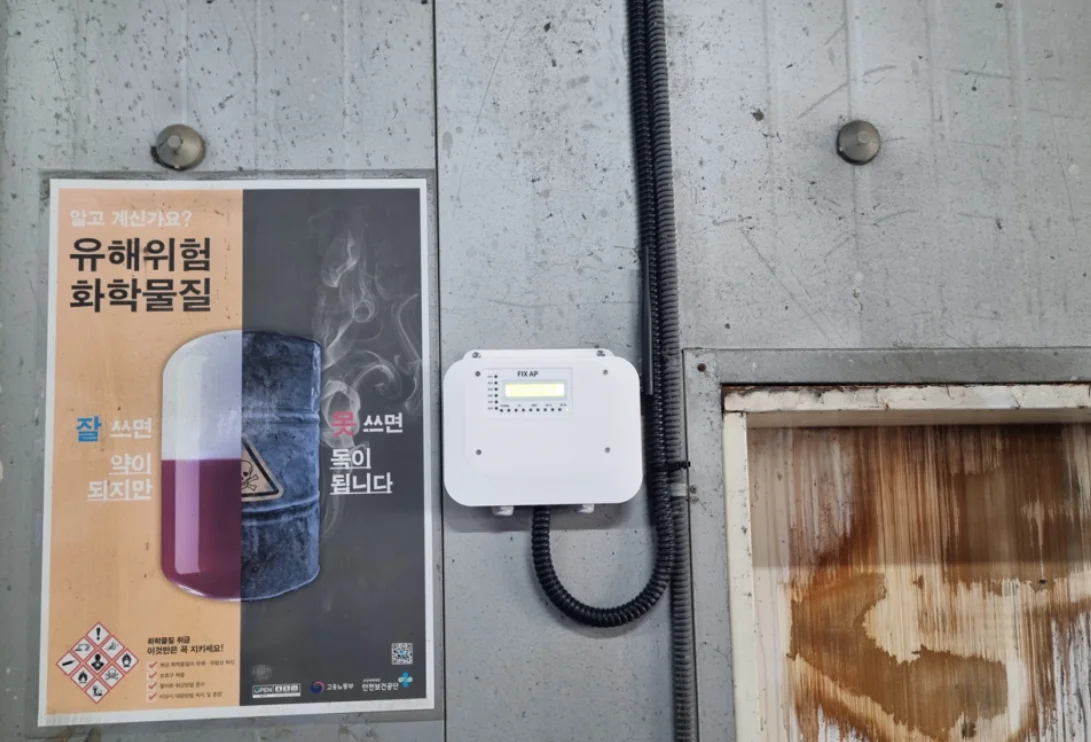
The FIX-AP unit simply needs to be installed in a location with good Wi-Fi reception. Field reports on FIX-AP installations tend to be short, because each unit is fully configured and tested before it leaves our facility - the only step required on site is connecting it to the local Wi-Fi network.
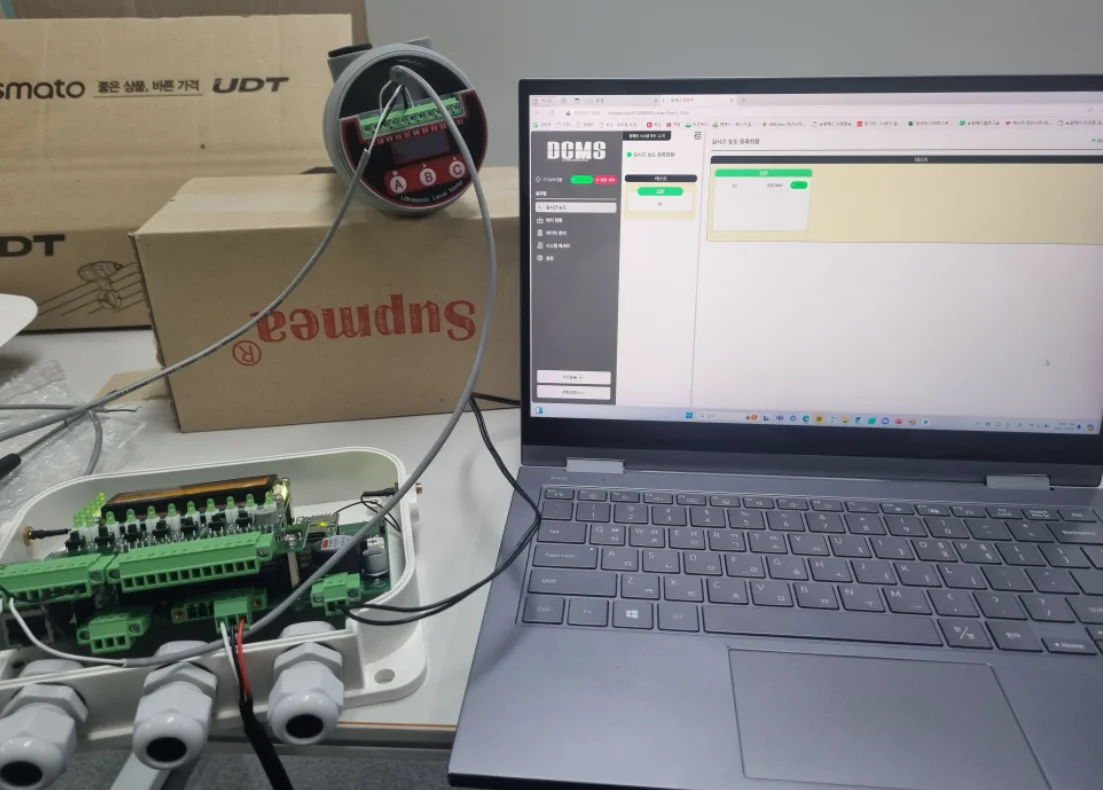
FIX-AP under testing before installation.
Looking at the wiring between FIX-AP and the connected device, the setup is not complicated - it simply requires a power connection and a connection to the communication line being used. Some users may find the accompanying software unfamiliar at first, but our team provides guidance over the phone on both wiring and software configuration.
Recently, a customer who purchased only the FIX-AP unit and set it up independently was guided step by step over the phone through the wiring and software configuration, based on photos of the wiring, and was able to get it running quickly.
In our earlier case study covering the Gwacheon chemical tank installation, we emphasized the convenience for the end user. This time, we wanted to highlight instead how easy the FIX-AP itself is to use.
This concludes our case study on the Dongducheon wireless IoT data communication installation.
Frequently Asked Questions (FAQ)
Q1. How does the ultrasonic level sensor measure the tank level?
It is a non-contact sensor mounted at the top center of the tank that measures the distance to the liquid surface using ultrasonic waves, which is then converted into a level reading on the connected digital indicator.
Q2. What chemicals were being monitored in this installation?
The tanks store hydrogen peroxide and sodium hydroxide at a textile dyeing factory, both of which require continuous level monitoring.
Q3. What is FIX-AP?
FIX-AP is wireless communication IoT hardware for measurement equipment. It is configured and tested before shipping, so the only on-site task is connecting it to the local Wi-Fi network.
Q4. Do workers still need to climb to the roof to check the tank level?
No. The sensor's communication and signal cable is routed down to a digital indicator on the ground floor, so the level can be checked without going up to the roof.
Q5. What if the on-site Wi-Fi network name has been changed from the default?
If a site's Wi-Fi network name (SSID) has been customized, confirming the correct network name with the site's facilities or communication team in advance allows the connection to be completed quickly.
#IoT #IIoT #WirelessMonitoring #LevelSensor #UltrasonicLevelSensor #TankMonitoring #ChemicalTank #RemoteMonitoring #SmartFactory #FIXAP
![[레이먼드] 오,폐수 처리실 유해가스 모니터링](https://wandi.co.kr/storage/construction-cases/YxFUQVBZ8Unnk7pJzzfsmezr6xNe0LZvQRDmt7TL.jpg)
![[브이피이코리아] 종합병원 지하 밀폐공간 가스 측정기 설치_FIX800 & FIX-DS](https://wandi.co.kr/storage/construction-cases/gNOA28xSlEy5uU3AOxyHDRH5UfAe0TpMTgAt4Uag.jpg)

