Project Details
Note: The R9600 data logger model referenced in this post has been discontinued and replaced by the RN3000 model.
Hello, this is the Technical Sales Team at RS Korea.
As autumn approaches, we're back with another update on level measurement projects. A few years ago, we published a series of posts about demonstrating and installing an ultrasonic level sensor (ZP) and a radar level sensor (RD) on a chemical wastewater storage tank at a medical foundation in Machon-dong, Songpa-gu, Seoul.
To keep this post from getting cluttered, we won't repeat all of the links to that earlier series here.
After that original installation, the customer handled a few service inquiries over the following years but was otherwise satisfied with the setup. Recently, a newly built annex building across from the original site needed the same kind of setup, so we prepared a quote. Since the tank structure was identical, we didn't need a separate on-site survey — we simply asked for a few site photos instead. For similar environments with no unusual conditions, a quote can often be prepared from photos alone.
- Installation location
- Power supply location
- A photo or drawing showing the distance between the power source and the installation point
In response to this request, we received two photos.
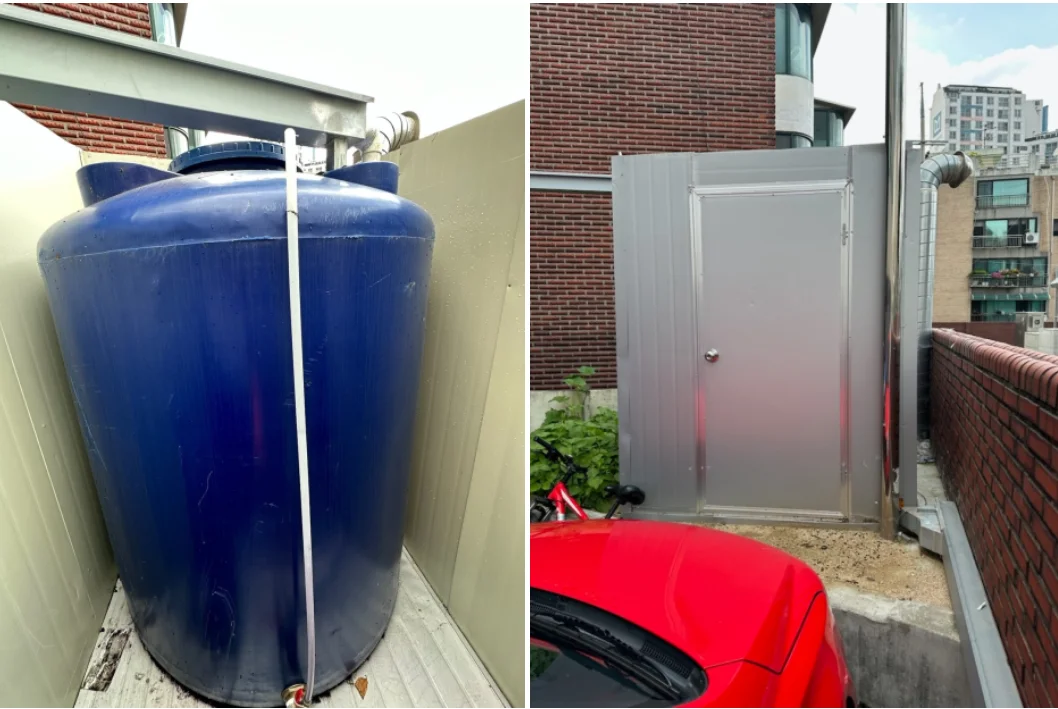
"Wait — this location is outdoors? The previous site was indoors. And where is the 220V power supply? There isn't one on site?"
Since the outdoor location wasn't protected from rain, the plan had to be revised. After discussion, it was agreed that the power wiring work would be arranged in advance through a separate electrical contractor. For the data logger, an outdoor-rated enclosure was used, and instead of the ZP or RD sensors — which have exposed controls and displays — a contact-type pressure level sensor was selected. Even equipment with a good IP rating can be prone to failure over time when mounted in a fully exposed outdoor location with no shelter from wind and rain, so we took a more cautious approach here.
Fortunately, the tank has no agitator or other internal fixtures — only a wastewater transfer pipe — so the risk of physical damage to a submerged sensor is low, and the P260 pressure sensor was a good fit for this tank.
The P260 is a pressure-type sensor with no onboard display. It measures the pressure at a fixed reference point in the liquid and converts that reading into an analog signal proportional to the liquid level.
The basic principle behind a pressure-type level sensor is straightforward: the pressure at a reference point within a liquid is proportional to the height of the liquid above that point. Since the installation itself was simple in this case, here's a short explanation of the underlying measurement principle for anyone interested.
Liquids carry potential energy, kinetic energy, and pressure energy that can be put to use in many ways — for example, driving a generator or producing a high-pressure water jet. When these forms of energy are expressed in terms of an equivalent height, that height is referred to as "head." Since this sensor relies on pressure, the relevant concept here is pressure head.
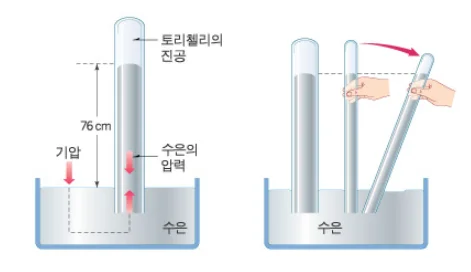
Most of us have seen a version of this diagram in school: it illustrates the classic experiment by the Italian physicist Evangelista Torricelli. He filled a 1-meter glass tube with mercury and inverted it into a basin, and found that a column of mercury 76 cm high remained standing. Repeating the experiment with tilted tubes, wider tubes, and differently shaped tubes always produced the same 76 cm column, leading to the conclusion that atmospheric pressure was what supported the liquid column.
This is the origin of the unit still used in the vacuum industry today: standard atmospheric pressure = 760 torr = 760 mmHg (millimeters of mercury). The "torr" unit itself is named after Torricelli.
If the same experiment were performed with water instead of mercury, the resulting column would be roughly 10 m (about 103,360 mm) tall, because mercury is about 13.6 times denser than water. This illustrates the relationship between a liquid's density and the height of the column needed to produce a given pressure.
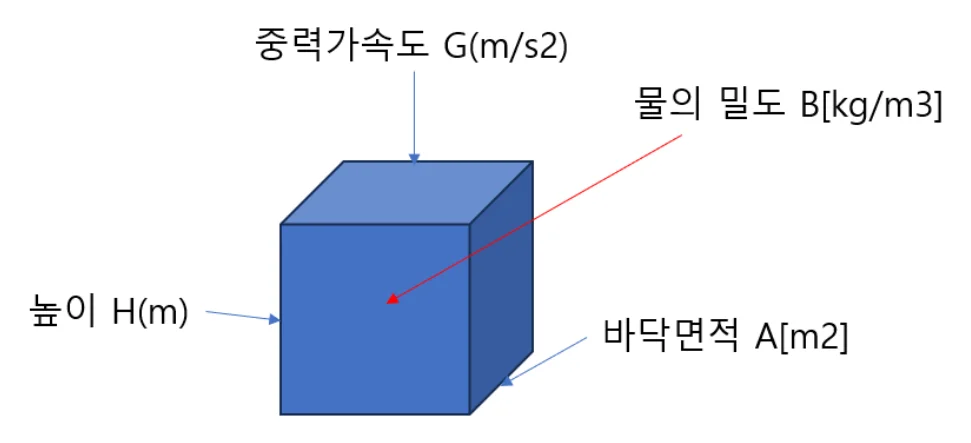
Working through the hydrostatic pressure formula: for a given volume of liquid, the total mass is the volume multiplied by density, and the total downward force is that mass multiplied by gravitational acceleration. Dividing force by the cross-sectional area gives pressure, and rearranging the equation for height gives H = P / (ρ × g) — meaning that liquid height depends only on the measured pressure, the liquid's density, and gravitational acceleration, and not on the tank's cross-sectional area at all.
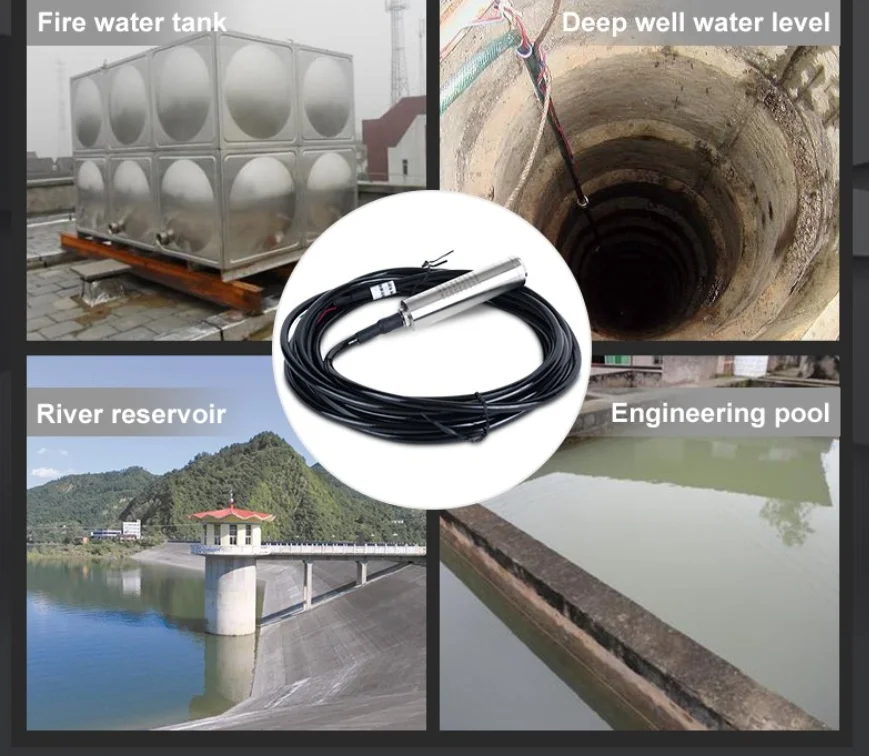
In other words, once you can measure pressure, you can determine liquid height regardless of the container's shape or diameter. This is exactly why a pressure-type level sensor like the P260 can be used not only in tanks of any size, but also in rivers, dams, and other open bodies of water.
Now, let's move on to the installation photos.
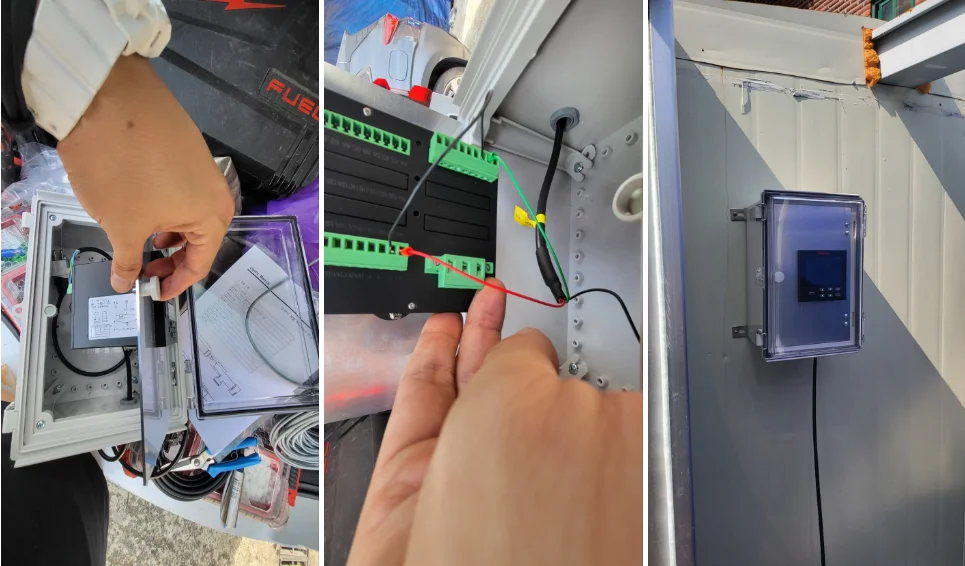
For the outdoor installation, the data logger was mounted in a double-door, outdoor-rated enclosure. The wiring for the power and sensor cables behind it is straightforward.
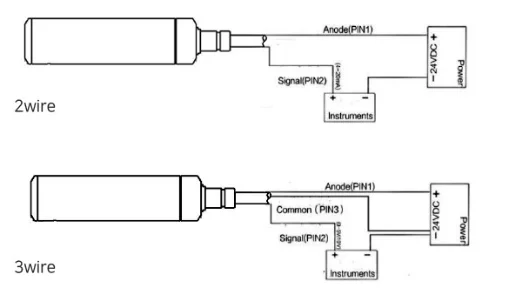
Depending on the configuration purchased, either a 2-wire or 3-wire option is available. When using a 4–20 mA signal, the power supply and measurement terminals can simply be wired together in a 2-wire loop configuration.
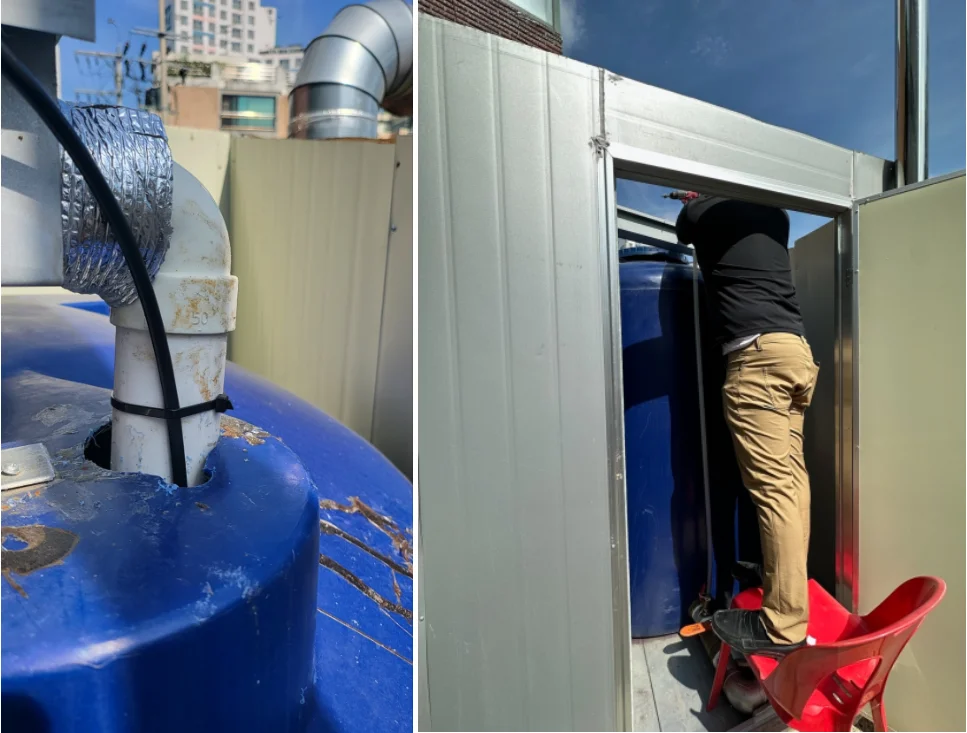
Since this was an outdoor installation, we agreed not to drill any additional holes into the tank. Wastewater treatment already carries its own cost, and any extra opening could cause significant losses during the rainy season. The sensor cable was routed through the existing opening and secured firmly with cable ties.
However, one issue came up during setup.
The previously installed ZP and radar (RD) level sensors allowed the measurement range and signal output range to be entered directly to match the specific installation height and application.
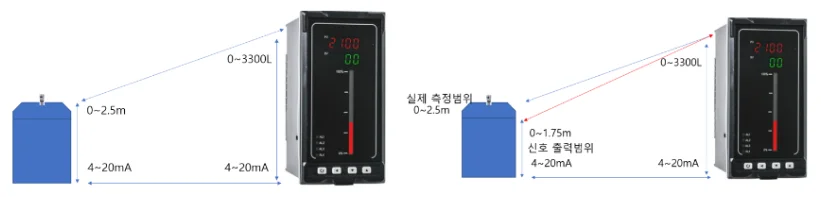
The diagram above, originally used in an earlier post on this same topic, illustrates the issue: the P260 is manufactured with a fixed measurement range, so for the 0–5 m version, the signal is fixed at 4 mA at 0 m and 20 mA at 5 m. This meant the corresponding volume values had to be calculated manually and entered into the data logger, since what the customer wanted displayed was tank volume rather than a raw level reading.
This particular 3-ton tank reaches its full level at approximately 162 cm (this varies by tank model) — well short of the sensor's full 0–500 cm measurement range.
To handle this, we calculated the values proportionally: dividing the tank's total liquid volume of 3,000 L by its full height of 162 cm gives approximately 18.518 L per cm. At the sensor's full range of 500 cm, this works out to 18.518 × 500 cm ≈ 9,259.26 L, based on the proportion 162 cm : 3,000 L = 500 cm : X.
With that calculation in hand, it was time to configure the data logger: 4 mA was set to correspond to 0 L, and 20 mA was set to correspond to 9,259.26 L.
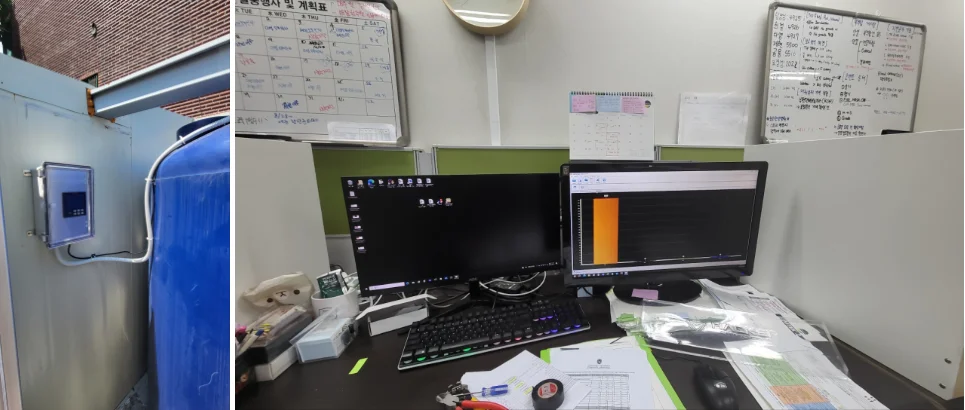
After connecting the cables left in place by the electrical contractor and completing the wiring, we connected the communication cable in the office and started up the monitoring software. Level and volume status can also be monitored indoors this way.
The software itself doesn't need much additional explanation here, since its usage was already covered in detail in an earlier post on this site.
Because the volume calculation was configured correctly from the start, there have been no reports of significant deviation from the reference flow meter readings, which suggests the calculation was accurate.
We look forward to helping more customers who need reliable tank, river, or open-channel level measurement. For inquiries about environmental monitoring equipment installation, commissioning, demo units, or products, please contact our team.
Frequently Asked Questions (FAQ)
Why was the SUPMEA P260 pressure-type sensor chosen for this outdoor wastewater tank instead of the ultrasonic/radar sensors used at the original site?
The new installation site turned out to be a fully exposed outdoor location with no dedicated power supply nearby, unlike the original indoor site. Because the ultrasonic (ZP) and radar (RD) sensors used previously have exposed displays and controls, continuous outdoor exposure to rain and weather could shorten their service life even with a good IP rating. The P260 is a contact-type pressure sensor that sits inside the tank without an external display, making it a more reliable choice for a fully exposed outdoor tank that also has no internal agitator or moving parts to risk damaging the sensor.
How does the SUPMEA P260 pressure-type level sensor measure liquid level?
The P260 measures the hydrostatic pressure at a fixed reference point inside the liquid. Since this pressure is directly proportional to the height of the liquid above the sensor, the measured pressure can be converted into a level reading — and, using the tank's known volume, into a corresponding volume value. The sensor outputs this as a standard analog signal without needing a display of its own.
How was the data logger configured to display tank volume instead of a raw water level reading?
The P260 has a fixed measurement range of 0–5 m, corresponding to a fixed 4–20 mA analog signal. Since this particular 3-ton tank reaches full level at around 162 cm — well short of the sensor's full 5 m range — the volume corresponding to the sensor's full range was calculated at approximately 9,259.26 L (based on a proportional ratio to the tank's rated 3,000 L capacity at 162 cm). The data logger was then configured so that 4 mA corresponds to 0 L and 20 mA corresponds to 9,259.26 L, allowing it to display tank volume directly.
Can the P260 pressure-type level sensor be used in locations other than tanks, such as rivers or dams?
Yes. Because the level calculated from hydrostatic pressure depends only on pressure, liquid density, and gravitational acceleration — not on the tank's cross-sectional area or shape — the P260 can be applied to rivers, dams, and other open-water monitoring points, in addition to tanks of any size.
Was a separate on-site survey required for this installation?
No separate site survey was needed. Because the new installation location had the same tank structure as a previous nearby installation, the quote was prepared from reference photos showing the installation location, the power supply location, and the distance between them — which is generally sufficient for quoting similar environments with no unusual site conditions.
#LevelSensor#PressureLevelSensor#HydrostaticPressure#WaterLevelMeasurement#DataLogger#TankLevelMonitoring#RiverLevelMonitoring#DigitalLevelMeter#SUPMEA#WANDI
![[레이먼드] 오,폐수 처리실 유해가스 모니터링](https://wandi.co.kr/storage/construction-cases/YxFUQVBZ8Unnk7pJzzfsmezr6xNe0LZvQRDmt7TL.jpg)
![[브이피이코리아] 종합병원 지하 밀폐공간 가스 측정기 설치_FIX800 & FIX-DS](https://wandi.co.kr/storage/construction-cases/gNOA28xSlEy5uU3AOxyHDRH5UfAe0TpMTgAt4Uag.jpg)

