Applied Markets
Installed Gases
Project Details
Hello, this is the Technical Sales Team at RS Korea.
Our blog updates were quieter in the first half of the year, but we have a good number of installation stories to share now.
Starting with a trial run at our Dongjak and Wonju branch offices last year, this year we completed an additional installation at the Wonju branch and installations at two branch offices in Jeonju.
Thank you again to everyone who has trusted and used our products as we continue rolling out installations to branch offices nationwide. Because there are several important points worth covering beyond the installation itself, we plan to split this story into two or three posts.
Let's get started.
Introduction
Under Article 618 of the Occupational Safety and Health Standards, five gases must be monitored to prevent asphyxiation accidents for workers in confined spaces.
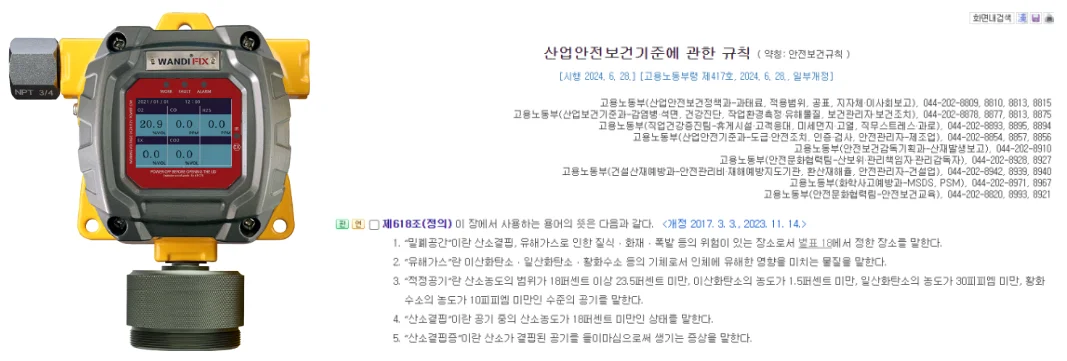
Unless the environment is a special case such as a research laboratory, the FIX800 is mainly used to measure the five gases required for confined-space worker safety. Following the amended regulation, which added a CO2 sensor, the monitored gases are now O2, CO, CO2, H2S, and combustible gas (EX). Today's site is a diesel tank room, one of the most common types of confined space.
The product being installed is the FIX800, a fixed multi-gas detector that can measure all five of the above gases at once.
By using a CO/H2S dual sensor, the FIX800 can measure all five required gases using only four physical sensor slots.
In addition, we installed a monitoring display at the entrance so that gas concentration status can be checked from both inside and outside the site at the same time.
Before Installation: Safety Preparation
Construction began at 9 AM. We arrived on site around 8:30 to set up installation materials and carry out safety training and a Tool Box Meeting (TBM). While this kind of process can sometimes feel like a formality, gathering everyone to sign off and go through the briefing does help reinforce safety awareness.
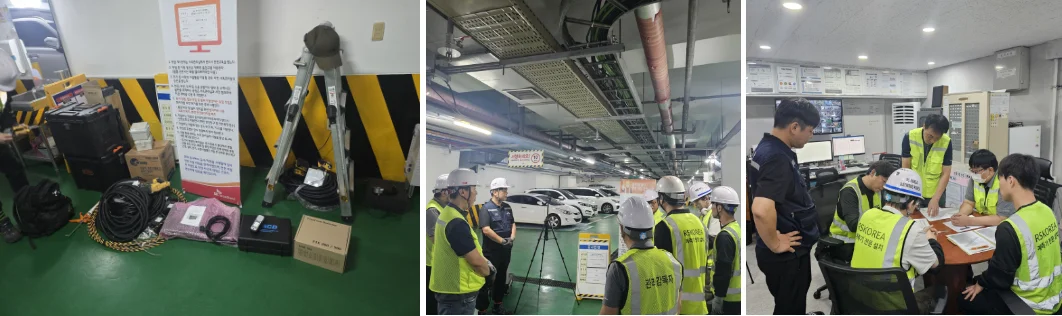
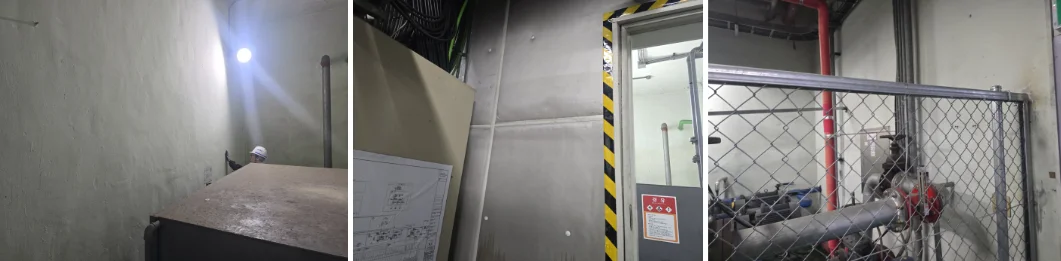
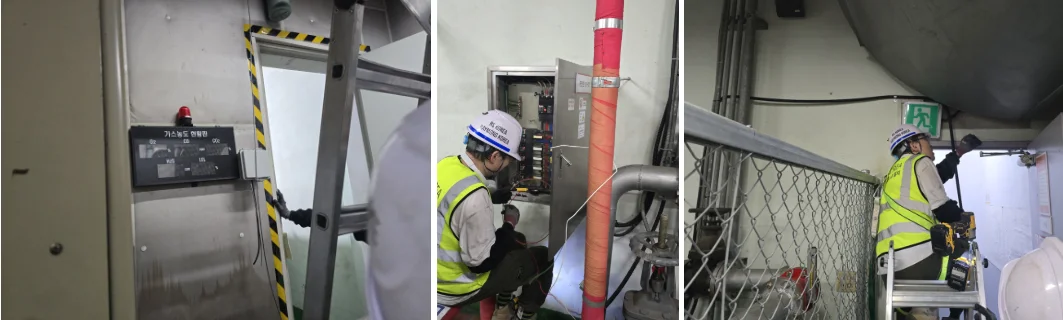
Since this was not a site we had surveyed in person beforehand, we discussed the detector installation location, display installation location, and power supply location on site. The power distribution panel was located far from the work area, which was expected to make the installation more difficult.
We set up a confined-space warning sign and installed a blower to ensure adequate oxygen supply, then measured the gas levels to confirm the environment was safe to work in. The instrument used for this was the EDW500, a portable IoT multi-gas detector.
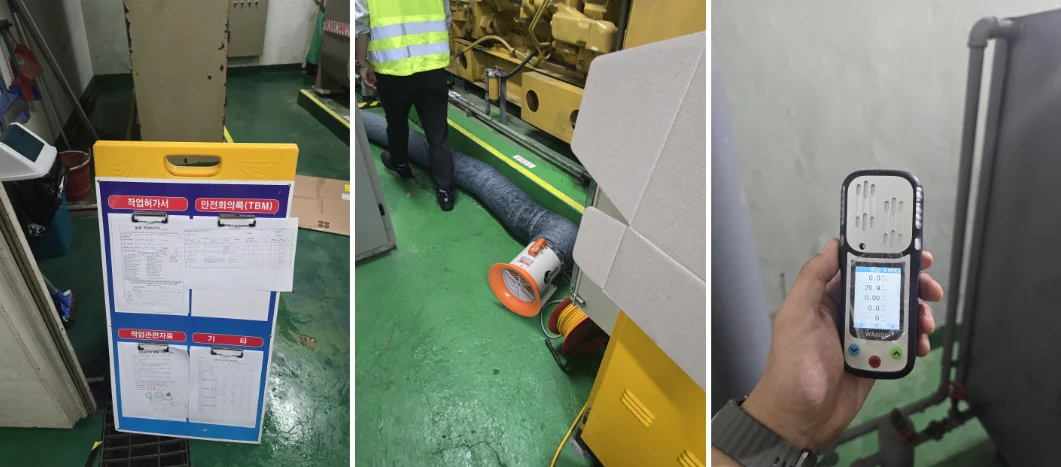
By keeping the EDW500 on site, which supports web-based monitoring over free LTE communication, data is sent to the server every minute, allowing mobile monitoring at all times. This means there is no need to re-enter the site every hour to check gas levels; readings can be monitored continuously. We set the logging interval to 30 minutes, shorter than the regulatory requirement, and generated a report. This allowed for a very safe measurement process.

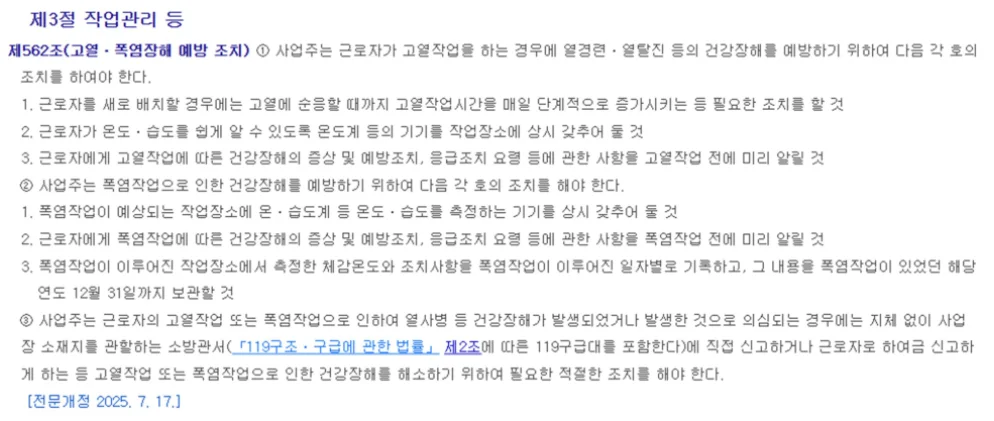
We'd also like to introduce another relevant update: following the July 17, 2025 amendment to the Occupational Safety and Health Standards, a heat index (perceived temperature) meter is now required at sites with a risk of heat-related illness.
Under the amended regulation, sites with a risk of heat-related illness must keep a heat index meter on hand at all times, record the readings, and retain those records until December 31.
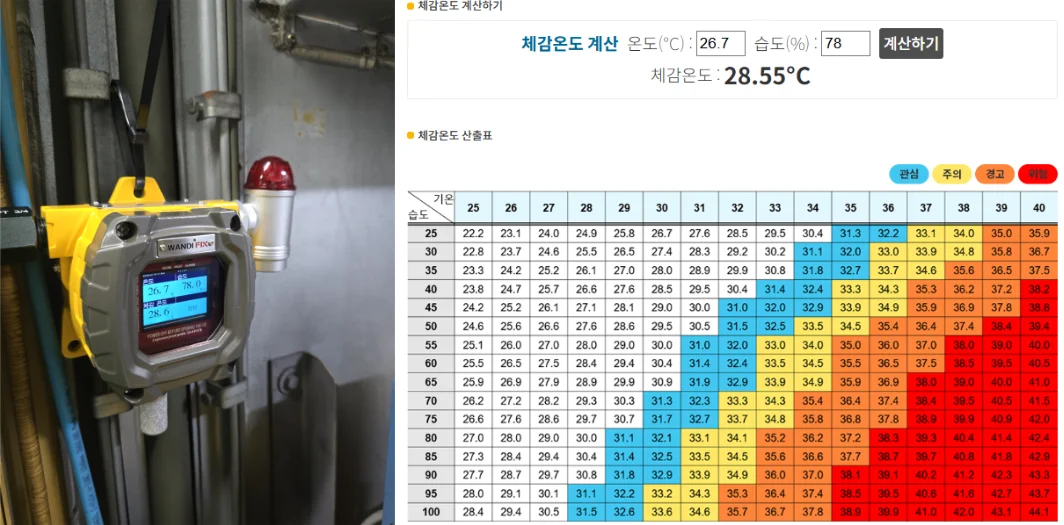
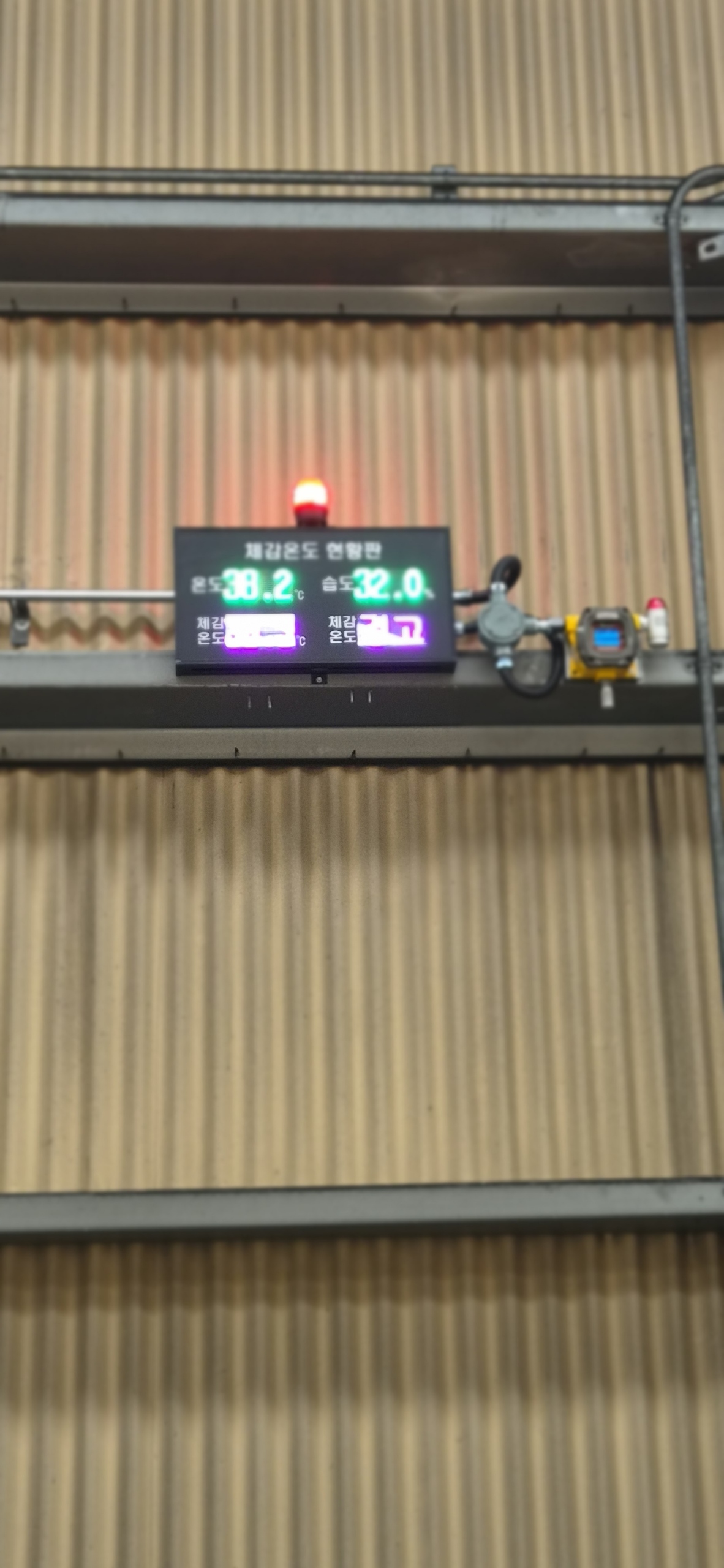
Although this underground space did not feel extremely hot, the nearby water treatment facility meant humidity levels were high, which can result in a perceived (heat index) temperature that is higher than the actual air temperature. In line with the regulation, we mounted the heat index meter at a height of roughly 1.2–1.5 meters.
As expected, the temperature reading was relatively low while humidity was high. Based on the heat index chart published by the Korea Occupational Safety and Health Agency, the meter calculates and displays the heat index along with a status message for current conditions.
At 26.7℃ and 78% RH, the displayed heat index was 28.6℃, which matched the reference chart exactly.
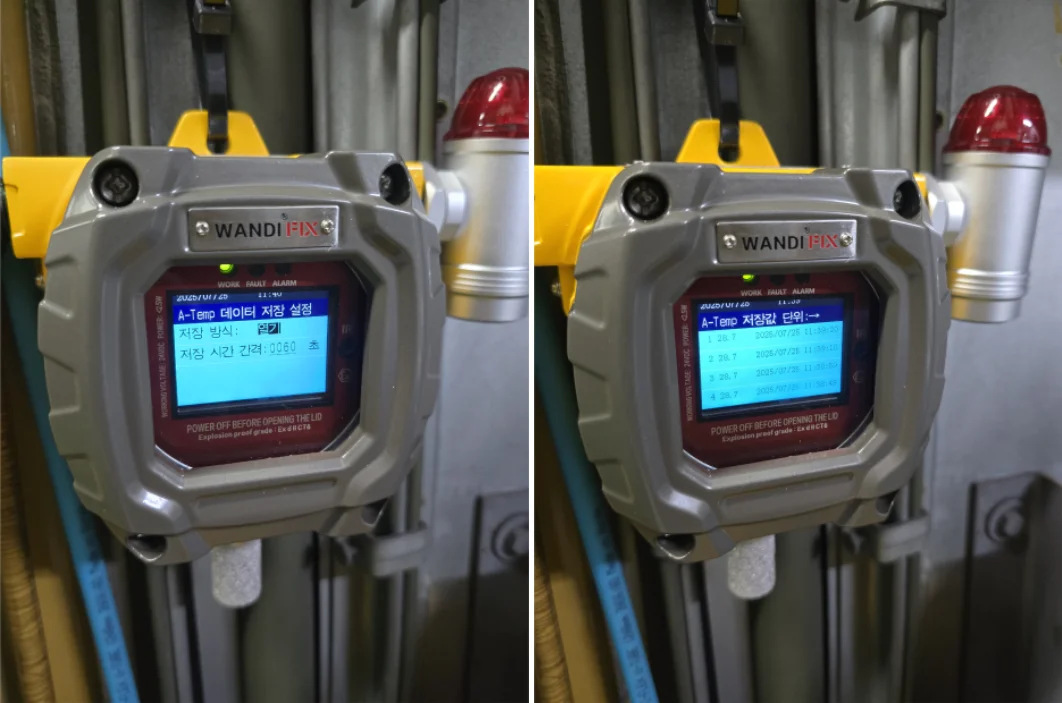
With onboard storage for 60,000 data points, the device can comfortably store 3–4 years of data at a 1-hour logging interval. The site managers were not yet aware of the updated regulation and mentioned this was the first time they had seen a contractor bring this kind of equipment to a job site.
While we brought the heat index meter primarily for safety compliance, it turned out to double nicely as an opportunity to introduce the product on site.
During Installation: Detector → Display → Wiring
After installing the detector, we ran the cabling between the detector and the display. Once 220V is supplied to the display, an internal voltage converter inside the display unit supplies the DC 24V required by the detector.
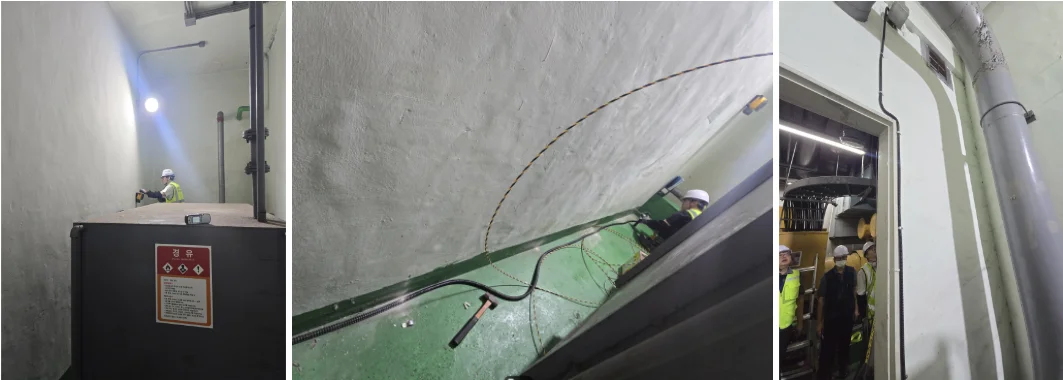
After installing the display, we installed a junction box next to it to connect the 220V power line and the DC 24V line running to the detector. As anticipated, running 220V from the distribution panel proved to be difficult given the distance involved.
After Installation: Gas Test and Commissioning
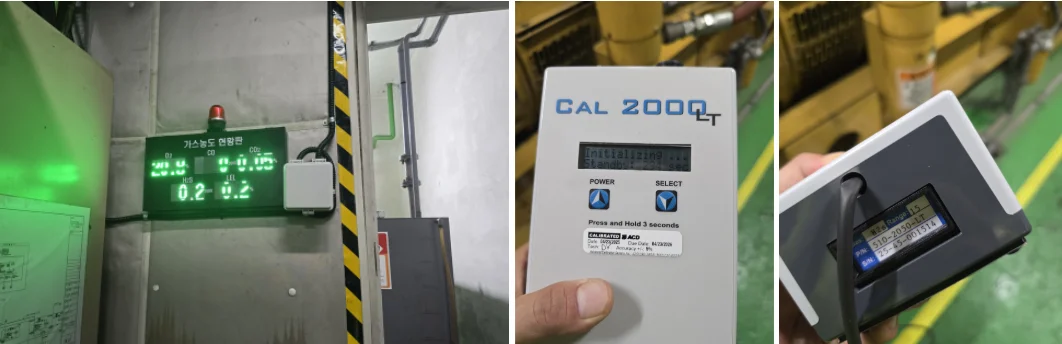
Once the power connections were complete, readings were displayed correctly on the monitoring display. This brings us to the third item we'd like to introduce today: the CAL2000 portable gas generator.
Here is a summary of how it works:
A gas source cartridge is attached to the back of the unit (available cartridges vary by model). The desired concentration and flow rate are set on the device itself (the LT version has a fixed concentration and flow rate). After a 5-minute warm-up, the unit produces a continuous, calibration-grade gas output.
Its advantages include:
It is small and lightweight. Unlike high-pressure gas cylinders, it is classified as non-hazardous, so it can even be shipped by air. The gas itself has a limited total output life, but no storage shelf life, so long-term storage is possible. It can run for extended periods on batteries, and a DC adapter is also provided so it can keep running from a standard 220V outlet on site once the batteries are depleted.
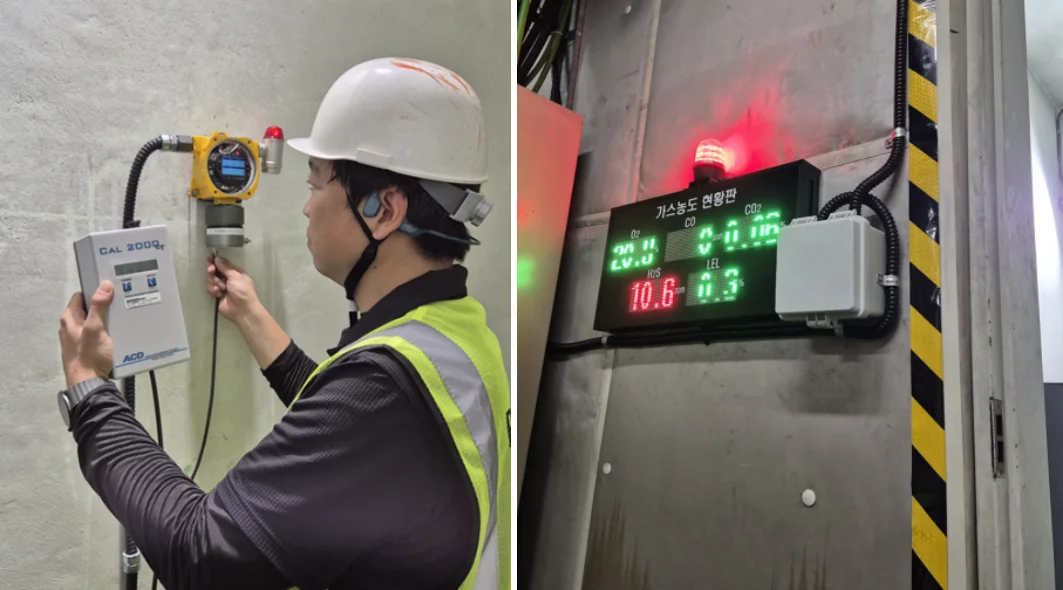
By injecting a 15 ppm test gas, we confirmed that both the detector and the monitoring display triggered an alarm correctly. This completed the first installation at the Jeonju branch office.
Since there were quite a few optional elements covered in this post, we wanted to organize a summary before wrapping up.
Summary
Site: Confined-space asphyxiation prevention (5-gas monitoring) for a diesel tank room at a Jeonju branch office
Products installed: FIX800 5-gas fixed detector for confined-space worker safety; fixed indoor monitoring display
Safety elements: Confined-space work warning sign, blower installation, safety gear, EDW500 portable IoT gas detector, heat index meter for heat-illness prevention
Installation crew: 2 installers, 1 safety manager
Installation time: Approximately 4 hours (varies depending on the power supply location)
Commissioning: H2S test run using the CAL2000 LT
Frequently Asked Questions (FAQ)
Q1. What gases does the FIX800 monitor at this site?
It monitors O2, CO, CO2, H2S, and combustible gas (EX) — the five gases required for confined-space asphyxiation prevention under the amended Occupational Safety and Health Standards.
Q2. How does the FIX800 measure five gases with only four sensor slots?
It uses a CO/H2S dual sensor, which allows all five required gases to be measured using just four physical sensor slots.
Q3. What role does the EDW500 play on site?
The EDW500 is a portable IoT multi-gas detector used for pre-work safety checks. It transmits data over LTE, and in this case was set to a 30-minute logging interval, allowing continuous remote monitoring without the need to re-enter the confined space.
Q4. Why was a heat index meter also installed at this site?
Following the July 17, 2025 amendment to the Occupational Safety and Health Standards, sites with a risk of heat-related illness are required to keep a heat index meter on hand, record readings, and retain those records until December 31.
Q5. How was the system tested after installation?
Using the CAL2000 portable gas generator, a 15 ppm test gas was injected on site, confirming that both the FIX800 detector and the monitoring display triggered an alarm correctly.
#FIX800 #GasDetector #ConfinedSpaceSafety #5GasDetector #IndustrialSafety #HeatIndexMeter #EDW500 #CAL2000 #OccupationalSafetyLaw #WANDI
![[레이먼드] 오,폐수 처리실 유해가스 모니터링](https://wandi.co.kr/storage/construction-cases/YxFUQVBZ8Unnk7pJzzfsmezr6xNe0LZvQRDmt7TL.jpg)
![[브이피이코리아] 종합병원 지하 밀폐공간 가스 측정기 설치_FIX800 & FIX-DS](https://wandi.co.kr/storage/construction-cases/gNOA28xSlEy5uU3AOxyHDRH5UfAe0TpMTgAt4Uag.jpg)

