Installed Gases
Project Details
Hello.
Today we'll explain a site where nitric oxide (NO) and nitrogen dioxide (NO2) were generated under plasma conditions.
First,
Plasma refers to a state in which gas is heated to extremely high temperatures and separates into electrons and positively charged ions.
In short, you can understand it as the progression: solid → liquid → gas → plasma.
When gas enters a plasma state, O3 (ozone), NO (nitric oxide), and NO2 (nitrogen dioxide) gases are generated.
Here's a brief overview of the site situation:
1. NO and NO2 are generated when ordinary air is converted into plasma using high voltage.
2. The gas concentration is expected to be high.
3. The unit will be used for experimental purposes and requires a data logging function.
The equipment that fit these requirements is the GasTiger6000 portable gas detector.
Let us briefly explain the product specifications.
Model: GasTiger6000
Overview: Portable multi-gas concentration detector
Product Specifications
1. High-concentration sensors
NO: 3000ppm
NO2: 1000ppm
2. Data logging capability
It can be connected to a PC via USB to extract real-time concentration data as an Excel file.
3. Built-in pump type suitable for experiments
The built-in pump draws in gas from the desired measurement point.
To ensure product reliability, we performed a performance comparison test against the analyzer already on site.
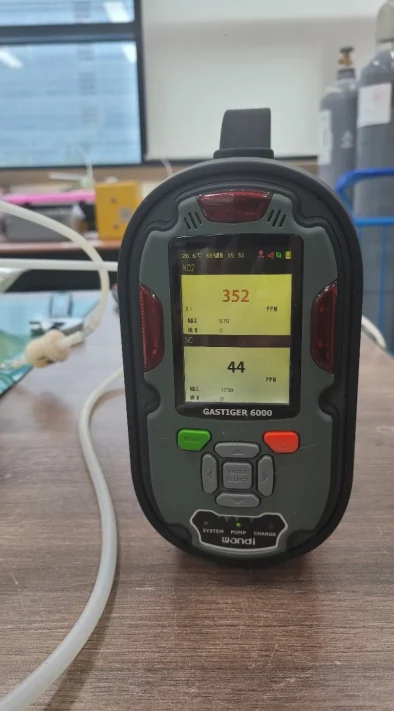
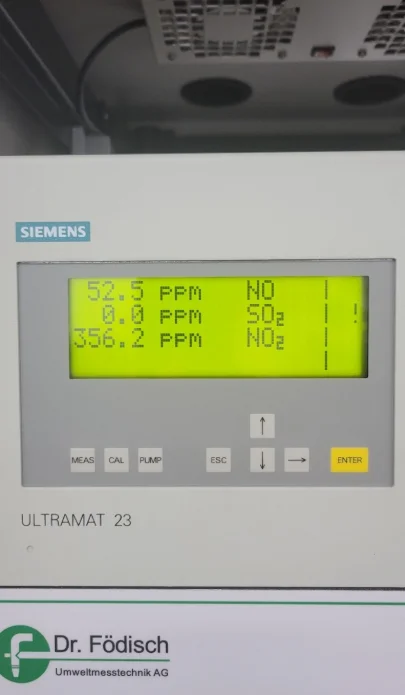
The readings fell within the margin of error compared to the analyzer. The product's reliability was confirmed, and the delivery was completed successfully.
This concludes today's post. Please feel free to contact us with any questions. Thank you.
Frequently Asked Questions (FAQ)
Q1. What is plasma?
Plasma is a state in which gas is heated to extremely high temperatures and separates into electrons and positively charged ions. It can be understood as the progression: solid → liquid → gas → plasma.
Q2. What gases are generated in a plasma state?
O3 (ozone), NO (nitric oxide), and NO2 (nitrogen dioxide) gases are generated.
Q3. What are the key specs of the GasTiger6000?
It features high-concentration sensors (NO 3000ppm, NO2 1000ppm), a data logging function that connects to a PC via USB to extract real-time concentration data as an Excel file, and a built-in pump that draws in gas from the desired measurement point.
Q4. How was the product's reliability verified?
A performance comparison test was conducted against an existing analyzer on site, and the readings were confirmed to fall within the margin of error, verifying the product's reliability.
Q5. What kind of site is this equipment suited for?
It is suited for experimental use in sites that require high-concentration gas measurement and data logging capability.
#WANDI #GasTiger6000 #PlasmaGasDetection #NODetection #NO2Detection #HighConcentrationSensor #DataLogging #PortableGasDetector #IndustrialSafetyEquipment #LabGasMeasurement
![[레이먼드] 오,폐수 처리실 유해가스 모니터링](https://wandi.co.kr/storage/construction-cases/YxFUQVBZ8Unnk7pJzzfsmezr6xNe0LZvQRDmt7TL.jpg)
![[브이피이코리아] 종합병원 지하 밀폐공간 가스 측정기 설치_FIX800 & FIX-DS](https://wandi.co.kr/storage/construction-cases/gNOA28xSlEy5uU3AOxyHDRH5UfAe0TpMTgAt4Uag.jpg)

