Applied Markets
Installed Gases
Project Details
Hello.
We occasionally receive inquiries about installing gas detectors in fire suppression agent rooms.
Let us briefly introduce gas fire suppression systems.
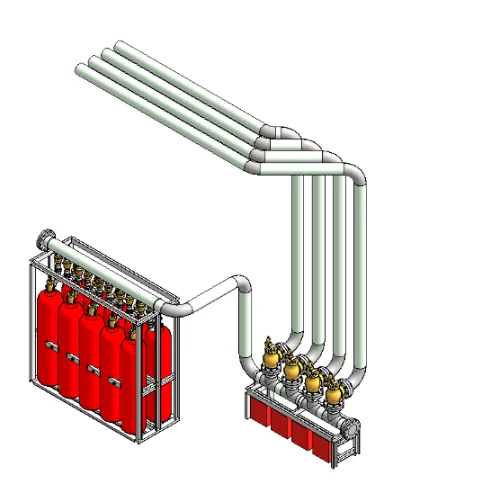
When a fire breaks out, this is a fire suppression system that uses high-purity gas to reduce oxygen — the key element of combustion — to 0%, extinguishing the fire.
These systems are typically located in factories of a certain size or in building basements.
When a fire occurs, a valve opens and high-purity gas is injected into the fire area — this is the main purpose of the system.
The gas cylinders are usually located in an enclosed space without windows. Since a valve malfunction or aging equipment could allow gas to leak into the suppression agent room and cause a worker to suffocate, oxygen concentration management is essential in these facilities.
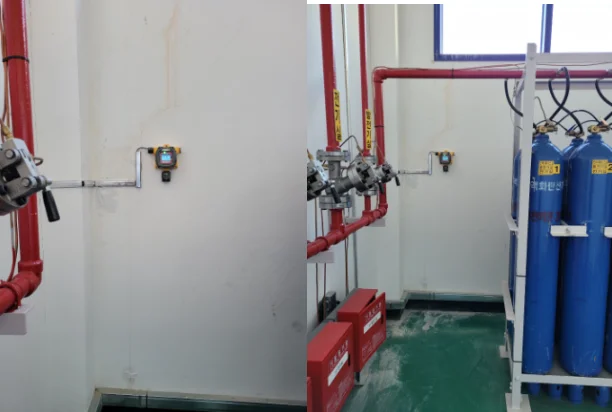
The extinguishing gas typically stored in suppression agent rooms is CO2 (carbon dioxide) or Halon.
Recently, due to environmental concerns, suppression agent rooms using refrigerant gas have also been built.
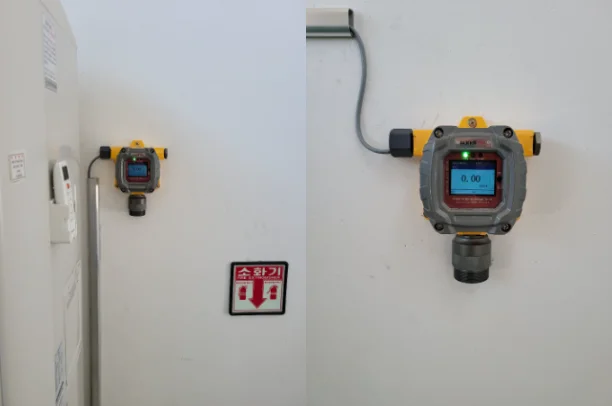
Regardless of which extinguishing gas is used, oxygen levels drop when high-purity extinguishing gas leaks, which is why 90% of suppression agent rooms have oxygen detectors installed.
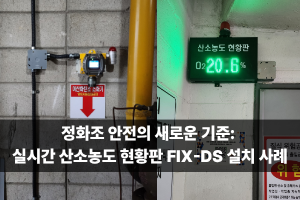
Of course, as shown in the photo, if a workplace uses only CO2 extinguishing gas, installing a CO2 detector alone is also fine.
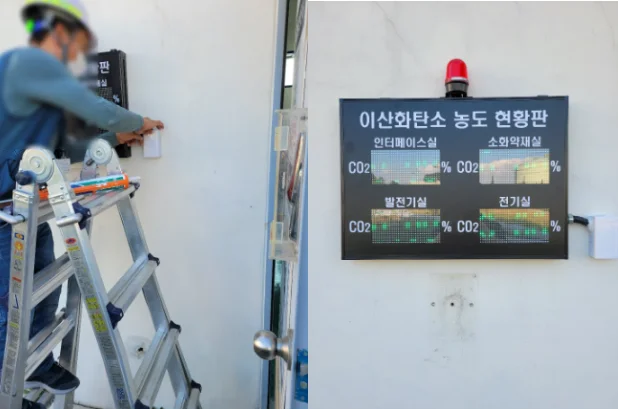
If high-purity gas has already leaked, a worker could collapse from oxygen deficiency immediately upon entering.
This is why a status display panel that shows the gas concentration in real time is installed at the entrance of the suppression gas room, enabling continuous monitoring as well.
This concludes our introduction to a gas concentration detector application case for fire suppression gas facility rooms.
Thank you.
Frequently Asked Questions (FAQ)
Q1. What is a gas fire suppression system?
It is a fire suppression system that uses high-purity gas to reduce oxygen — the key element of combustion — to near 0%. When a valve opens, high-purity gas is injected into the fire area to extinguish the fire.
Q2. Where are these systems typically installed?
They are commonly found in factories of a certain size or in enclosed, windowless spaces such as building basements, where the gas cylinders are located.
Q3. What extinguishing gases are used?
CO2 (carbon dioxide) or Halon is typically used. Recently, suppression agent rooms using refrigerant gas have also been built due to environmental concerns.
Q4. Why is oxygen concentration management necessary?
If gas leaks into the suppression agent room due to valve malfunction or aging equipment, workers could suffocate, making oxygen concentration management essential. Since oxygen levels drop when high-purity extinguishing gas leaks, 90% of suppression agent rooms have oxygen detectors installed; workplaces using only CO2 extinguishing gas can install a CO2 detector alone.
Q5. How is gas concentration monitored?
A status display panel is installed at the entrance of the suppression gas room, showing gas concentration in real time for continuous monitoring.
#WANDI #FireSuppressionSystem #CO2Detector #HalonGas #OxygenMonitoring #GasLeakDetector #IndustrialSafetyEquipment #FireSafety #GasConcentrationMonitor #SuppressionAgentRoom
![[레이먼드] 오,폐수 처리실 유해가스 모니터링](https://wandi.co.kr/storage/construction-cases/YxFUQVBZ8Unnk7pJzzfsmezr6xNe0LZvQRDmt7TL.jpg)
![[브이피이코리아] 종합병원 지하 밀폐공간 가스 측정기 설치_FIX800 & FIX-DS](https://wandi.co.kr/storage/construction-cases/gNOA28xSlEy5uU3AOxyHDRH5UfAe0TpMTgAt4Uag.jpg)

