📌 3 Key Takeaways
- In confined spaces like septic tanks and wastewater facilities, oxygen deficiency happens with no visible or detectable warning<\/strong>. Without a pre-entry check, it can turn into an accident within minutes.
- A septic tank site in Yeongdeungpo, Seoul installed a fixed FIX800 oxygen detector together with a FIX-DS real-time display board<\/strong>, giving workers a double-check system: the display board before entry, and the detector's own screen for continuous on-site monitoring.
- If a hazardous drop is detected, a warning light and alarm activate immediately<\/strong>. WANDI supports on-site design and installation consultation for fixed gas monitoring systems including the FIX800 and FIX-DS.
In confined, poorly ventilated spaces like septic tanks, having a device that lets workers "see" the oxygen level before they step in can be the difference between an accident and a safe day's work.<\/strong> In September, a fixed FIX800 oxygen detector and a FIX-DS display board were installed together at a septic tank site in Yeongdeungpo, Seoul. This article covers the risk at this site, how the two devices split the work of managing that risk, and the pre-entry procedures that should be followed for confined space work — illustrated with real installation photos.
Why Oxygen Deficiency Is Especially Dangerous in Spaces Like Septic Tanks
Septic tanks and wastewater facilities are classic confined spaces where microbial breakdown of organic matter consumes oxygen and can generate hazardous gases such as hydrogen sulfide. Normal ambient air contains roughly 20.9% oxygen, but in a poorly ventilated space like this, the level can drop far below that. The problem is that oxygen deficiency has no color and no smell — by the time a worker notices something is wrong, they are often already on the verge of losing consciousness or have already lost it. Pre-entry measurement and continuous monitoring are the only reliable safeguards.
What Was Installed at the Yeongdeungpo Site, and Why
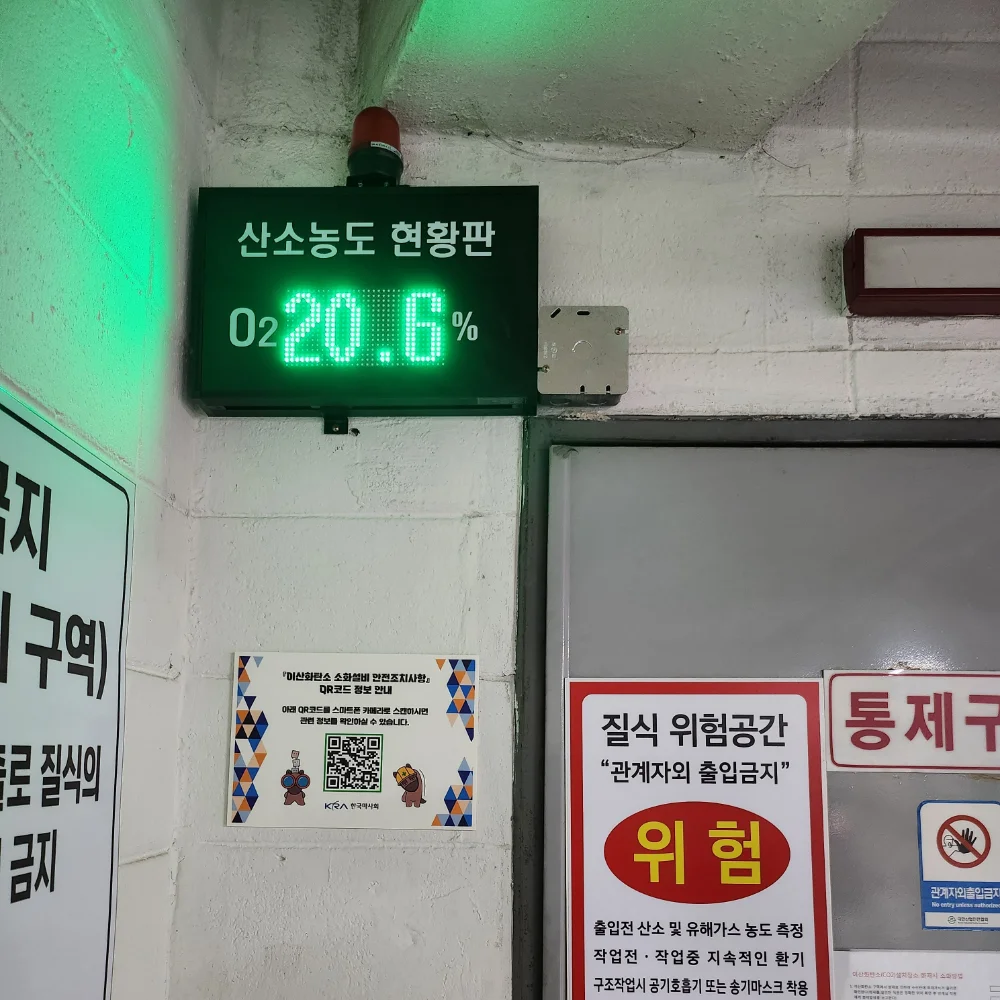
At this site, a fixed FIX800 oxygen detector<\/strong> was mounted on the wall near the septic tank, while a FIX-DS oxygen display board<\/strong> was installed separately at the entrance, where workers see it first. The reason for using both together is that "measuring" and "confirming" are two different jobs.
FIX800 — Continuous Oxygen Measurement Inside the Confined Space
The FIX800 is securely mounted on the concrete wall and continuously measures the oxygen level near the interior of the septic tank, 24 hours a day. The reading is also shown on the detector's own screen, and if the oxygen level drops to a hazardous point, the warning light and alarm at the top of the unit activate immediately to alert anyone on site.
FIX-DS — A Display Board Anyone Can Check Before Entering
The FIX-DS takes the reading measured by the FIX800 and shows it in large, bright green LED digits at the most visible spot at the site entrance. In the photos from this site, the display board clearly showed a reading of 20.6%<\/strong>. Before entering the septic tank, a worker can simply check this number to instantly judge whether it's safe to proceed — no need to walk over and check the detector itself, giving both peace of mind and a safety check at the same time.
How the Installation Was Carried Out — By On-Site Professionals
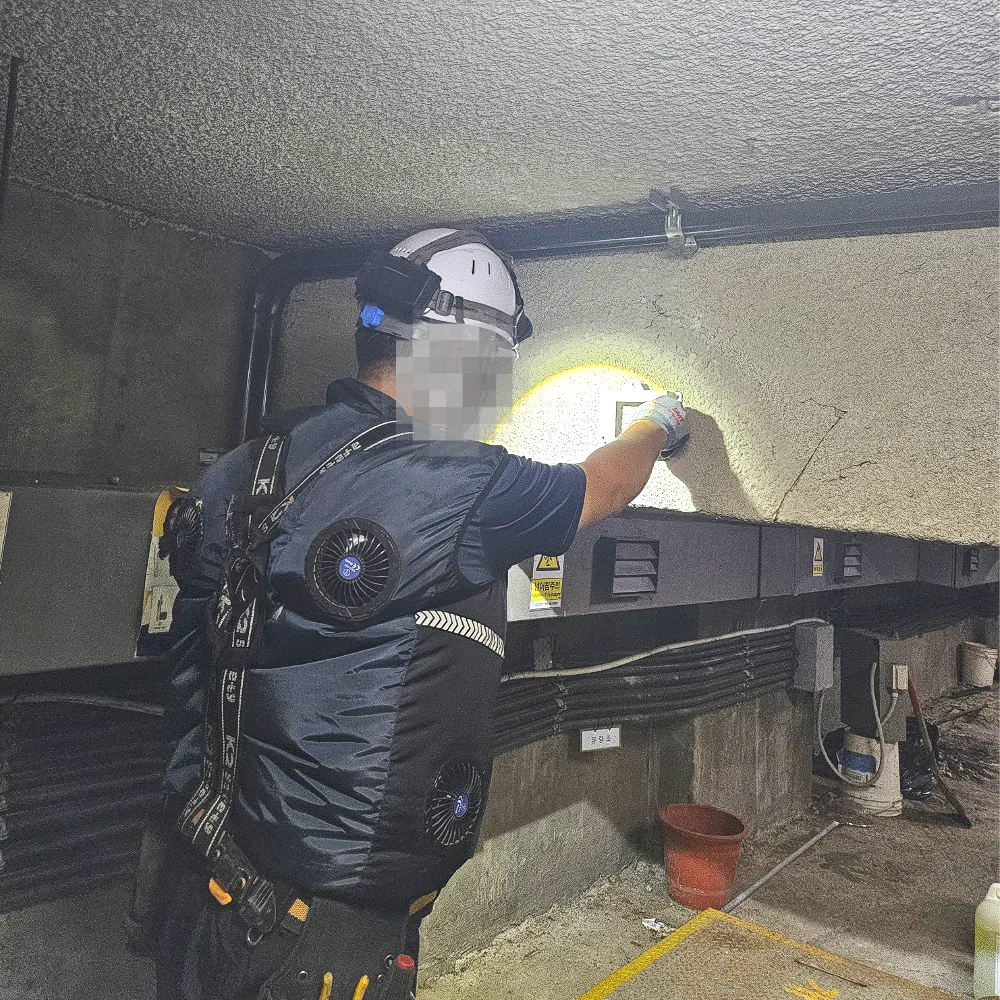
This system was installed by technicians from TS Korea, a WANDI partner, who visited the site in person. They positioned the detector and display board at the most effective locations, mounted them on the concrete wall by drilling, and completed the conduit wiring needed for stable signal transmission. Beyond simply placing the equipment, the key was choosing positions that accounted for workers' movement and line of sight.
Why the FIX800 + FIX-DS Combination Works So Well in Confined Spaces
- 24/7 continuous monitoring<\/strong> — Oxygen levels are watched without interruption, with no need for a worker to carry a separate meter at all times.
- Excellent visibility<\/strong> — The display board's large LED digits are clearly readable even in dark underground areas or from a distance.
- Instant alarm<\/strong> — A visual and audible alarm activates together the moment a hazardous level is reached, helping ensure a swift evacuation.
- Double-check structure<\/strong> — The display board (checked before entry) and the detector itself (monitoring continuously on site) confirm safety at two different points in time.
What to Check Before Entering a Confined Space
- Is there equipment in place (such as a display board) that measures and shows oxygen levels before entry?
- Has the reading been confirmed to be within a normal range (generally above 18%) before entry?
- Is the detector being regularly inspected and calibrated?
- Is there a clear evacuation procedure and contact chain in place if an alarm triggers?
- In addition to a fixed detector, is each worker also carrying a personal gas detector?
Closing
Oxygen deficiency accidents at septic tanks and wastewater facilities usually start with the assumption that "today will probably be fine." A double-check setup like the one at the Yeongdeungpo site — continuous measurement with the FIX800 and pre-entry confirmation with the FIX-DS — turns an invisible risk into a number anyone can see and manage. If you need a continuous oxygen monitoring system for a septic tank or other confined space, contact WANDI (+82-31-340-6952) for a configuration suited to your site.