📌 3 Key Takeaways
- Ozone (O₃) gas, used for disinfection at water treatment plants, kills pathogens hundreds of times faster than chlorine — but that same oxidizing power makes it a serious respiratory hazard.
- Under Korea's Ministry of Employment and Labor standards, ozone's Time-Weighted Average (TWA) is just 0.1ppm and its Short-Term Exposure Limit (STEL) is 0.3ppm — low enough that instruments need to catch it before the human nose reliably can.
- A water treatment facility in Busan installed WANDI's FIX800 ozone detector with a dedicated status display panel to continuously monitor concentration levels in its ozone generation area, turning a guessing game into a measured system.
Ozone is both the gas that makes water clean and a gas that threatens the ability to breathe. In water treatment, ozone is a powerful oxidizing disinfectant that solves odor and color problems chlorine alone can't fully resolve — but that means the area around the ozone generator and contact tank becomes one of the most hazardous zones for workers. The problem is that ozone's legal exposure limit sits at roughly 0.1ppm, low enough that by the time someone notices an odd smell, the concentration may already be well past the limit. This article looks at a real installation case at a Busan water treatment facility, where WANDI's partner VPI Korea installed a FIX800 ozone detector, to understand both the hazard and how a continuous monitoring system is built around it.
Why Ozone Gas Is Dangerous at Water Treatment Plants
Ozone (O₃) is a molecule made of three oxygen atoms. High in the atmosphere it forms the ozone layer that blocks UV radiation, but near ground level at elevated concentrations, its strong oxidizing power damages living tissue. Water treatment plants harness that same oxidizing power to eliminate pathogenic microorganisms and odor- or color-causing compounds in water.
- Respiratory and lung damage — can cause chronic and acute conditions including pulmonary edema, asthma, and reduced lung function.
- Irritation of mucous membranes and sensory organs — irritates the eyes, nose, and throat, which can reduce concentration during work.
- Weakened immunity and overall health decline — repeated exposure can lower the body's overall resistance.
- Equipment corrosion and environmental impact — the same strong oxidizing power that affects people also affects piping and equipment.
※ The information above summarizes general hazards associated with ozone gas; actual health effects vary with exposure concentration, duration, and individual health condition.
Why Water Treatment Facilities Use Ozone in the First Place
Chlorine disinfection has long been the standard process, but it doesn't fully solve every problem — certain earthy or musty odor compounds like geosmin and 2-methylisoborneol, or chlorine-resistant pathogenic protozoa, can slip through. Ozone fills that gap.
- Kills viruses and bacteria hundreds of times faster than chlorine.
- Rapidly eliminates pathogenic protozoa resistant to chlorine disinfection.
- Fully oxidizes and removes musty, earthy odor-causing compounds.
- Oxidizes color-causing substances to produce clear, clean water.
In other words, ozone raises water quality to another level — but the trade-off is a zone of high-concentration ozone around the generator room and contact tank that people should never be directly exposed to.
Site Overview — Ozone Disinfection Area at a Busan Water Treatment Facility
| Installation partner | VPI Korea (WANDI authorized partner) |
| Location | Water treatment facility in Busan — ozone generation and contact area |
| Equipment installed | FIX800 ozone (O₃) gas detector + dedicated O₃ status display panel |
| Gas monitored | Ozone (O₃), expandable to the five confined-space safety gases |
The Problem — A Powerful Disinfectant That Doubles as a Respiratory Hazard
This water treatment facility was getting excellent water-quality results from its ozone disinfection process, but workers still had to inspect and maintain equipment around the ozone generator room and contact tank. Ozone has a somewhat pungent smell that gives some indication of its presence, but because the legal exposure limit (TWA 0.1ppm) sits at a concentration the human nose can't reliably distinguish, continuing or stopping work based only on "it smells a bit off" carried real risk. Without continuous measurement, there was no way to know whether the concentration at any given moment was within limits or already over them.
The Solution — Turning Exposure Limits Into a Number With the FIX800 Ozone Detector
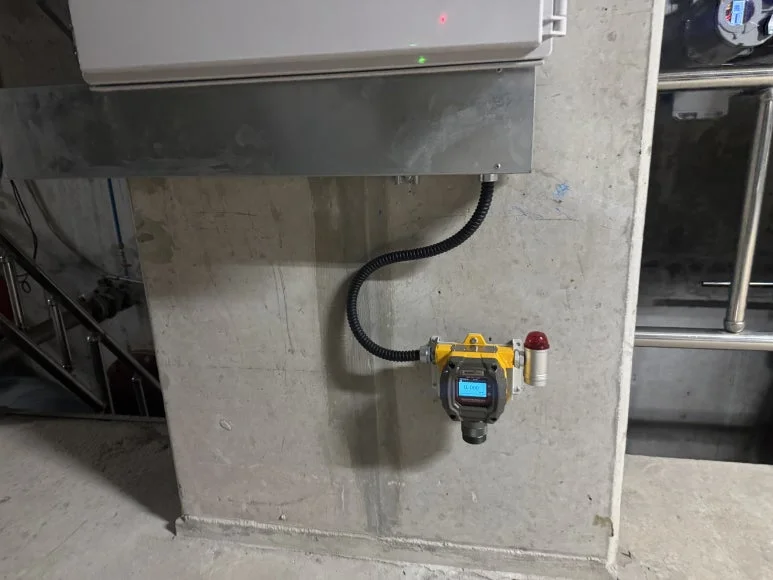
VPI Korea configured and installed a WANDI FIX800 with a dedicated ozone sensor at this site. The core idea was to replace "guessing by smell" with "confirming by number."
- Wide measurement range — sensors span from a low-concentration range of 0–5ppm up to a high-concentration range of 20,000ppm, covering everything from routine monitoring to an abnormal high-concentration event with a single unit.
- Expandable to 5 confined-space gases — beyond ozone, the unit can be expanded to also measure oxygen, carbon monoxide, hydrogen sulfide, and other confined-space safety gases.
- Simple remote-control operation — setpoints can be checked and adjusted on site without additional wiring work.
- Linked to a dedicated O₃ status display — a display panel at the entrance lets both managers and workers see the real-time ozone reading at a glance.
- Optional remote monitoring — concentration readings can also be checked via PC or smartphone, so a manager doesn't need to be physically on site to know the current status.
The Result — A Safety System That Also Covers Ozone Leak Response
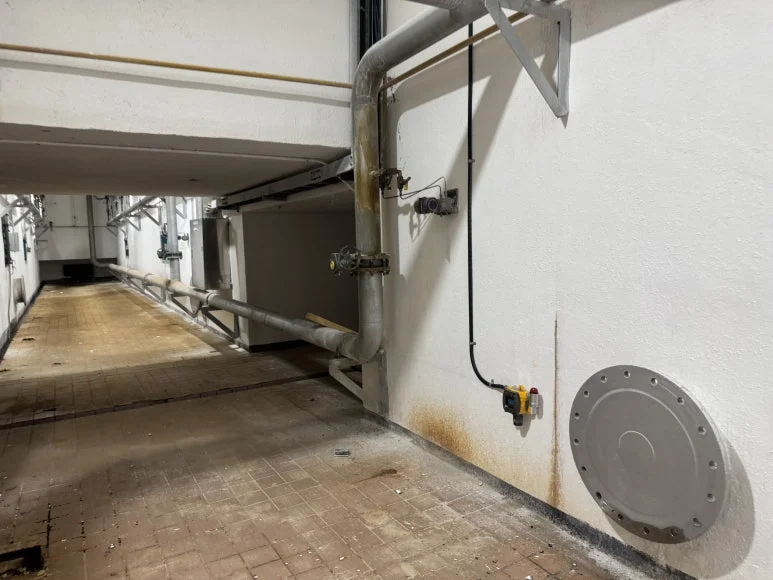
After installation, the facility could continuously verify ozone levels in the generation area against Ministry of Employment and Labor standards (TWA 0.1ppm, STEL 0.3ppm). Under normal conditions, staff can visually confirm operation stays within range, and if an abnormal reading occurs, the display panel and alarm let workers recognize it immediately and evacuate or ventilate proactively. VPI Korea also continues to support secondary inspection with reference equipment, KOLAS calibration, and annual scheduled maintenance after installation, so measurement reliability holds up over the long term.
How to Respond to an Ozone Gas Leak
Even with a continuous monitoring system in place, workers need to know the sequence of actions to take during an actual leak.
- Stop work and evacuate immediately — if the detector alarm sounds or a strong pungent smell is noticed, stop work right away and leave the area.
- Move upward or toward the windward direction — ozone is denser than air and tends to settle in low areas, so avoid low ground and move to higher ground or toward the direction the wind is blowing from.
- Activate emergency ventilation — run ventilation fans to quickly exhaust the leaked ozone to the outside.
- Cut power — immediately shut off power to the ozone-generating equipment to prevent further release.
- Re-verify concentration before re-entry — after taking these steps, use the detector to confirm the on-site ozone concentration has returned below the legal limit (0.1ppm) before anyone goes back in.
Managing Ozone at Water Treatment Facilities Starts With Knowing the Legal Limits
Korea's Ministry of Employment and Labor sets the workplace ozone exposure limit at a Time-Weighted Average (TWA) of 0.1ppm and a Short-Term Exposure Limit (STEL) of 0.3ppm — both far lower than the default alarm setpoints on many general-purpose gas detectors. Rather than relying on manufacturer defaults, facilities should review and reset alarm setpoints based on how ozone is actually generated and how workers are exposed on site. Korea's Occupational Safety and Health Standards likewise require continuous monitoring and ventilation systems for workplaces where hazardous gas may be present, making a properly configured monitoring system essential for any water or wastewater treatment facility using ozone — both for compliance and for worker safety.
Closing
Ozone is a valuable gas that raises water quality, but it's also a hazardous gas that threatens the respiratory system even at very low concentrations. Shifting from "guessing by smell" to "confirming by number" is the core of what this Busan water treatment case demonstrates. With a FIX800 ozone detector and dedicated status display continuously monitoring the generation area, and alarm stages set against the legal exposure limits, a facility can meet both safety and regulatory requirements at once. For inquiries about ozone gas detectors for water and wastewater treatment facilities, contact WANDI (+82-31-340-6952) — we'll help configure the right setup for your site conditions.