📌 3 Key Takeaways
- Korea's Occupational Safety and Health Standards define heat-wave work by a heat index of 31°C or higher, not by air temperature alone.
- Employers must keep temperature/humidity measuring equipment on site at all times where heat-wave work is expected, and record the heat index and any measures taken, by date (Article 562).
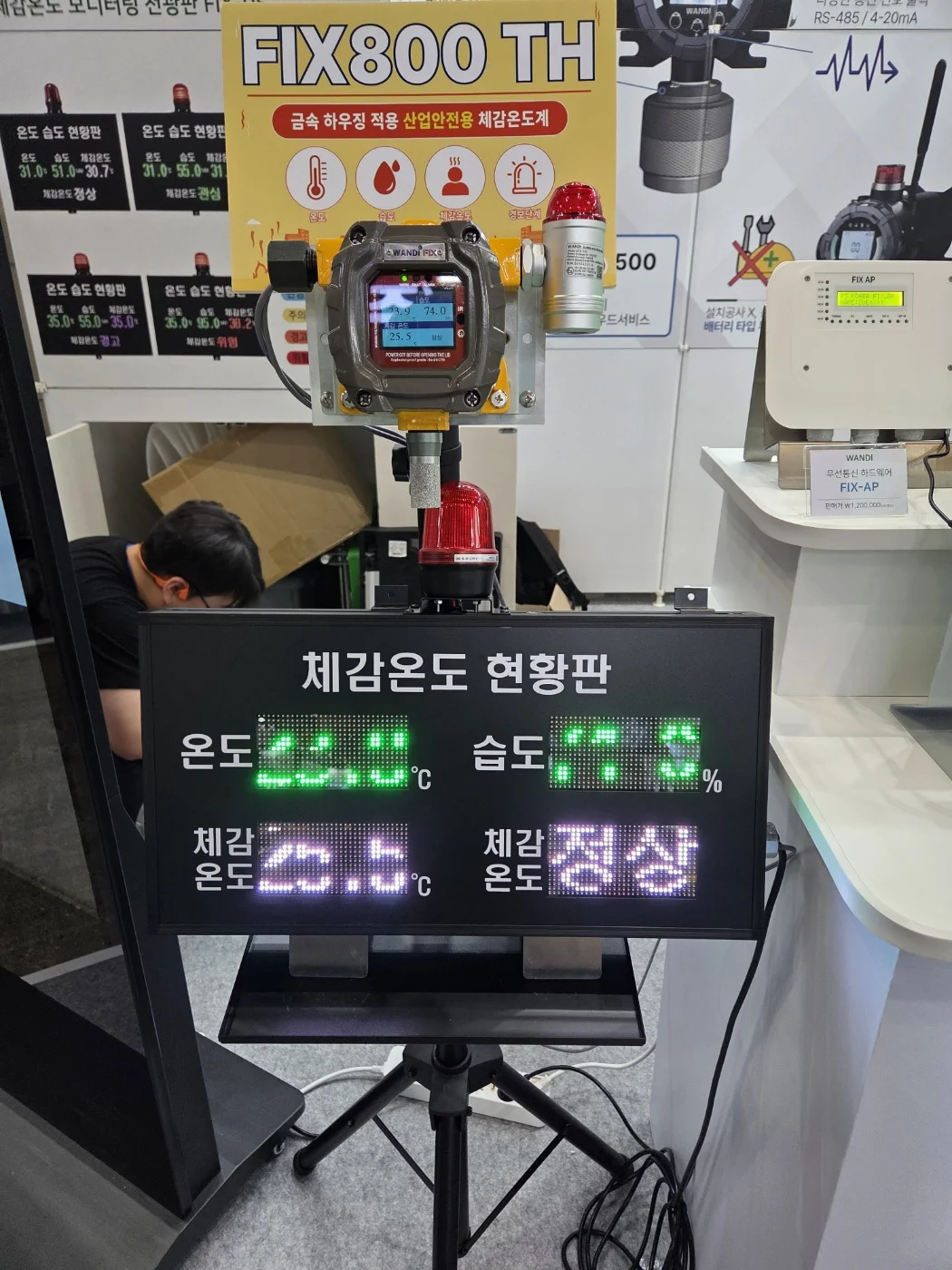
- A steel plant in Gwangyang, Jeollanam-do installed a WANDI FIX800TH heat-index meter together with a large LED display board, so any worker can check current conditions from a distance.
At summer manufacturing and steel sites, heat from equipment and processes adds to the outdoor temperature, so the heat workers actually feel can be far greater than the number on a wall-mounted thermometer. Steel processes in particular involve a lot of high-temperature equipment, making heat-illness management more critical than at a typical manufacturing site. Korea's Occupational Safety and Health Standards, however, determine whether work counts as "heat-wave work" based not on air temperature but on heat index. This article walks through the legal requirements and how to apply them on site, using a case study of a WANDI FIX800TH heat-index meter and large display board installed at a steel plant in Gwangyang, Jeollanam-do.
A More Important Question Than "What's Today's Temperature" — What's the Temperature Where the Worker Is Actually Standing?
It's common for site managers to check only a thermometer mounted on a wall. But the heat a worker actually experiences isn't determined by air temperature alone. Humidity, radiant heat, and heat given off by equipment all combine, so the same air temperature can feel very different depending on conditions. That's why Korea's Occupational Safety and Health Standards use heat index, not air temperature, to judge whether heat-wave work is occurring. Current regulations define work performed for an extended period at a location where the heat index reaches 31°C or higher due to a heat wave as "heat-wave work." In other words, the question that matters on site isn't "what's today's temperature," but "what is the heat index at the exact spot where the worker is performing the task?"
Three Legal Obligations for Employers — Measure, Record, Retain
Article 562 of the Occupational Safety and Health Standards requires employers to take the following three measures to prevent health hazards from heat-wave work.
- 1Keep equipment on hand: Locations where heat-wave work is expected must always be equipped with devices such as a thermo-hygrometer.
- 2Record by date: When heat-wave work takes place, the measured heat index and any measures taken must be recorded for each day.
- 3Retain the records: These records must be kept until December 31 of the year in which the heat-wave work occurred.
The Ministry of Employment and Labor also distributes a separate heat-index measurement log and calculation table for workplaces to use. It's possible to calculate heat index manually from a simple thermo-hygrometer, but using a fixed installation that displays temperature, humidity, and heat index on site makes record-keeping considerably easier.
Installation Location Also Has a Standard — 1.2–1.5 m Above the Floor
Appendix 13-2 of the Occupational Safety and Health Standards specifies that heat index should be measured at a height of about 1.2–1.5 m from the floor where employees are working. Where on-site measurement is difficult, such as for outdoor mobile work, the heat index published by the Korea Meteorological Administration can be used instead. So the installation point for a heat-index meter shouldn't be chosen for wiring convenience — it should reflect where workers are actually exposed to heat and how they move through the site.
This Steel Plant Site Was Configured with a FIX800TH Plus a Large Display Board
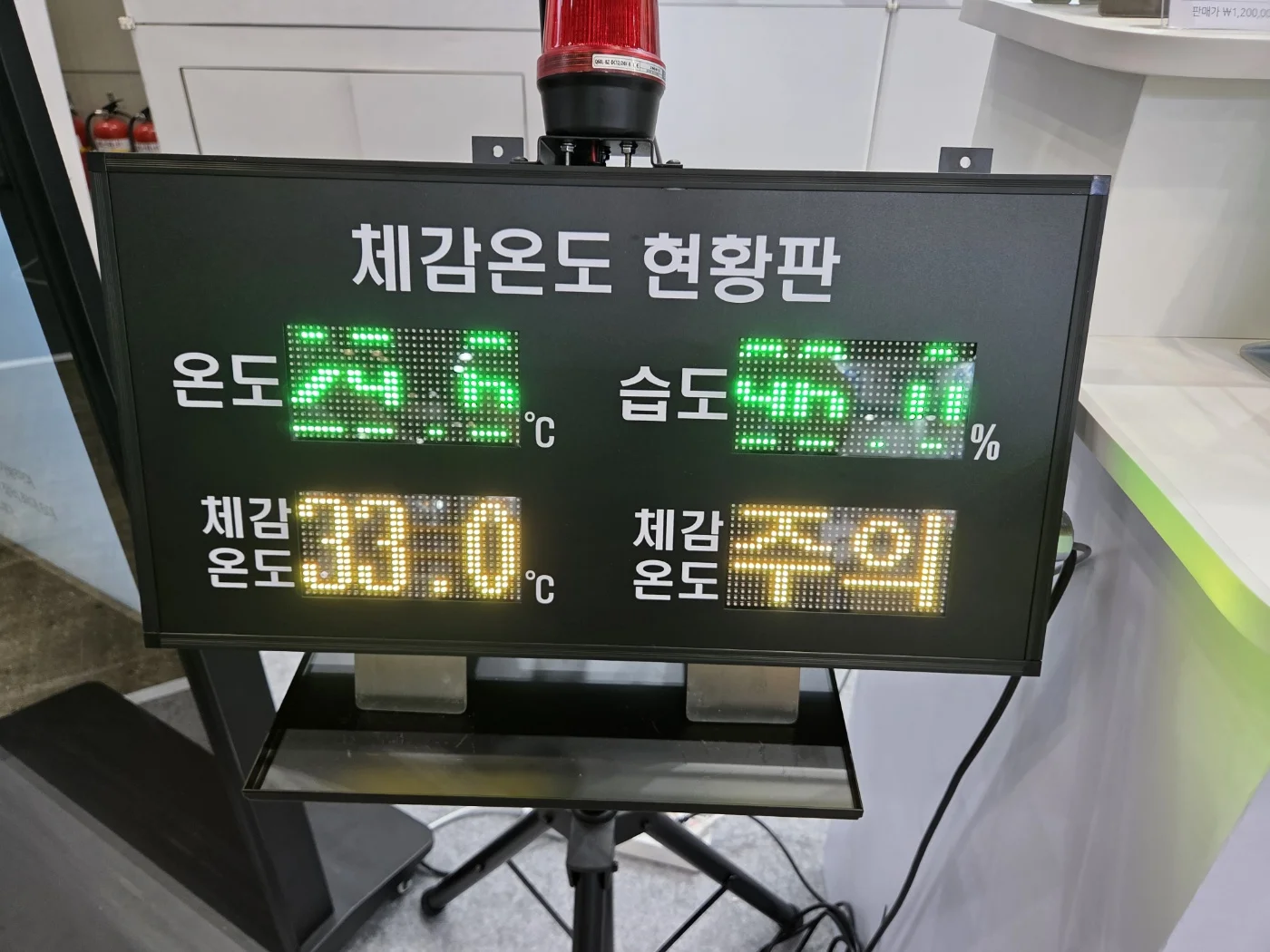
At this site, a WANDI FIX800TH heat-index meter was installed together with a large heat-index display board. The manufacturer positions the FIX800TH as a fixed-installation device for measuring and recording heat index at heat-wave work sites. The meter's own screen shows the readings, but in a large steel plant not every worker passes directly in front of it. That's why a large LED display board was added, breaking the readings into temperature, humidity, heat index, and heat-index status in large text, so workers can check the current conditions at a glance from a distance.
What's the Difference Between a Meter Alone and a Meter Plus a Display Board?
| Category | Meter only | Meter + large display board |
|---|---|---|
| How to check | Workers must walk directly up to the meter | Readable instantly from a distance via LED numbers |
| Coverage of large sites | Limited information sharing when workers range widely | Status shared across the whole plant, warehouse, or line |
| Manager response | Requires checking individually before deciding | Current status shared instantly, speeding up decisions on rest breaks, cooling, etc. |
※ A heat-index display board itself is not a legally mandated facility. However, it's worth considering as a practical addition at factories, warehouses, and production lines where workers move across a wide area.
Checklist to Review Before Installing a Heat-Index Meter
- Are you measuring at the actual location where employees are working?
- Are you continuously checking temperature, humidity, and heat index?
- Are you continuously checking whether the heat index reaches 31°C or higher?
- Are you recording the heat index and any measures taken, by date, during heat-wave work?
- Are you implementing measures such as cooling, ventilation, adjusted work hours, or rest breaks when needed?
- Have you confirmed the statutory rest requirements for heat index of 33°C or higher?
- Are you regularly maintaining the meter's condition and accuracy (e.g., KOLAS-accredited calibration)?
Installing a heat-index meter doesn't complete heat-wave management on its own. What matters is building a management cycle that runs from measurement → monitoring → sharing → action → recording, not just installing a single device.
Closing
At large industrial sites such as steel plants, metal processing facilities, and logistics centers, a single wall-mounted thermo-hygrometer makes it difficult for every worker to share awareness of current conditions. Combining a heat-index meter with a large display board lets a site meet the legal heat-wave work threshold while giving workers an intuitive, direct read on their own working environment. For help selecting a heat-index meter configuration or reviewing installation locations for your site, contact WANDI at +82-31-340-6952.