EDW500 + DCMS: Stronger Together
Simply carrying a portable gas detector on-site is not enough. Data must be logged, history recorded, and alarms delivered to safety managers without fail—only then can we truly call it "safety management." WANDI's EDW500 portable gas detector and DCMS (Data Cloud Monitoring System) are designed to close exactly this gap. When a worker-worn portable device and cloud software work in close integration, simple "handheld measurement" becomes an intelligent safety management system.
💡 Key Point
The EDW500 + DCMS combination integrates the entire gas safety lifecycle—from worker-carried detection to wireless real-time transmission, cloud analysis, and remote manager alerts—into a single unified system.
What Is the EDW500?
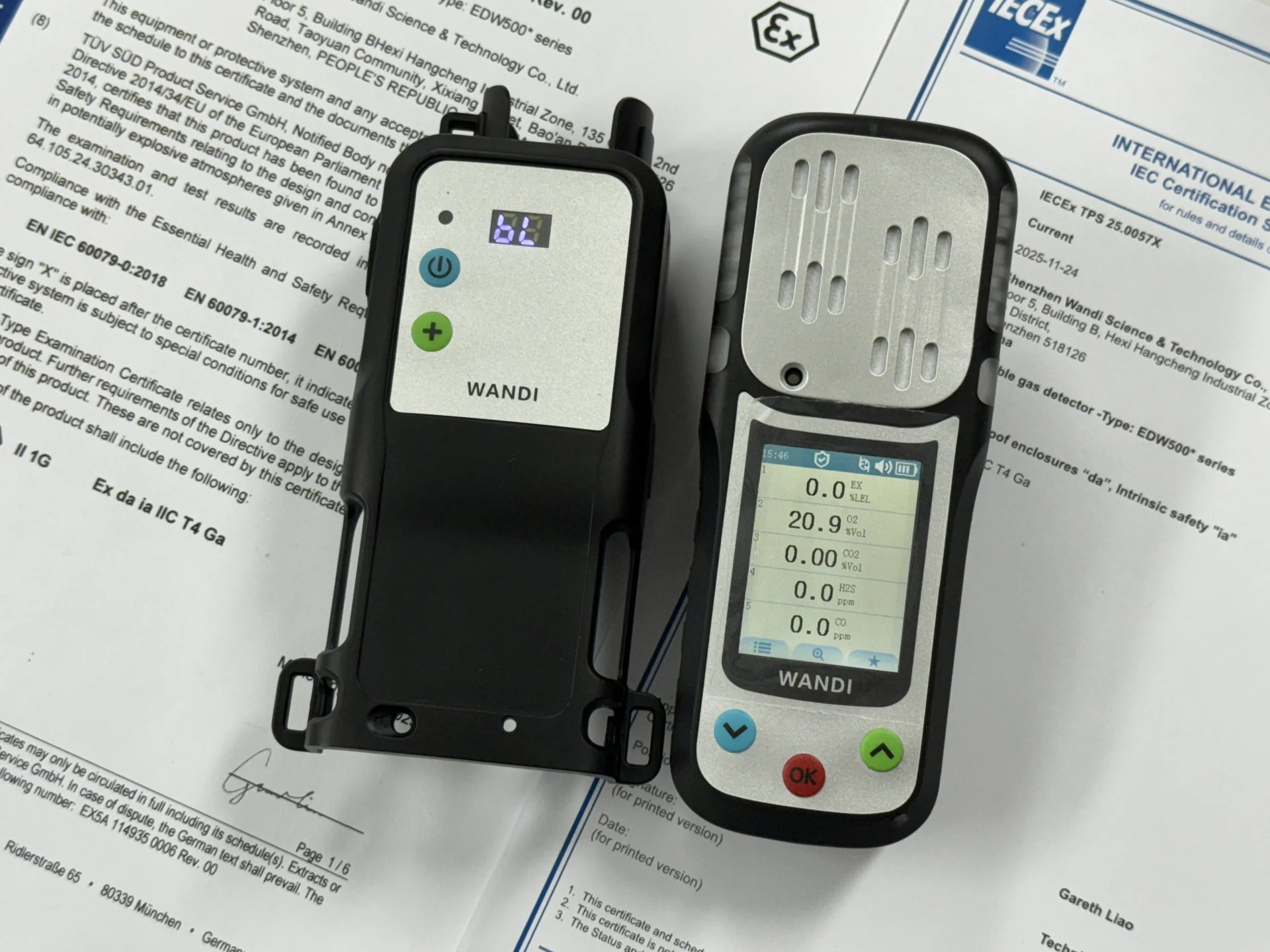
The EDW500 is WANDI's portable (handheld/wearable) multi-gas detector. Workers carry or clip it on while moving through the site, detecting surrounding gas concentrations in real time. It supports EC (electrochemical), catalytic bead, PID, and IR sensors in a modular design, and holds IECEx TPS 25.0057X explosion-proof certification for safe use in Zone 1 hazardous areas. Its built-in wireless communication transmits measurement data to the DCMS cloud in real time.

What Is DCMS?
DCMS (Data Cloud Monitoring System) is WANDI's cloud-based gas monitoring platform. Real-time gas concentration data collected by workers carrying the EDW500 is transmitted to cloud servers, where safety managers can monitor each worker's gas exposure status at a glance via PC or smartphone dashboard. Push notifications and SMS alerts are sent immediately upon alarm, and measurement history is automatically stored for compliance reporting.
7 Reasons to Use EDW500 + DCMS Together
| Feature | EDW500 Alone | EDW500 + DCMS |
|---|---|---|
| Alarm Delivery | Worker buzzer/vibration only | Worker + manager smartphone push/SMS simultaneously |
| Data History | Limited device memory | Unlimited cloud storage |
| Worker Status | Requires physical check | Real-time monitoring of all workers' gas exposure |
| Multi-worker Management | Check each device individually | All workers on one integrated dashboard |
| Reporting | Manual records | Automated reports from measurement history |
| Device Management | Physical device inspection | Remote battery and sensor life monitoring |
| Compliance | Manual record keeping | Cloud history for regulatory compliance |
Operational Improvements in Practice
- 1Zero Missed Alarms: Alarms reach not just the worker but also the manager's smartphone instantly, eliminating response gaps.
- 2Manage Multiple Workers Simultaneously: Managers can monitor gas concentrations for all mobile workers across the site through a single DCMS platform.
- 3Route-based Data Accumulation: Gas concentration data is logged by zone as workers move, enabling data-driven identification of high-risk areas.
- 4Audit-ready Records: Auto-saved cloud history serves as verifiable evidence for occupational safety compliance.
- 5Maintenance Efficiency: DCMS remotely tracks battery levels and sensor replacement cycles, reducing unnecessary device retrieval and inspection.

Ideal Use Cases
The EDW500 + DCMS combination is best suited for environments where workers move across large sites, confined space or elevated work requiring close hazard management, and sites where a manager must remotely monitor multiple workers simultaneously. It has been validated across oil refineries, semiconductor/display cleanrooms, cold storage warehouses, wastewater treatment plants, and tunnel/underground construction sites.
Real-time detection while moving
Manager access anywhere
Safe in hazardous areas
Pre-Deployment Checklist
- Identify target gas types and explosion/toxicity hazard classification
- Confirm hazardous area zone (Zone 0/1/2) and explosion-proof requirements
- Determine number of concurrent users and shift rotation patterns
- Verify internet connectivity for DCMS cloud communication
- Configure alarm recipients (managers, safety officers) and notification methods (app/SMS/email)