📌 3 Key Takeaways
- Gas detectors broadly use three sensor technologies — electrochemical, catalytic bead (pellistor), and infrared (NDIR) — and each is suited to different gases and environments.
- A catalytic bead sensor measures gas by burning it, so it carries a risk of malfunction in oxygen-deficient confined spaces and should be paired with an oxygen sensor or an infrared sensor.
- A multi-gas detector such as the GasTiger G1000, which combines several sensor types in one unit, lets you monitor oxygen, toxic gases, and combustible gases simultaneously with a single device.
When choosing a gas detector, many site managers first check "how many gases can it measure." But there's a more fundamental question to ask first: what sensor technology is actually measuring that gas? Even products sharing the label "multi-gas detector" can differ enormously in measuring principle, response speed, risk of malfunction, and replacement cycle, depending on the sensor type inside. This article compares the principles and trade-offs of the electrochemical, catalytic bead, and infrared sensors most widely used in industrial sites, and uses the GasTiger G1000 multi-gas detector supplied by WANDI as a real-world example of how to configure sensors for your site.

Sensor Technology Determines Which Gases Can Be Measured
A gas sensor is the component that reacts with a specific gas in the air and converts that reaction into an electrical signal. Different reaction mechanisms detect different gases, cover different concentration ranges, and require different environmental conditions to work reliably. Three sensor technologies are most widely used in industrial settings.
① Electrochemical Sensors — The Standard for Oxygen and Toxic Gas Measurement
An electrochemical sensor uses electrodes and an electrolyte, and calculates gas concentration from the magnitude of the electrical current generated when the target gas undergoes an oxidation-reduction reaction at the electrode surface. Most of the toxic gases routinely monitored at industrial sites — oxygen (O₂), carbon monoxide (CO), hydrogen sulfide (H2S), ammonia (NH3), and nitrogen dioxide (NO2) — are measured this way.
- 1Advantages: High selectivity for a specific gas, with relatively accurate measurement down to low ppm-level concentrations.
- 2Drawbacks: Because the electrolyte is a consumable, these sensors have a limited service life and need periodic replacement and calibration.
- 3Typical applications: Continuous oxygen monitoring in confined spaces, hydrogen sulfide detection at wastewater treatment plants, toxic gas management in semiconductor and chemical processes.
② Catalytic Bead (Pellistor) Sensors — The Standard for Combustible Gas LEL% Measurement
A catalytic bead sensor heats a catalyst-coated bead wound around a platinum wire coil, then converts the heat change produced when surrounding combustible gas burns (oxidizes) on that surface into a change in electrical resistance, displaying the result as a percentage of the lower explosive limit (LEL%). This is the most widely used method for detecting combustible and explosive gases such as methane (CH4), propane, and hydrogen (H2).
※ Important caution: because catalytic bead sensors measure gas by actually burning it, they may fail to respond properly, or respond with reduced sensitivity, if there isn't enough oxygen nearby. In confined spaces where oxygen deficiency is a concern, an oxygen (electrochemical) sensor must be configured alongside it to separately verify the oxygen level.
③ Infrared (NDIR) Sensors — Why They Stay Reliable Even When Oxygen Is Low
An infrared sensor doesn't burn the gas; instead it calculates concentration from how much infrared light at a specific wavelength is absorbed as it passes through the gas molecules. This method is mainly used for gases that absorb infrared light well, such as carbon dioxide (CO2), or for combustible-gas monitoring in low-oxygen, high-concentration environments where catalytic bead sensors struggle.
- 1Advantages: Because the gas is never burned, the sensor works stably even in oxygen-deficient environments, and it's less vulnerable to catalyst poisoning (damage from silicones, sulfur compounds, etc.), giving it a longer service life.
- 2Drawbacks: The sensor's more complex structure means a relatively higher upfront cost, and it isn't usable for every gas — gases that don't absorb infrared light can't be measured this way.
- 3Typical applications: CO2 monitoring in cold storage warehouses and parking garages, and combustible gas monitoring in low-oxygen environments such as nitrogen-purged equipment.
Comparing Sensor Technologies at a Glance
| Category | Electrochemical | Catalytic Bead | Infrared (NDIR) |
|---|---|---|---|
| Main gases measured | Toxic gases: O₂, CO, H2S, NH3, etc. | Combustible gases (LEL%): CH4, propane, H2, etc. | CO2, combustible gases in low-oxygen settings |
| Suitability for low-oxygen settings | Varies by sensor (an oxygen sensor's purpose is to measure oxygen itself) | Unsuitable — combustion reaction requires oxygen | Suitable — measures without combustion |
| Typical service life tendency | Relatively shorter (consumable electrolyte) | Moderate (vulnerable to catalyst poisoning) | Relatively longer |
| Typical sites | Confined spaces, wastewater plants, semiconductor processes | Gas piping, boiler rooms, paint shops | Cold storage, parking garages, nitrogen-purge equipment |
※ The table above summarizes general characteristics of each sensor technology. Exact service life and accuracy vary by manufacturer specification and operating conditions (temperature, humidity, frequency and concentration of gas exposure). Contact WANDI to review your specific site conditions before formal adoption.
Why Combine Several Sensor Types in One Multi-Gas Detector — The GasTiger G1000 Example
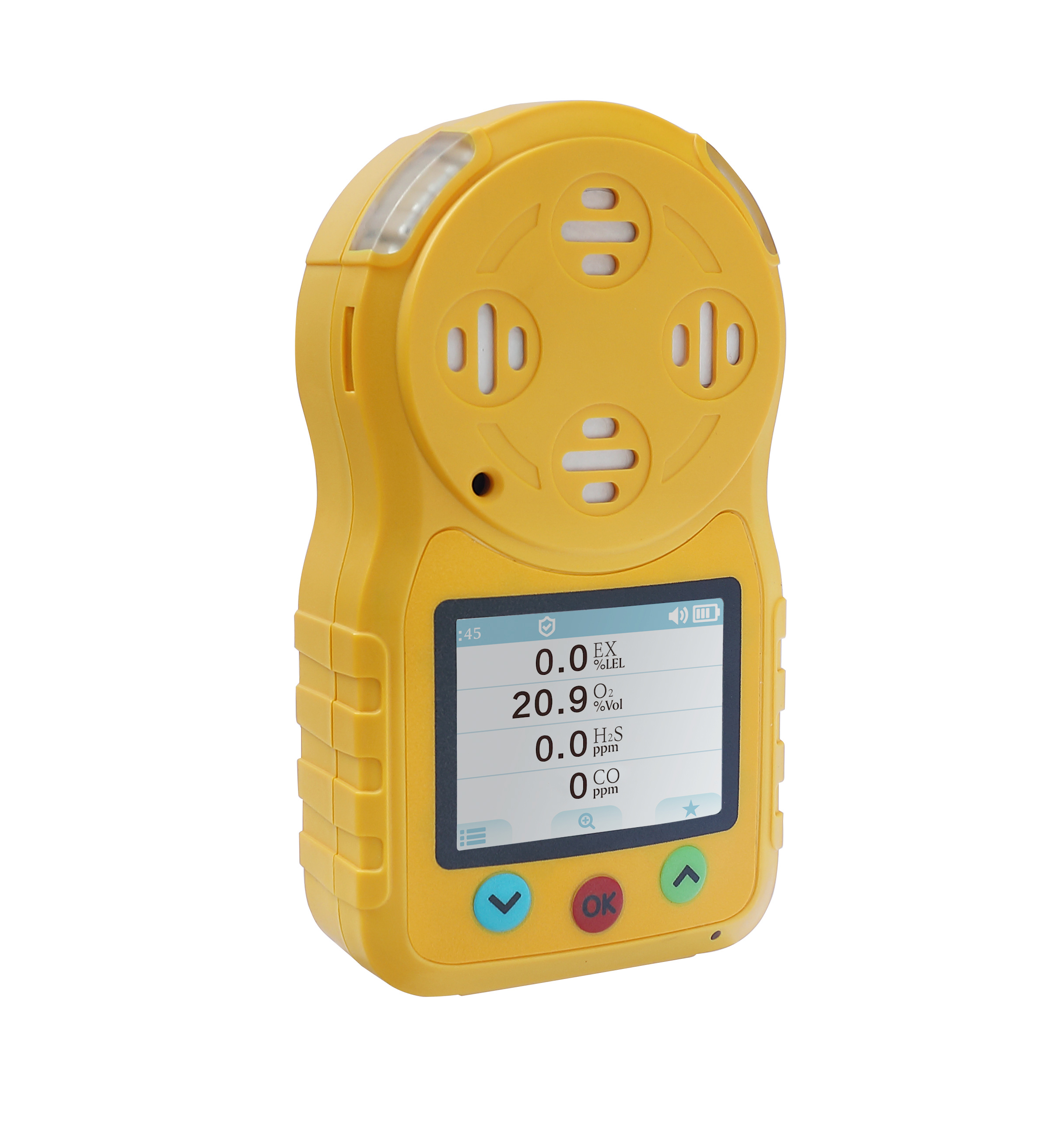
Real sites can face three hazards at once — oxygen deficiency, toxic gas leaks, and combustible gas explosions. That's why a single sensor type usually isn't enough at confined spaces, wastewater treatment plants, and construction sites. The GasTiger G1000 portable multi-gas detector supplied by WANDI is designed with both electrochemical sensors (for oxygen and toxic gases) and a catalytic bead sensor (for combustible gas) built in, so a worker can check multiple hazards at once with a single instrument. The exact gas combination (O2, CO, H2S, combustible gas, etc.) can be configured differently depending on the nature of the work, so before adopting one, it's important to first assess which gases could actually occur in your specific working environment.
Checklist Before Choosing a Sensor Technology
- What gases could actually occur at this site — toxic gas, combustible gas, or oxygen deficiency?
- Is this a confined space where oxygen could become deficient? (Using a catalytic bead sensor alone can be risky.)
- Does the gas you need to measure require tracking down to low ppm-level concentrations?
- Do you have an operational system in place to handle the sensor replacement and calibration cycle?
- If multiple hazards exist at once, can a multi-gas detector provide integrated management?
Closing
For a gas detector, "which sensor technology is measuring the gas" matters just as much as "how many gases it can measure." Understanding the principles and limitations of electrochemical, catalytic bead, and infrared sensors helps you avoid choosing a sensor mismatched to your site — whether that means missing a hazardous gas or being plagued by unnecessary false alarms. For help configuring sensors to match your site's gas types and environment, contact WANDI at +82-31-340-6952.