Ammonia (NH₃) is a toxic gas widely used and generated in cold-storage refrigerants, livestock manure, wastewater treatment, fertilizer production, and semiconductor processes. Although it has a strong pungent odor, at high concentrations the sense of smell becomes paralyzed, making detection impossible — and once it reaches its flammable range (15–28 %vol), it can explode. In 2012, a cold-storage NH₃ explosion in Gwangju, Gyeonggi-do killed 2 and injured 10; in 2014, a Binggrae plant in Namyangju killed 1. The WANDI EDW500 portable 5-gas detector measures up to 5 gases including NH₃ simultaneously, holds dual ATEX/IECEx explosion-proof certification for safe use in flammable NH₃ environments, and offers free DCMS cloud IoT for remote monitoring.
⚠️ 3 Key Takeaways
- NH₃ exposure limits: TWA 25 ppm / STEL 35 ppm (Korean MoEL Notice 2020-48) — 25 ppm causes respiratory irritation, 300 ppm is IDLH.
- 2012 Gwangju cold-storage NH₃ explosion 2 dead, 10 injured; 2014 Binggrae 1 dead — combined flammability + toxicity risk.
- EDW500 — ATEX/IECEx dual explosion-proof + NH₃ + 4-gas simultaneous + free DCMS IoT — covers portable + remote monitoring needs.
Part 1. Why NH₃ Is Dangerous — Environments and Real Accident Cases
Where Does NH₃ Occur?
Ammonia is used and generated across many industries. The following environments have high leak risk and require portable gas detectors for workers:
| Environment | NH₃ Source | Risk Point |
|---|---|---|
| Cold storage / food processing | NH₃ refrigerant, pipe leaks | Confined space + flammable (15–28 %vol) + explosion risk |
| Livestock / pig / chicken farms | Manure fermentation | Chronic high-concentration exposure, respiratory damage |
| Fertilizer / compost facilities | Organic decomposition / composting | H₂S / VOC compound odor, neighborhood complaints |
| Wastewater / septic tanks | Protein decomposition | O₂ deficiency + H₂S co-exposure |
| Semiconductor / LCD process | NH₃ process gas (etching, cleaning) | Immediate exposure on high-purity pipe leaks |
| Chemical plants | Synthesis / storage-tank leaks | Large-scale release, wide dispersion |
Health Effects by NH₃ Concentration — "300 ppm is IDLH"
Korean MoEL Notice 2020-48 sets NH₃ exposure limits at TWA (8 h) 25 ppm and STEL (15 min) 35 ppm. 300 ppm is Immediately Dangerous to Life or Health (IDLH); above 2,500 ppm can cause death within 30 minutes.
| NH₃ Concentration | Health Effect |
|---|---|
| 5 ppm | Odor detection threshold (pungent) |
| 25 ppm (TWA) | Legal 8-h limit — eye / nose / throat irritation |
| 35 ppm (STEL) | 15-min short-term limit |
| 100 ppm | Breathing difficulty within 1 hour |
| 300 ppm (IDLH) | Immediately Dangerous to Life or Health |
| 700 ppm | Mucosal damage; olfactory paralysis |
| 2,500 ppm+ | Death within 30 minutes |
| 15–28 %vol (LEL–UEL) | Explosive (with ignition source) |
Sources: Korean MoEL Notice 2020-48 "Exposure Limits for Chemical & Physical Agents" · KOSHA Accident-Prevention Substance Key Info Guide (2022) · Korean OSH Standards Rule
Real Accident Cases — The Flammability + Toxicity Double Tragedy
Case ① July 18, 2012 — Gwangju cold-storage NH₃ explosion: 2 dead, 10 injured
At a logistics warehouse in Docheok-myeon, Gwangju, Gyeonggi-do, NH₃ refrigerant leaked during pipe-repair welding work and ignited from the welding sparks. Of the 12-ton refrigerant tank, 0.3 tons was released, killing 2 workers and injuring 10. NH₃ combines toxicity and flammability — the worst possible accident type.
Source: Safedu — Gwangju cold-storage explosion analysis

Case ② February 13, 2014 — Namyangju Binggrae Plant NH₃ explosion: 1 dead
An NH₃ refrigerant pipe exploded at the Binggrae 2nd Plant in Dono-dong, Namyangju, releasing 1.5 tons of ammonia. 1 employee died and nearby residents reported eye pain. NH₃ refrigerants are environmentally friendly but cause massive human and environmental damage when released.
Source: Gas News — Cold-storage ammonia leak and explosion
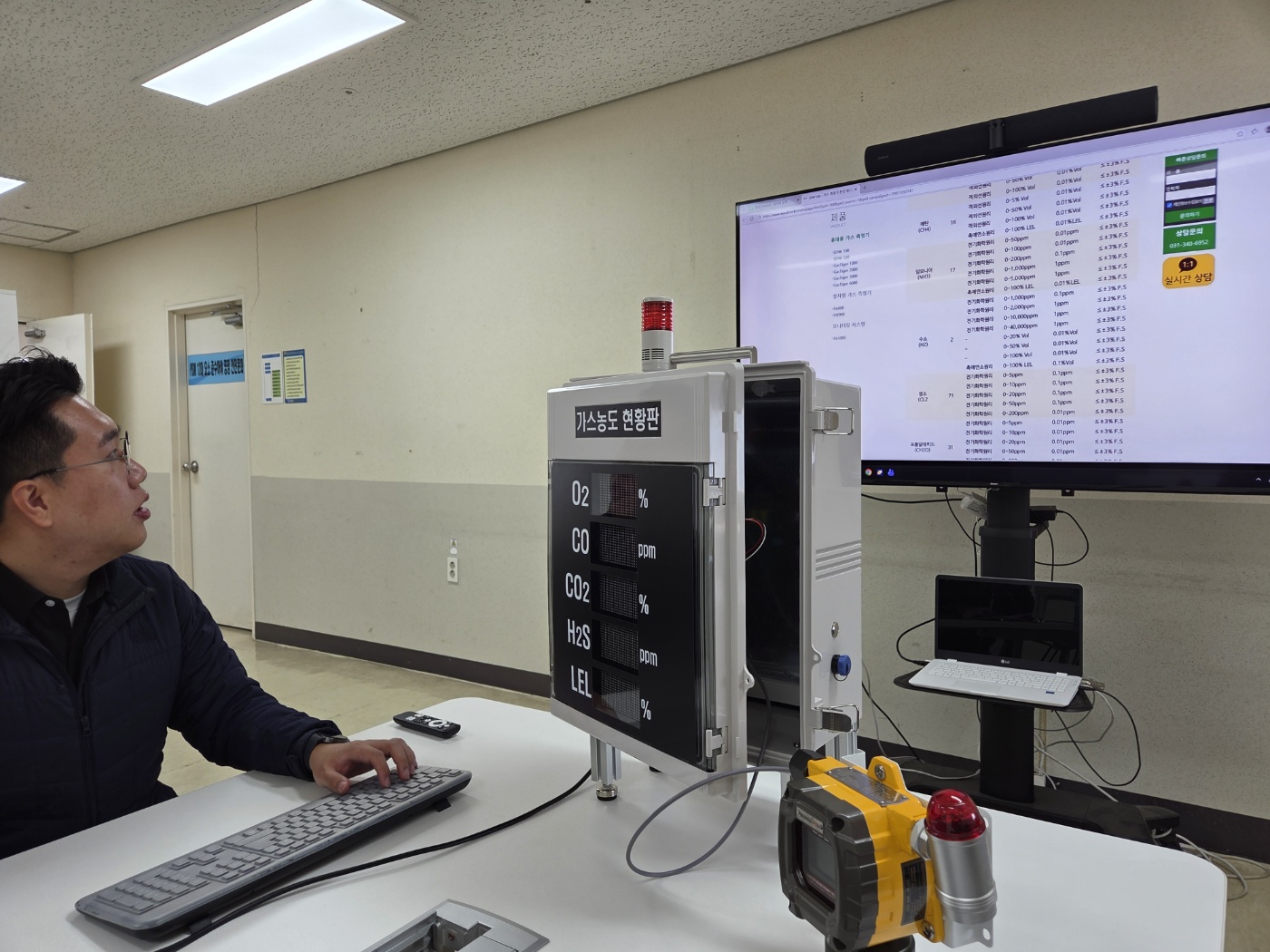
Case ③ January 7, 2008 — Icheon cold-storage fire: 40 dead
An explosion / fire during insulation-foam work at a cold-storage construction site in Icheon killed 40 workers in one of Korea's worst industrial disasters. This case showed the danger when NH₃ refrigerant facilities combine with flammable insulation, and led to a comprehensive overhaul of cold-storage safety standards.
Source: Namuwiki — 2008 Icheon Cold-Storage Fire

📌 NH₃ is Designated "Accident-Prevention Substance" by Korean MoE
Ammonia is designated as an Accident-Prevention Substance under Korea's Chemical Substances Control Act. Above threshold quantities, facilities must establish self-defense plans, train workers, and install gas detectors. Violations result in corrective orders / fines; fatal accidents trigger the Serious Accidents Punishment Act.
Conclusion — That's why a portable NH₃ gas detector is essential. Olfactory paralysis at high concentrations means human senses cannot judge the risk, and flammability adds explosion danger. Workers need a portable detector to verify concentrations in real time on site, and it must have explosion-proof certification to be safely used in flammable NH₃ environments.
Part 2. How EDW500 Portable 5-Gas Detector Prevents Accidents
EDW500's Unique Capabilities — Tailored for NH₃ Environments
WANDI EDW500 protects workers with 7 unique capabilities specialized for NH₃ environments:
| EDW500 Capability | Function in NH₃ Environment |
|---|---|
| ATEX + IECEx dual explosion-proof | Safe use in flammable NH₃ environments, globally accepted |
| NH₃-dedicated EC sensor + 5-gas simultaneous | NH₃ 0–100 ppm precision; O₂·H₂S·LEL·CO together — combined risk detection |
| 3-stage alarm (vibration / sound / LED) | 25 / 35 / 300 ppm staged alarms; vibration alarm even in noisy sites |
| DCMS wireless IoT cloud (free) | Remote real-time monitoring; zero communication / subscription fees |
| 3-month auto-email backup | Measurement data auto-backed-up → 3-year retention legal requirement auto-met |
| Man-Down alarm | Auto-alarm on worker unconsciousness → prevents secondary rescuer deaths |
| IP67 + suction pump option | Cold-storage condensation, livestock dust environments; remote sampling |
How EDW500 Eliminates Risk in Real Environments
① Cold storage / food processing — explosion-proof for flammable NH₃
NH₃ poses explosion risk at 15–28 %vol, so non-certified detectors can themselves become ignition sources. EDW500 holds ATEX (Europe) + IECEx (international) dual explosion-proof certification, enabling safe use in flammable NH₃ environments. Pre-work measurement during pipe inspection or welding can prevent explosions like the 2012 Gwangju case.
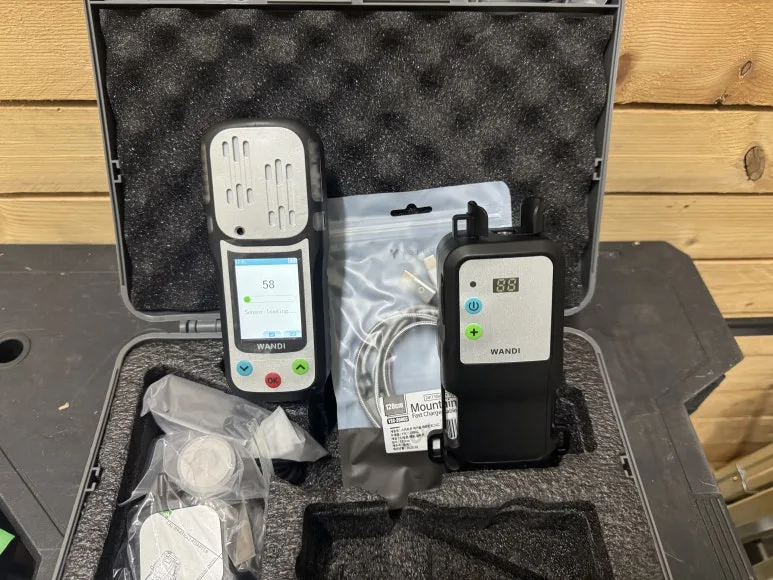
② Livestock / pig farms / fertilizer — 5-gas simultaneous for compound odor
Livestock and fertilizer facilities have NH₃ + H₂S + VOC compound-odor environments. EDW500 measures NH₃ + H₂S + O₂ + LEL + CO simultaneously in one unit, covering both worker safety and odor-reduction monitoring. DCMS cloud lets headquarters / managers verify real-time concentrations remotely — effective for managing distributed facilities.
③ Wastewater / septic tanks — vibration + man-down alarm for confined-space response
Wastewater confined spaces combine NH₃ + H₂S + O₂ deficiency, posing high risk of sudden worker unconsciousness. EDW500's Man-Down alarm auto-triggers if no worker motion is detected for a set time, enabling external watchers to respond immediately. Vibration alarms provide reliable warnings even in noisy environments.
④ DCMS free IoT — automatic 3-year retention compliance
EDW500's DCMS cloud is free of communication and subscription fees and auto-emails measurement data every 3 months. The email inbox itself becomes the backup, satisfying Korean OSH 3-year retention requirements with zero manual work. Competitors typically charge monthly subscriptions for this — EDW500 makes the biggest difference in 5-year TCO.

EDW500 NH₃ Model Standard Specifications
| Item | Specification |
|---|---|
| Sensor type | Electrochemical (EC) NH₃ sensor |
| Measurement range | 0–100 ppm (high-concentration option 0–500 ppm) |
| Alarm setpoints | 1st: 25 ppm (TWA) / 2nd: 35 ppm (STEL) / 3rd: 300 ppm (IDLH) |
| Explosion-proof certification | ATEX + IECEx dual (global) |
| Simultaneous gases | Up to 5 gases (NH₃·O₂·H₂S·LEL·CO custom combination) |
| Alarm | Vibration + sound (90 dB) + LED 3-stage / Man-Down alarm |
| Protection rating | IP67 dust- and water-resistant |
| Communication | NB-IoT built-in / DCMS cloud (free) / 3-month auto-email |
| Battery | Rechargeable Li-ion (18-hour continuous use) |
🛡️ EDW500 NH₃ Detector — Safe Even in Flammable Environments
Cold storage · livestock · wastewater · semiconductor — anywhere, portable
💬 Request a Free Quote 📋 View EDW500 Details
Phone +82-2-2088-7334 · +82-31-340-6952
Closing — Relying on Smell Is the Most Dangerous Safety Practice
"The smell is strong, I'll know right away" — this judgment is exactly how NH₃ accidents start. High concentrations paralyze the sense of smell, and flammability adds explosion risk. EDW500 enables safe use in flammable environments via ATEX/IECEx dual certification and detects combined risk through NH₃ + 4-gas simultaneous measurement. Free DCMS IoT and 3-month auto-email automatically satisfy the data-management requirements of Korean OSH law — the most reliable solution for field workers.
Frequently Asked Questions (FAQ)
Q1. Where must a portable NH₃ detector be used?
Required sites include cold storage / food processing using NH₃ refrigerants, livestock / pig / chicken farms, fertilizer / compost facilities, wastewater / septic-tank work, semiconductor / LCD processes, and chemical plants. NH₃ is designated as an Accident-Prevention Substance under Korean law, so above threshold quantities, gas detector installation is mandatory and worker-carried portable detectors are recommended.
Q2. At what ppm does NH₃ become dangerous?
Korean MoEL Notice 2020-48 sets TWA 25 ppm (8 h) and STEL 35 ppm (15 min). At 100 ppm, breathing difficulty occurs within 1 hour; 300 ppm is Immediately Dangerous to Life or Health (IDLH); above 2,500 ppm death within 30 minutes is possible. Concentrations of 15–28 %vol pose explosion risk.
Q3. What are EDW500's ATEX / IECEx explosion-proof certifications?
ATEX is the EU explosion-proof standard; IECEx is the International Electrotechnical Commission's global explosion-proof certification. EDW500 holds both, designed so the detector itself does not become an ignition source in flammable NH₃ / LEL environments. Safe for use globally in flammable-gas environments.
Q4. Can EDW500 measure other gases simultaneously with NH₃?
Yes. EDW500 hosts up to 5 gas sensors in one unit. In NH₃ environments, H₂S (odor), O₂ (deficiency), LEL (flammability), and CO (incomplete combustion) commonly co-occur, so NH₃ + O₂ + H₂S + LEL + CO is the standard combination. Custom configurations are available based on site needs.
Q5. Is the DCMS cloud really free?
Yes. EDW500's DCMS cloud has no communication or subscription fees — all included free. Most competitors charge monthly IoT subscription fees (KRW 10K–30K), but EDW500 provides this free for life. Measurement data is also auto-emailed every 3 months, automatically satisfying Korean OSH 3-year retention requirements.
Q6. How does the Man-Down alarm work?
EDW500's built-in motion sensor continuously detects worker movement. If no motion is detected for a set time (configurable, default 30 seconds), vibration / sound / LED alarms trigger; if there is no response, DCMS cloud auto-sends notifications to managers. This is a critical function to prevent secondary rescuer deaths from worker unconsciousness.
Q7. Does EDW500 work in cold-storage condensation / low-temperature environments?
Yes. EDW500 has IP67 dust- and water-resistance, operating stably in condensation, splash, and dust environments. Operating temperature is −20 °C to 50 °C, suitable for cold-storage and refrigeration. The optional suction pump enables sampling from up to 30 m away, reducing the need for direct entry.
Q8. How can I request an EDW500 NH₃ detector quote?
Visit the WANDI quote page (wandi.co.kr/en/quote) and enter your site environment (NH₃ measurement range, additional gases, quantity, explosion-proof requirement) to receive a custom quote within 1–2 business days. Phone consultation: +82-2-2088-7334 or +82-31-340-6952.