Ozone (O₃) is an indispensable gas across industries—used in water purification, semiconductor cleaning, food sterilization, and medical research. Yet exposure above just 0.1 ppm causes headaches, coughing, and respiratory distress, while levels above 1 ppm pose a serious risk of lung damage. The WANDI FIX800 fixed gas detector provides real-time ozone leak detection with instant alarms, safeguarding workers at industrial sites.
What Is Ozone (O₃) and Why Is It Dangerous?
Ozone is an unstable molecule composed of three oxygen atoms (O₃). While stratospheric ozone shields Earth from UV radiation, ground-level and industrial ozone is a highly toxic hazardous gas.
Health Effects by Ozone Concentration
| Concentration (ppm) | Exposure Duration | Health Effect | Risk Level |
|---|---|---|---|
| 0.05 | 8 hours | Eye/nose irritation, odor detected | ⚠ Caution |
| 0.1 | 1 hour+ | Headache, coughing, breathing difficulty | ⚠ Warning |
| 0.3 | Short-term | Chest pain, reduced lung function, dizziness | 🚨 Danger |
| 1.0+ | Immediately | Pulmonary edema, loss of consciousness, life-threatening | 💀 Extremely Dangerous |
Industries with High Ozone Exposure Risk
- Water treatment & wastewater plants — Ozone injection for disinfection
- Semiconductor & display factories — Substrate cleaning and oxide film formation
- Food & medical sterilization — Ozone water/gas-based sanitation
- Printing & coating facilities — UV curing ozone byproduct
- Cold storage & freezing warehouses — Ozone for mold suppression
- Research laboratories — Ozone generator experiments
Real Ozone Accident Cases
Case 1 — Ozone Leak Injures Workers at Korean Water Plant (2019)
At a water treatment facility in Gyeonggi Province, a piping defect caused a sudden ozone leak. With no fixed detectors on site, two workers suffered eye and airway injuries and were hospitalized. Operations were halted for 48 hours. (Source: Korea Occupational Safety & Health Agency, 2019)

Case 2 — Semiconductor Worker Wins Occupational Disease Ruling (2021)
A semiconductor factory worker who spent over 10 years in ozone-exposed conditions was officially recognized with a chronic respiratory occupational disease. The court found the employer in violation of mandatory ozone monitoring obligations under Article 125 of Korea's Occupational Safety and Health Act. (Source: Seoul Administrative Court, 2021)
How Does the FIX800 Prevent Accidents?
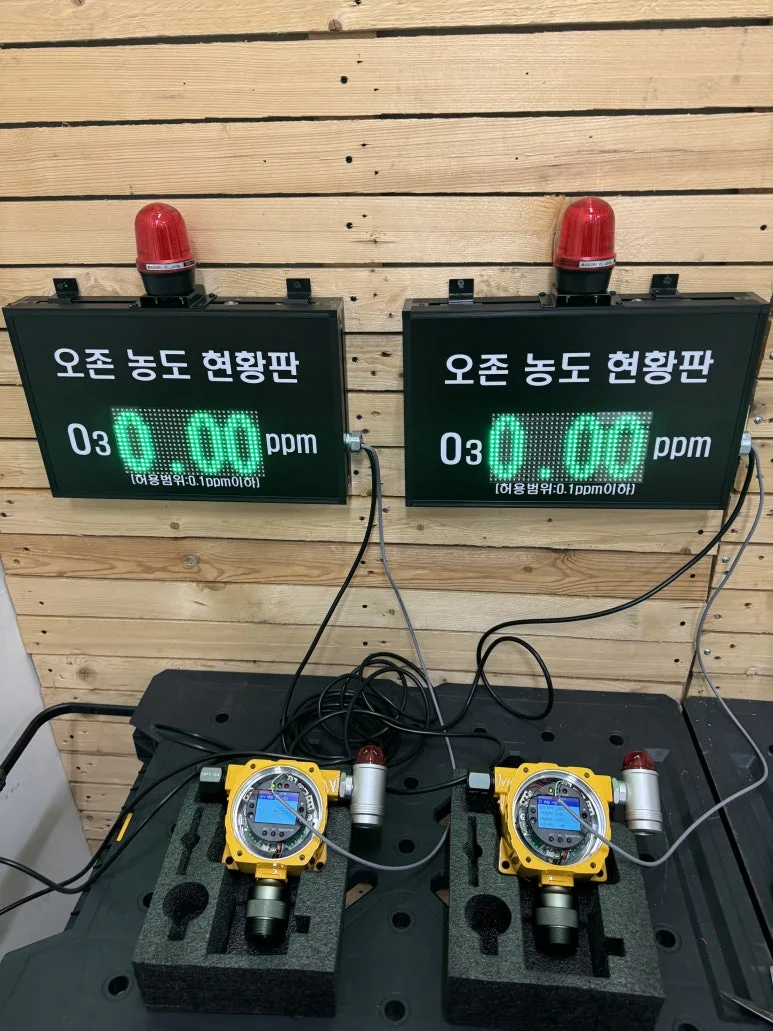
The WANDI FIX800 is a fixed multi-gas detector equipped with an electrochemical O₃ sensor. It simultaneously measures up to 4 gas types and triggers instant alarms with relay outputs to activate ventilation and shutdown systems.
🛡 Prevention Scenario
In the 2019 water plant incident, FIX800 would have triggered a 1st-stage alarm at 0.05 ppm prompting evacuation, and a 2nd-stage alarm at 0.1 ppm activating automatic ventilation—preventing both injuries and 48 hours of downtime.

WANDI FIX800 Key Specifications
| Specification | Details |
|---|---|
| Detection Method | Electrochemical (O₃), Catalytic, Infrared |
| Range (O₃) | 0–1 ppm (custom ranges available) |
| Sensor Slots | Up to 4 channels simultaneous |
| Output | 4–20 mA, RS-485, Relay |
| Alarm | 2-stage (LED + Buzzer + Relay) |
| Protection Rating | IP54+ (optional IP65 enclosure) |
