Applied Markets
Installed Gases
Project Details
GasTiger 2000 Helium (He) Detector — Scrubber Leak Testing (Hwaseong, Gyeonggi-do)
This case covers a delivery to a scrubber manufacturing facility in Hwaseong, Gyeonggi-do.
Why Helium Was Chosen for Leak Testing
During the quality inspection of completed scrubbers, high-concentration helium gas is injected into the pipework to verify airtightness. Helium is used because its small molecular size allows it to pass through even the smallest leaks. A GasTiger 2000 configured for He at 0–100% was ordered for this leak detection application.
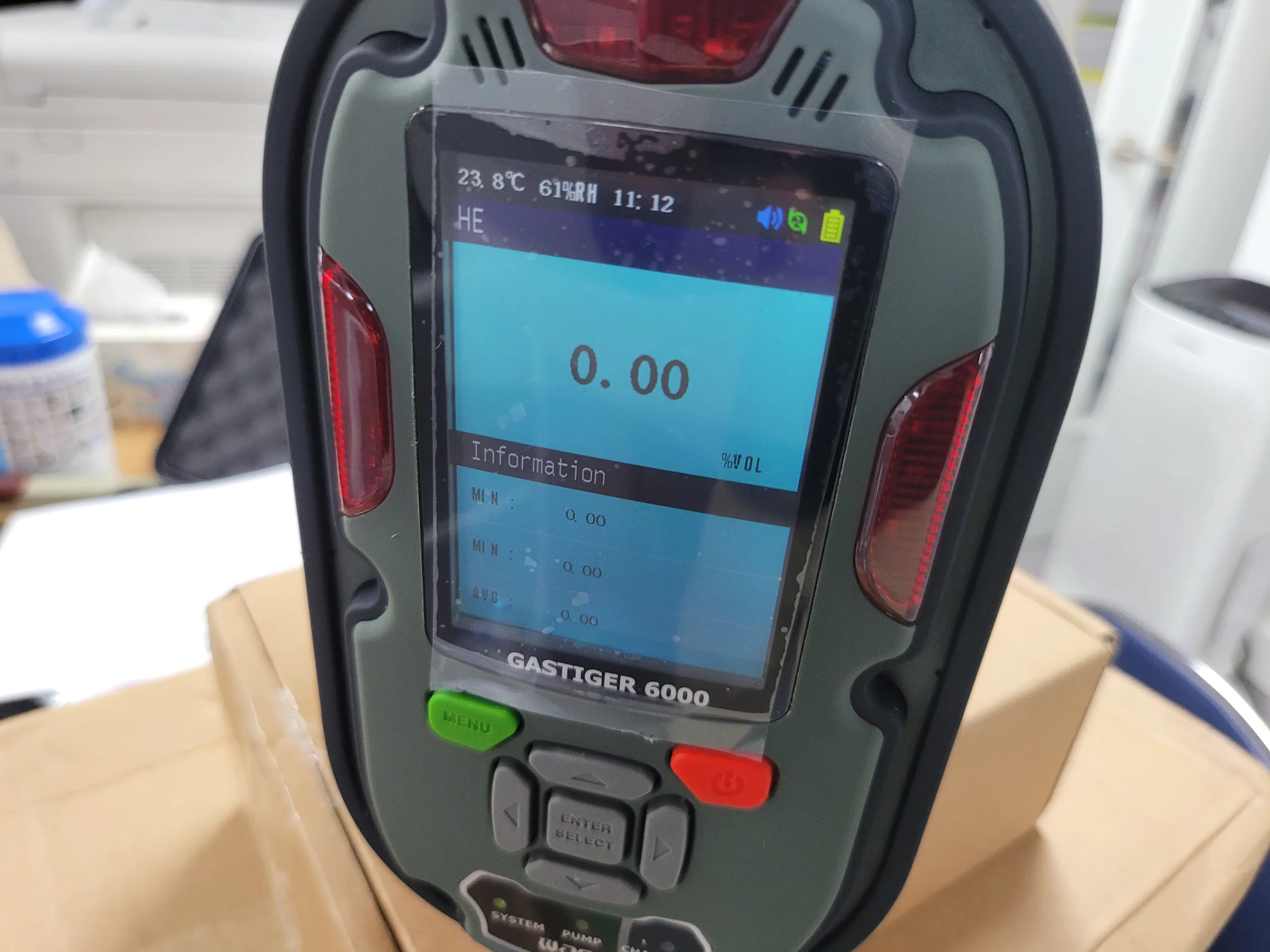
Thermal Conductivity (TCD) Sensor — Full 0–100% Range
The instrument is fitted with a thermal conductivity detector (TCD) sensor capable of measuring from 0 to 100% with a resolution of 0.01% — equivalent to 100 ppm resolution.
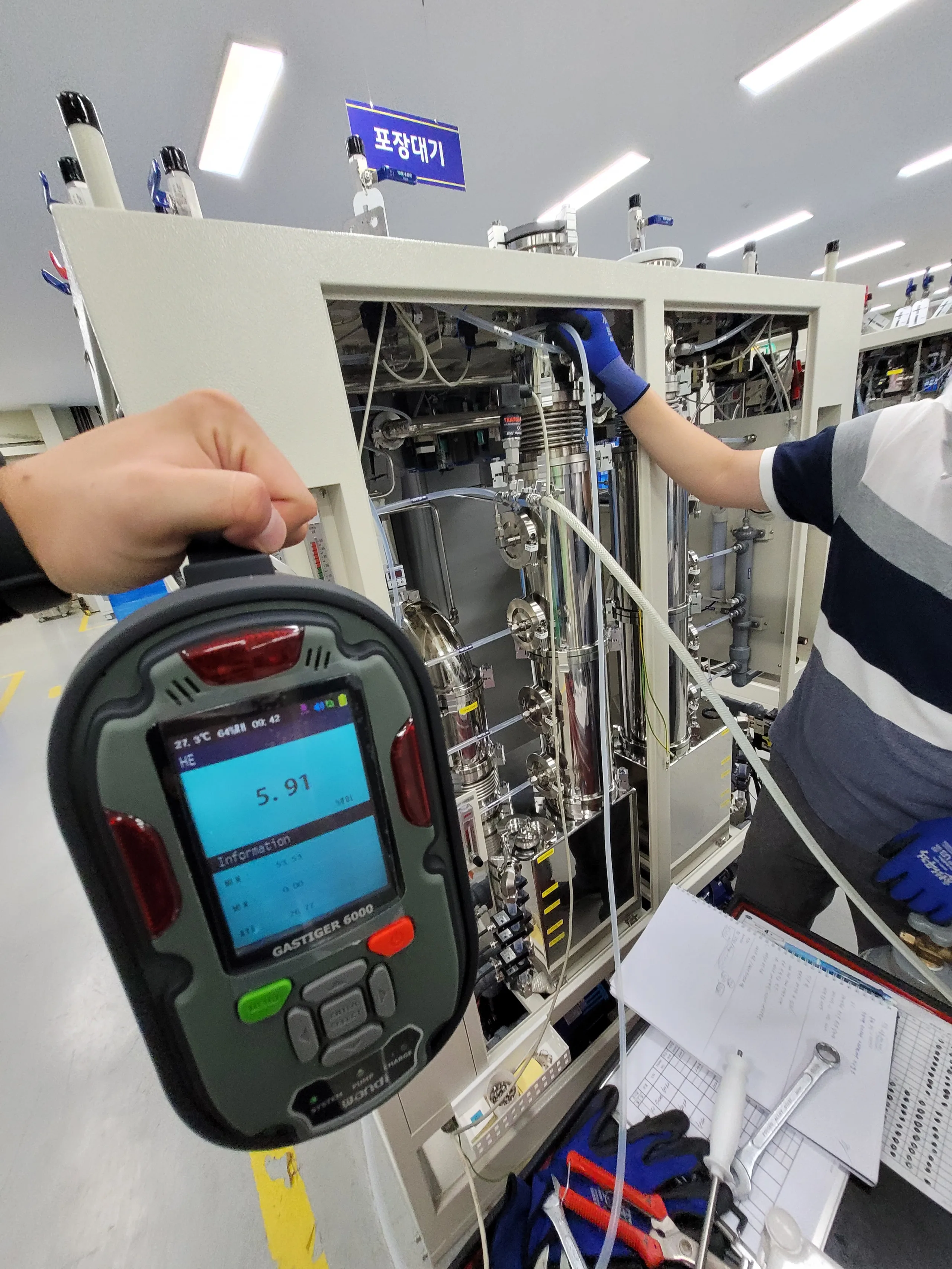
The instrument responds rapidly at suspected leak points.
Frequently Asked Questions
Q1. Why is helium used for leak testing instead of other gases?
Helium molecules are among the smallest in existence, allowing them to pass through even extremely fine leaks that larger gas molecules cannot. Helium is also chemically inert (no explosion risk) and present in ambient air at only approximately 5 ppm — providing an effectively zero background level for accurate leak detection without signal interference.
Q2. How does a thermal conductivity (TCD) sensor work?
Different gases have different thermal conductivities. Helium's thermal conductivity is approximately 6 times higher than air. A TCD sensor detects changes in heat transfer from a heated element when gas composition changes — the greater the helium concentration, the greater the heat dissipation and the measurable signal change. TCD sensors cover the full 0–100% range and have longer service lives than electrochemical sensors.
Q3. Is 100 ppm resolution sufficient for scrubber leak testing?
Yes, for this application. During leak testing, helium introduced at a suspected leak point typically appears at concentrations of percent-level rather than ppb-level. The 0–100% range with 100 ppm resolution allows rapid identification of whether a leak is present and its approximate severity — which is what scrubber QC inspection requires.
Q4. What other industries use helium leak detectors?
Common applications include refrigeration and HVAC piping airtightness testing, semiconductor and display chamber leak detection, medical device gas line integrity testing, and hydrogen fuel cell system piping inspection — any application requiring high-sensitivity detection of leaks in precision piping or sealed enclosures.
Q5. How does a TCD sensor differ from an electrochemical sensor?
Electrochemical sensors are optimized for low-concentration detection (ppm range) of specific target gases and tend to be gas-selective. TCD sensors are designed for high-concentration measurements (0–100%) of gases with distinct thermal conductivity characteristics, offer low cross-sensitivity to other gases, and typically have longer service lives. For high-concentration inert gas measurement like helium leak testing, TCD is the appropriate technology.
#HeliumLeakTest #GasTiger2000 #HeliumDetector #ScrubberInspection #PipingLeakDetection #ThermalConductivitySensor #LeakDetector #InertGasMeasurement #WANDI #Hwaseong
![[레이먼드] 오,폐수 처리실 유해가스 모니터링](https://wandi.co.kr/storage/construction-cases/YxFUQVBZ8Unnk7pJzzfsmezr6xNe0LZvQRDmt7TL.jpg)
![[브이피이코리아] 종합병원 지하 밀폐공간 가스 측정기 설치_FIX800 & FIX-DS](https://wandi.co.kr/storage/construction-cases/gNOA28xSlEy5uU3AOxyHDRH5UfAe0TpMTgAt4Uag.jpg)

