Applied Markets
Installed Gases
Project Details
Hello, this is our team at RS Korea. For this project, we visited a sewage treatment facility located inside a national hospital in Gangwon-do.
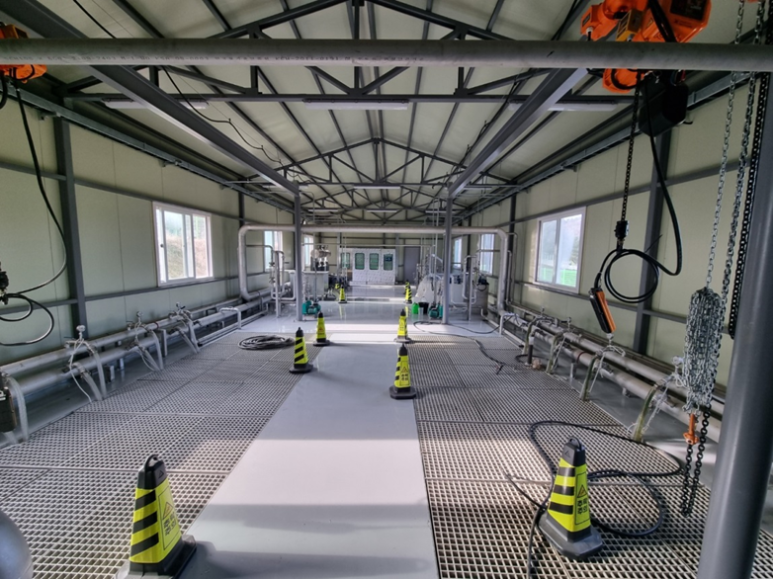

What is a sewage treatment facility?
A sewage treatment facility collects wastewater generated from everyday use, treats it until it is clean, and then discharges it into a river or the sea.
Purpose of installation

The Occupational Safety and Health Act applies to every site. Since a 2017 amendment, confined spaces — locations with a risk of suffocation, fire, or explosion — must measure a total of five gases: the original four (O2, CO, H2S, LEL) plus carbon dioxide (CO2). In particular, environments where hazardous gas may be generated require gas concentration to be measured whenever work is carried out, so a gas detector must be installed inside the confined space, together with a gas status display board outside the entrance so that conditions inside can be understood from outside.
For this project, we visited a sewage treatment facility located inside a national hospital. Sewage and wastewater treatment facilities are environments where hydrogen sulfide (H2S) is generated; the odor is strong, and H2S generation increases sharply when sediment in the settling tank is disturbed. Since this is a confined space, a five-gas detector — the gases required under the Occupational Safety and Health Act — was needed to protect worker safety, and installation proceeded accordingly.
Installed product

FIX800 multi-gas detector (custom-built with user-selectable sensors). FIX800 is an installed-type gas detector that can measure up to five gases in a single unit. The detector is installed inside the space where gas may occur, while the gas concentration status board is installed outside so conditions inside can be understood from the outside.

Installation example 1: septic tank room — a safety-oriented 5-gas detector (O2, CO, H2S, LEL, CO2), a warning light, and a gas concentration status board.
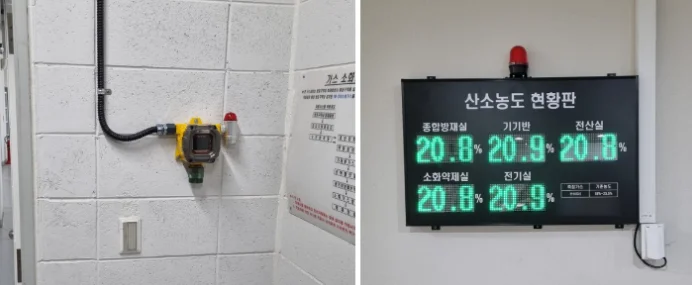
Installation example 2: central disaster prevention room, equipment room, server room, extinguishing agent room, electrical room — FIX800 oxygen detector (O2), warning light, and gas concentration status board.

Installation example 3: extinguishing agent room — oxygen detector (O2), warning light, and gas concentration status board.
Installation materials

The items needed for this installation were the FIX800 installed-type gas detector, a gas concentration status board, and — since the board would be installed outdoors — a custom acrylic enclosure for waterproofing. Unlike our usual installations, this project included an additional custom item: although the gas status board is manufactured as a standard waterproof outdoor unit, the site manager requested a cover so that the display would not be fully exposed, so we manufactured one accordingly. Our team takes the site environment and conditions into account, and we provide custom-built solutions based on what the end user actually needs.
Installation points

Inside the sewage treatment facility — the installation point for the FIX800 gas detector.

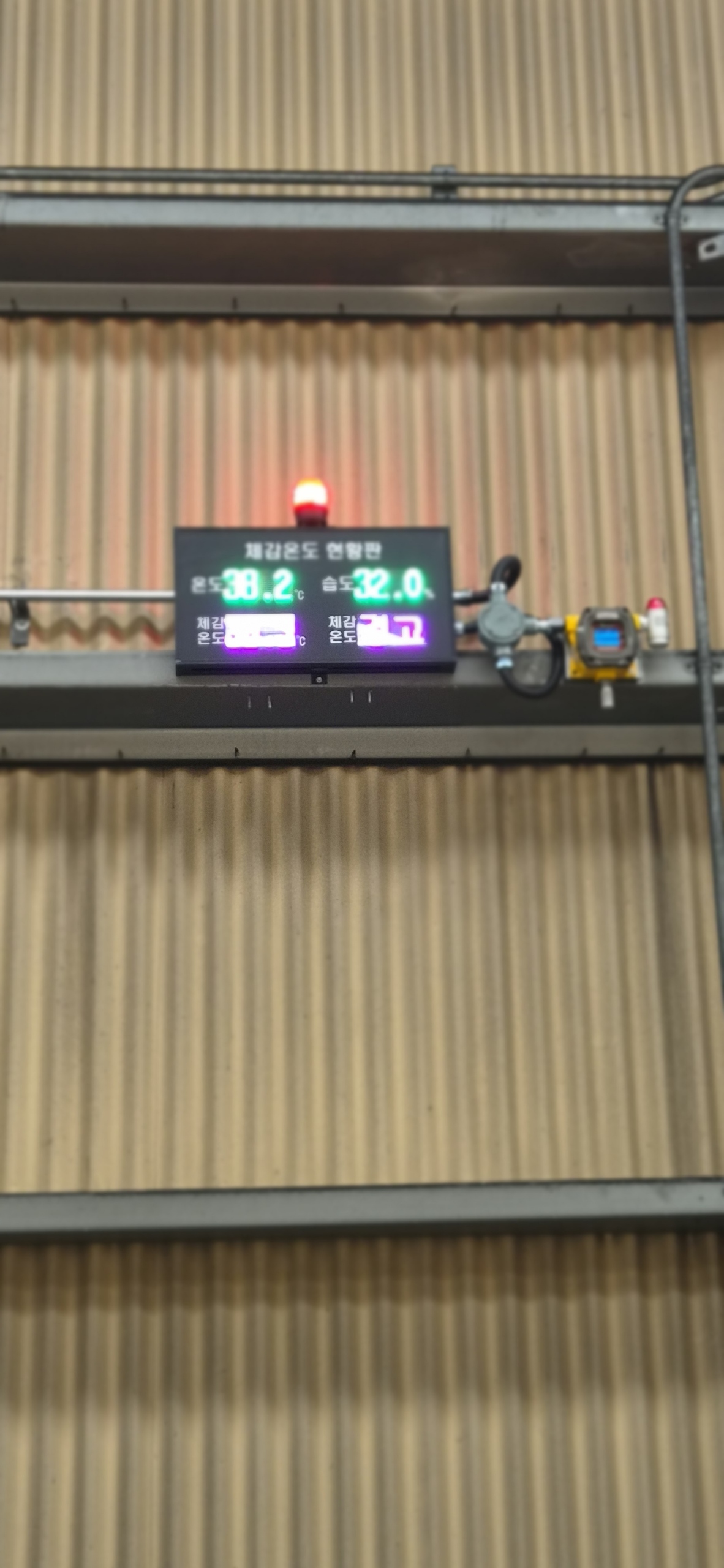
Outside the sewage treatment facility — the installation point for the gas concentration status board.
Installation

First, the bracket position was set and the detector was mounted.

Although the sewage facility is a confined space, it is built as a ground-level container structure, so we kept it continuously ventilated throughout the installation work.

Outside the facility, the gas concentration status board was installed to the left of the entrance. Since a power connection needed to be run to the indoor display board, the wall was drilled — which was straightforward given the container-type structure.
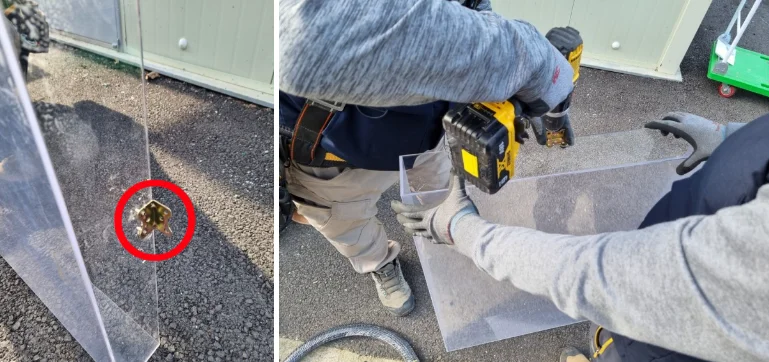
Preparation work for installing the custom acrylic enclosure requested by the site manager.

The completed acrylic enclosure had holes drilled at the bottom to prevent moisture buildup.

Installation of the custom acrylic enclosure was completed.
Installation completed

The installation was completed.

Although the units are calibrated at our technical department before shipping, the measured concentration on site turned out higher than expected. Even with continuous ventilation during the work, more gas than expected was detected, which was somewhat unexpected for us. The levels were not high enough to cause harm from short-term exposure, but considering what could happen if the space were sealed with the windows closed, or if work continued for a long period with ongoing low-level exposure, this was not a site to take lightly. Rather than installing a gas detector simply because the law requires it, we came away convinced that it is essential to install one for worker safety and to actively manage the readings it provides. The installation concluded with a test run, product orientation, and training for the person in charge.
In a confined space, air circulation is poor and the space is cut off from the outside, so a hazardous gas leak or a drop in oxygen concentration can lead to fatal asphyxiation. In environments that generate strong odors, such as sewage treatment facilities, it is essential to install a gas detector and place a status board outside to keep the workplace safe. At this site, the detector was installed inside the space and the gas concentration status board outside, allowing conditions inside to be checked from outside both before and during work, helping to keep workers safe.
Beyond simply selling products, our team also provides in-house calibration, domestic repair service, custom manufacturing, and installation — and based on our experience across demonstrations, site surveys, deliveries, repairs, and installations in a wide range of environments, we provide tailored, one-on-one solutions for each gas-measurement environment.
Site summary
Environment: sewage treatment facility inside a national hospital
Products: FIX800, warning light, status board
Gases / ranges: O2 0–30% Vol, CO 0–1,000 ppm, H2S 0–100 ppm, LEL 0–100% LEL, CO2 0–5% Vol
Notes: 2 people, 4 hours; detector installed inside the facility, status board installed outside; waterproof corrugated conduit used; a custom cover for the outdoor display board was made at the site manager's request, with drainage holes at the bottom to prevent moisture buildup; unexpectedly elevated low-level hazardous gas was detected on site.
This concludes our post on installing a fixed FIX800 gas detector with a status board and warning light at a sewage treatment facility. If you have any questions about site surveys, installation, or other environmental monitoring instruments, please feel free to contact our team.
This was RS Korea's team. Thank you.
Frequently Asked Questions (FAQ)
Q1. Why does this site need a five-gas detector instead of the older four-gas setup?
Following a 2017 amendment to the Occupational Safety and Health Act, confined spaces must measure a fifth gas, CO2, in addition to the original four (O2, CO, H2S, LEL) — so a five-gas FIX800 configuration was used here.
Q2. Why is hydrogen sulfide (H2S) a particular concern at this site?
Sewage and wastewater treatment facilities generate H2S, and concentrations can rise sharply when sediment in settling tanks is disturbed, making continuous monitoring important for worker safety.
Q3. Why was a custom acrylic enclosure added to this installation?
Although the outdoor status board is manufactured as a standard waterproof unit, the site manager asked that the display not be fully exposed, so a custom acrylic cover with drainage holes at the bottom was made for this site.
Q4. What did the on-site readings reveal during installation?
Even with continuous ventilation, the detector recorded higher gas concentrations than expected — not enough to cause harm from brief exposure, but a clear reminder of the risk from prolonged, low-level exposure in a sealed space.
Q5. What other services does RS Korea provide besides installation?
Beyond product sales, the team also provides in-house calibration, domestic repair service, custom manufacturing, and tailored one-on-one solutions based on experience across many different gas-measurement environments.
#FIX800#ConfinedSpaceSafety#FiveGasDetector#SewageTreatment#HydrogenSulfide#GasDetectorInstallation#OccupationalSafety#IndustrialSafety#WANDI#RSKorea
![[레이먼드] 오,폐수 처리실 유해가스 모니터링](https://wandi.co.kr/storage/construction-cases/YxFUQVBZ8Unnk7pJzzfsmezr6xNe0LZvQRDmt7TL.jpg)
![[브이피이코리아] 종합병원 지하 밀폐공간 가스 측정기 설치_FIX800 & FIX-DS](https://wandi.co.kr/storage/construction-cases/gNOA28xSlEy5uU3AOxyHDRH5UfAe0TpMTgAt4Uag.jpg)

