Applied Markets
Installed Gases
Project Details

Hello, this is RS Korea. We're sharing details from a recent installation for reference. This site is a wastewater treatment facility, and the inquiry came in specifically for the influent pump room — one stage of the treatment process — to protect worker safety with a gas detector. After completing an on-site survey, we returned to carry out the installation.
The wastewater treatment process
Domestic sewage and industrial wastewater are collectively referred to as wastewater. Domestic sewage comes from everyday sources such as toilets, kitchens, and bathrooms, while industrial wastewater is typically discharged from factories. A wastewater treatment plant collects this water through sewer lines and purifies it through biological and physicochemical treatment processes.

The treatment process runs as follows: source (households/industry) → grit chamber → influent pump → primary settling tank → aeration tank → final settling tank → discharge. Incoming sewage first passes through the grit chamber, where sand, soil, and debris are filtered out. It is then lifted by the influent pump into the primary settling tank, where floating and settling materials are separated. In the aeration tank, air is introduced so that microorganisms can break down organic matter into settleable solids. In the final settling tank, the water remains for about three hours while the solids settle and the clarified water is sent onward, ultimately discharged into a river once fully treated.
Product installed
The unit installed was the FIX800, a fixed gas detector from the gas-detection specialist brand WANDI.

A single FIX800 unit can be configured with up to five safety-related gases under Korea's Occupational Safety and Health Act — O2, CO, H2S, LEL, and CO2 — in either single-gas or multi-gas configurations.

The sensor housing size differs depending on configuration: a single-gas unit has one sensing element and a slimmer housing, while a multi-gas unit has two or more sensing elements and a thicker housing.

The housing and display both vary depending on whether the unit is configured for a single gas or multiple gases. From a list of roughly 40 gases, the FIX800 can be configured from a single gas up to five gases with dual sensors, with all configured gases measured and displayed simultaneously in real time. It can also connect to an optional remote display or PLC, allowing readings to be monitored externally and enabling an immediate alarm response if a hazardous condition is detected.
Installation environment and points
This installation took place in a confined space — the influent pump room, where large pumps lift incoming sewage for settling. Outside the entrance, a confined-space warning sign was posted in accordance with Korea's Occupational Safety and Health regulations, identifying the space as an asphyxiation hazard.

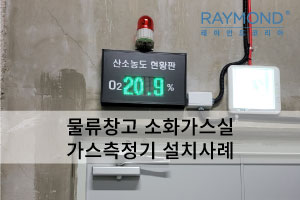
This is the remote display installation point. Opening the outer entrance reveals the door to the influent pump room, with the display panel to be mounted above that doorway.

Beyond the pump room entrance, a stairway leads down to the influent pump room itself. Since the gas detector had not yet been installed, the entrance was opened to ventilate the space thoroughly, and a portable detector was used to check conditions before entering.

This is the detector's installation point, mounted at eye level — about 140 to 150 cm above the floor.
Installation

These are the materials prepared for the installation: the detector unit, mounting bracket, gas concentration display panel, and other supporting materials. The package also included the manufacturer's own calibration certificate confirming the unit was calibrated prior to shipment.

The detector's position was set using the mounting bracket, and the display panel's position was set on the exterior wall above the entrance.

With the mounting positions set, power and communication wiring work was carried out.
Installation completed


Installation was completed successfully. Power and communication were tested, and the display panel showed readings without issue. The alarm test, commissioning, and a product briefing rounded out the work.
After everything was finished, while returning through the entrance to take site photos, the pump room door briefly swung shut — and the moment it closed, a strong odor rose immediately. Ventilation before entry had kept conditions safe throughout the work, but even a brief closure of the door was enough to let the odor build up, with the detector responding right away. It was a clear, first-hand reminder of exactly why confined spaces like this are legally required to have gas detection in place.
When the gases present at a site are unknown, or the exact concentrations are difficult to confirm even when the gases are known, selecting the right detector in advance can be challenging. Consulting thoroughly with a specialist — taking into account the environment, the gases involved, their frequency, and their concentrations — is the safest way to choose a detector with the correct measurement range.
Beyond simply supplying products, RS Korea specializes in gas detection with in-house calibration, domestic repair service, custom manufacturing, and installation.
Project summary
Purpose: confined-space worker safety in a wastewater treatment plant's influent pump room.
Product: WANDI FIX800 with a gas concentration remote display.
Gases and ranges: O2 0–30% Vol, CO 0–1,000 ppm, H2S 0–100 ppm, LEL 0–100% LEL.
Crew and duration: 2 installers, approximately 4 hours.
Notes: the detector was installed inside the pump room, with the display mounted on the exterior wall above the entrance; all exposed wiring (power and communication) was run through flexible conduit; a strong odor was observed when the entrance door briefly closed after installation.
Frequently Asked Questions (FAQ)
What gases does this system monitor, and what are the measurement ranges?
The system monitors four gases: O2 (0–30% Vol), CO (0–1,000 ppm), H2S (0–100 ppm), and LEL (0–100% LEL) — all relevant to confined-space safety in a wastewater pump room.
Why is this space classified as a confined space requiring gas monitoring?
The influent pump room carries an official confined-space entry warning under Korea's Occupational Safety and Health regulations due to asphyxiation risk. After installation, briefly closing the entrance door caused a strong odor to build up immediately, with the detector responding right away — a clear illustration of why continuous monitoring matters.
Where were the detector and display installed?
The FIX800 detector was mounted inside the pump room at eye level (about 140–150 cm above the floor), while the remote display panel was installed on the exterior wall above the entrance so conditions can be checked before entering.
How long did the installation take?
Two installers completed the work in about four hours, including mounting, power and communication wiring through flexible conduit, and full commissioning.
Was the equipment calibrated before installation?
Yes. The FIX800 unit shipped with the manufacturer's own calibration certificate confirming it was calibrated prior to delivery, and the completed installation was further verified with alarm and commissioning tests on site.
#FIX800#GasDetector#ConfinedSpaceSafety#WastewaterTreatment#H2SDetection#OxygenMonitoring#COMonitoring#LELDetection#IndustrialSafety#WANDI