Applied Markets
Installed Gases
Project Details
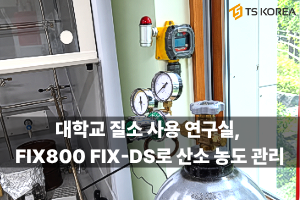
Hello! Today we'd like to share the installation of a fixed nitrogen (N₂) concentration monitoring system.
This site uses nitrogen in its process, and the goal was to measure gas conditions at several points and display all the readings in real time on a single status display. However, this installation didn't simply mean selecting a product and installing it on site right away.
Because the installation method for a fixed gas detection system depends heavily on the layout of the site, our team first visited the site before the main installation to check the intended sensor locations and the condition of the existing equipment.
This system also has one notable characteristic: the status display shows the N₂ concentration, but what is actually measured on site is oxygen (O₂). The logic works as follows — O₂ concentration is measured, the N₂ concentration is calculated from that O₂ reading, and the converted N₂ value is shown on the status display.
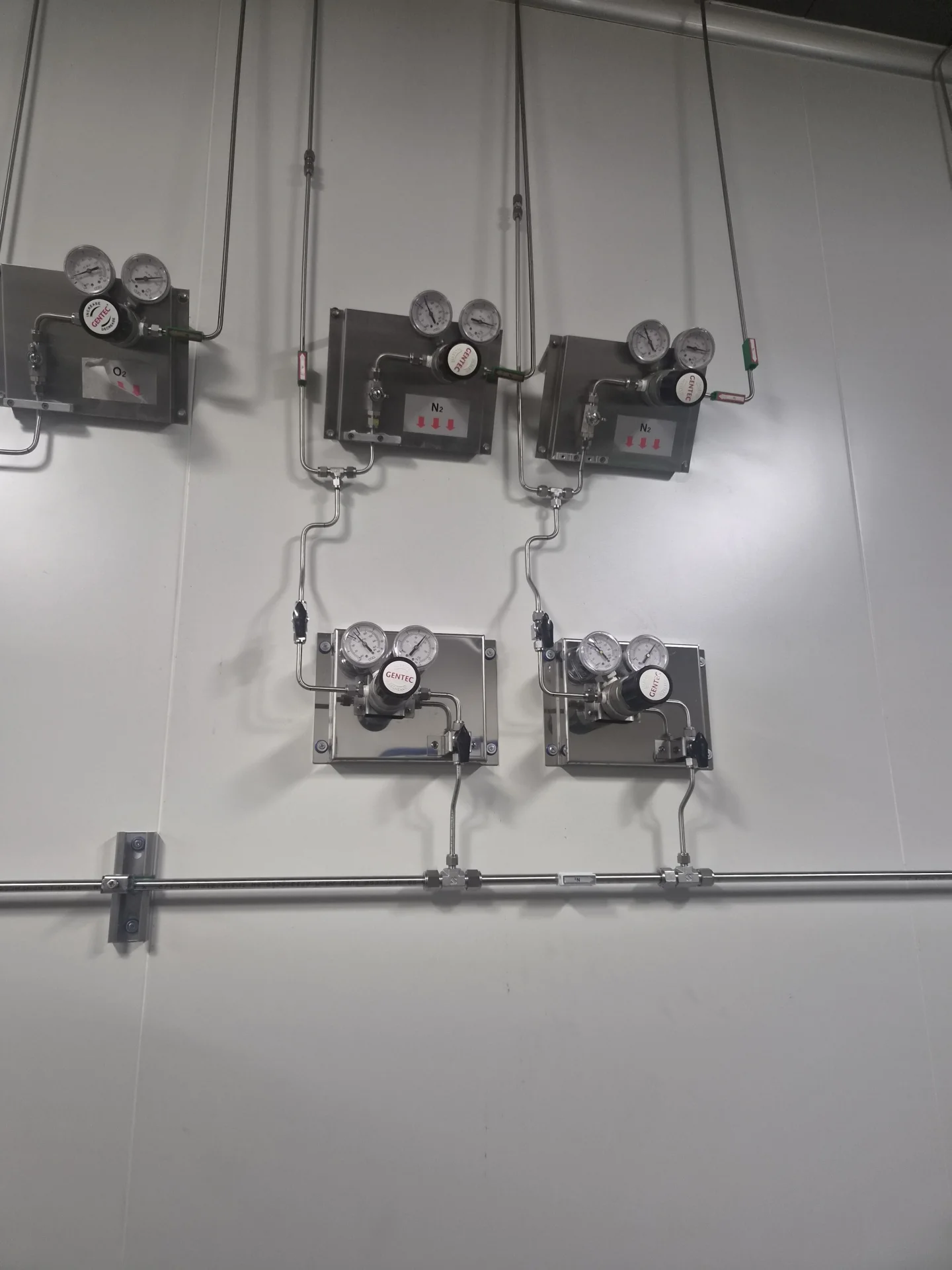
Pre-Installation Site Visit
With fixed gas detectors, it is difficult to decide on the installation location based on product specifications alone. That's why our team visited the site in advance of the actual installation.
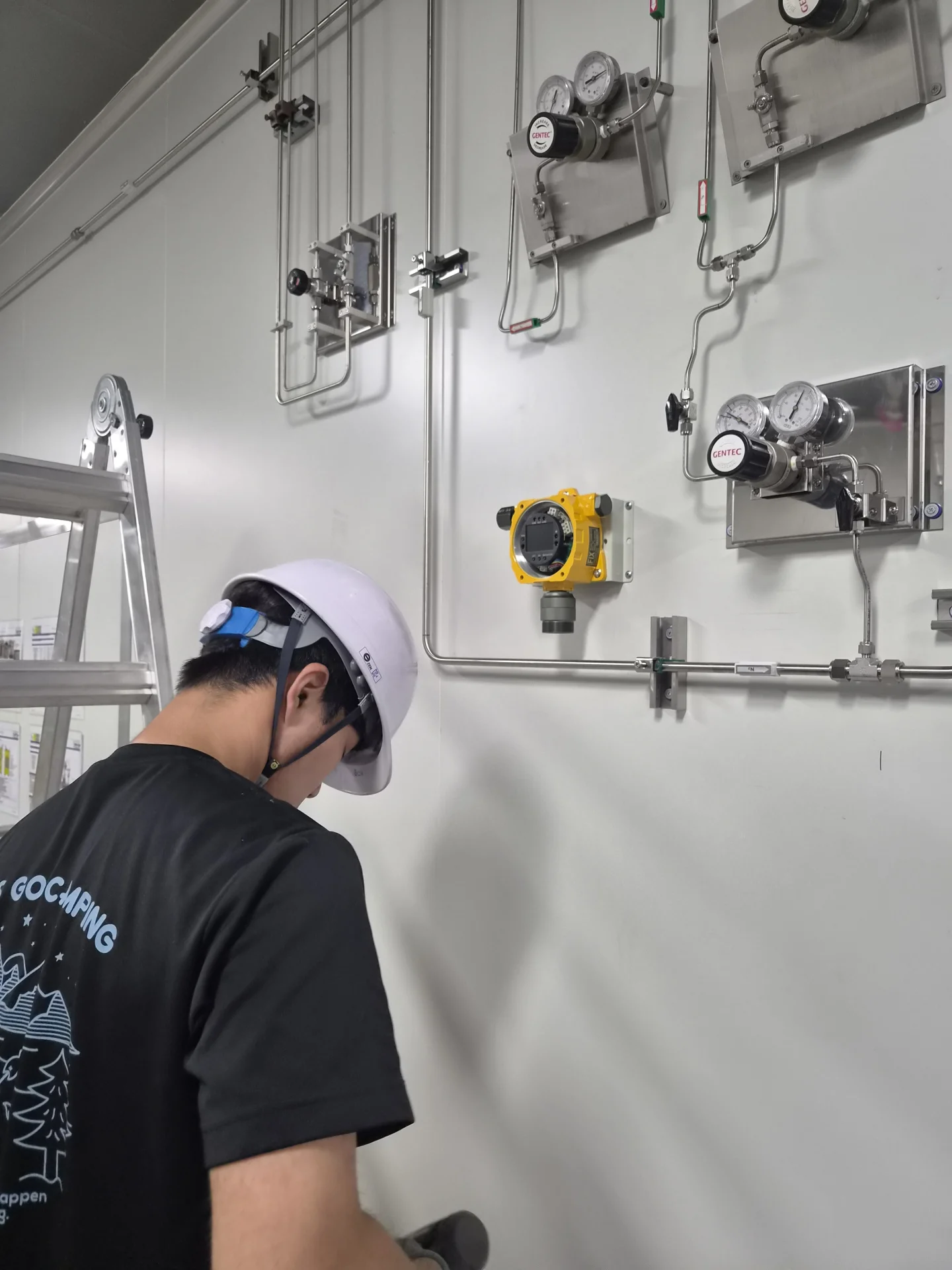
On site, the first things we checked were: how the nitrogen piping was configured, where the measurement points needed to be, where the detector should be mounted, whether there was any interference with existing equipment, how the power and signal wiring should be routed, where the status display should be placed, and whether the location would allow for future inspection and maintenance.
Because the site already had several stainless steel pipes and regulators in place, it was necessary to confirm the installation location in person rather than relying only on photos or drawings.
This is exactly the point our technical team considers most important in field installation: a location "where equipment can be installed" and a location "that is good for installing equipment" are not always the same. The decision has to account for the measurement purpose, piping layout, worker accessibility, and future maintenance — not just finding an empty space to mount a detector. After the preliminary visit, we finalized the detector locations and the overall system configuration before scheduling the main installation.
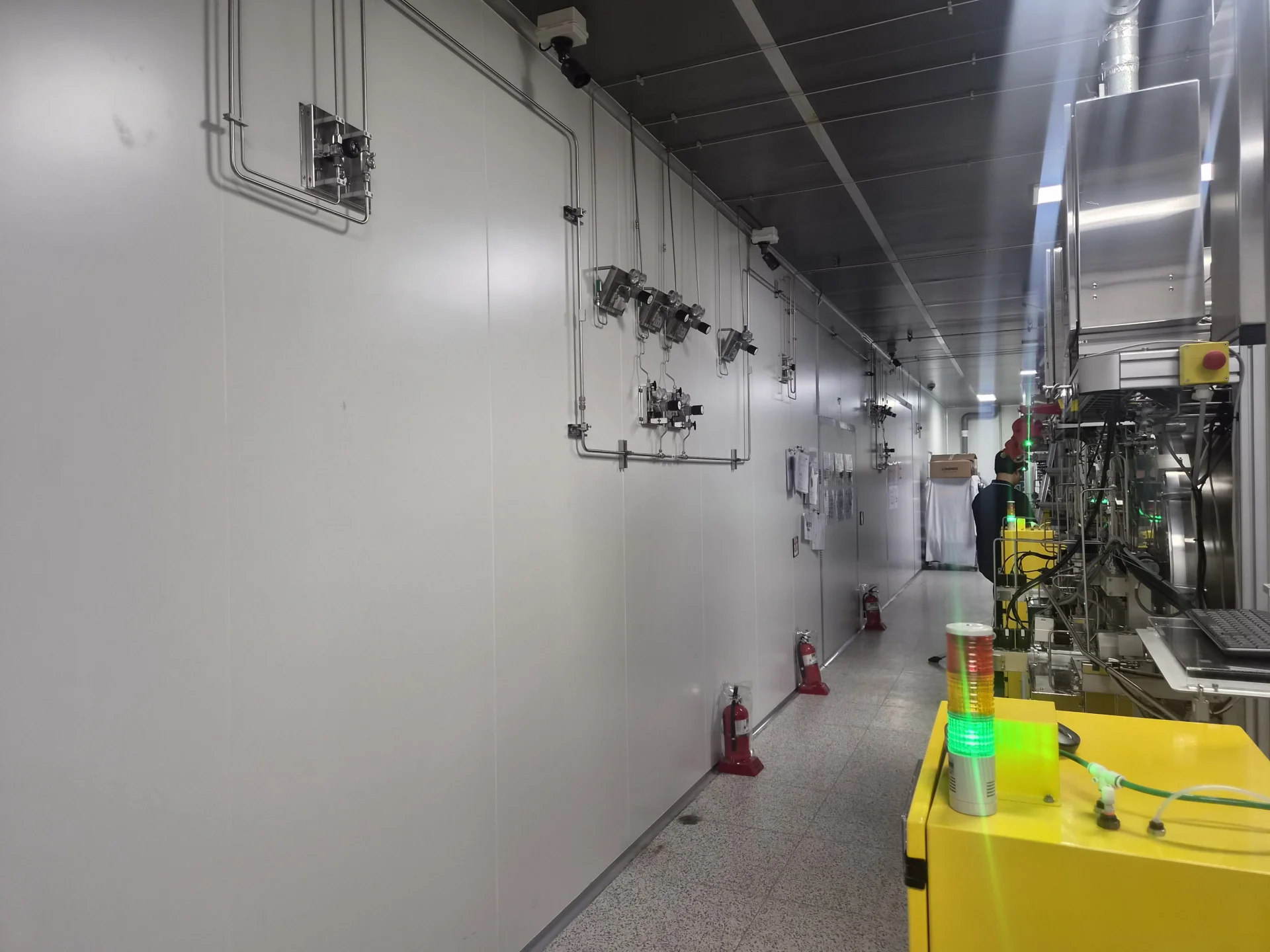
Installation Day
On the day of the main installation, work began based on the locations confirmed during the preliminary site visit.
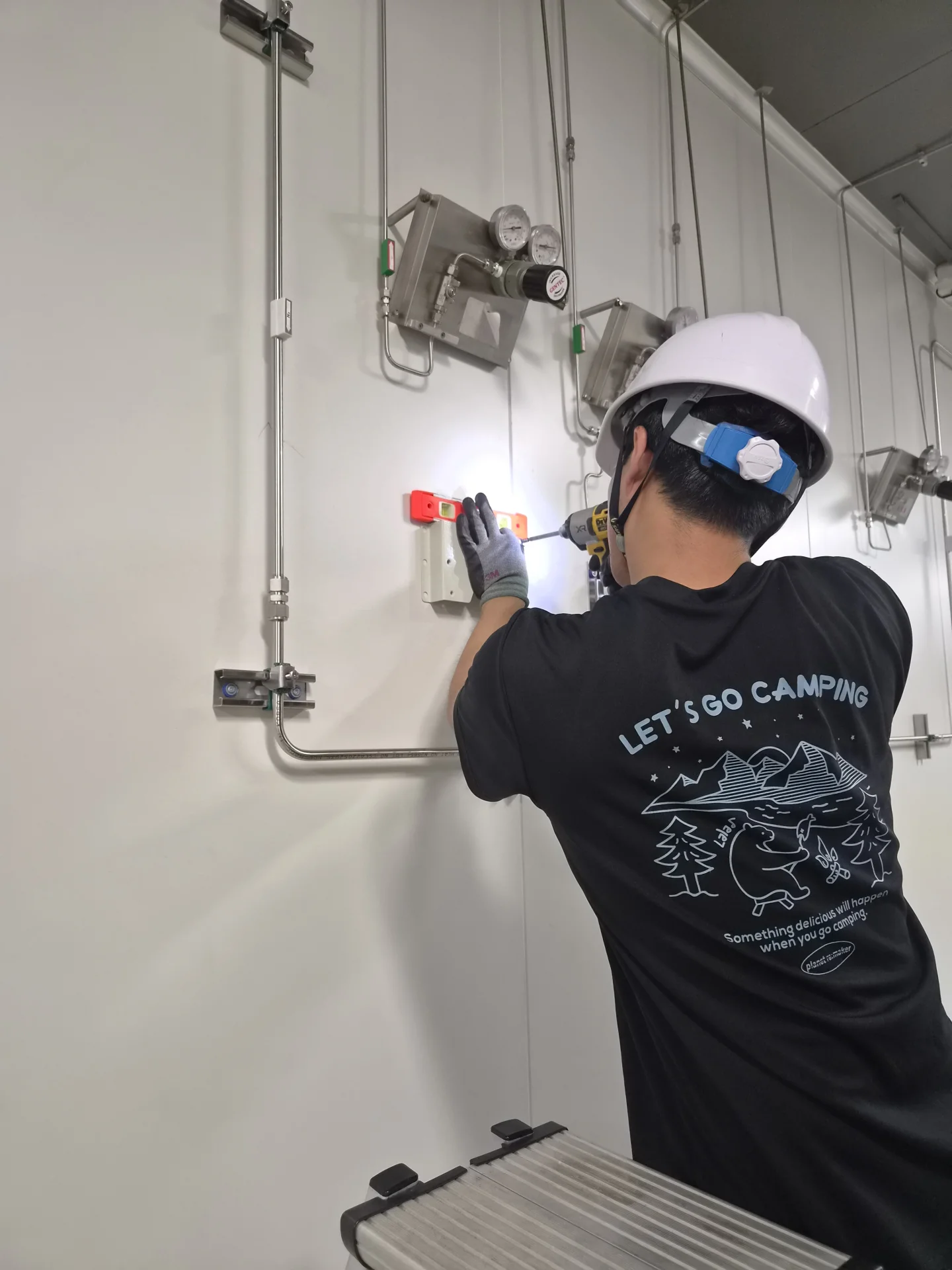
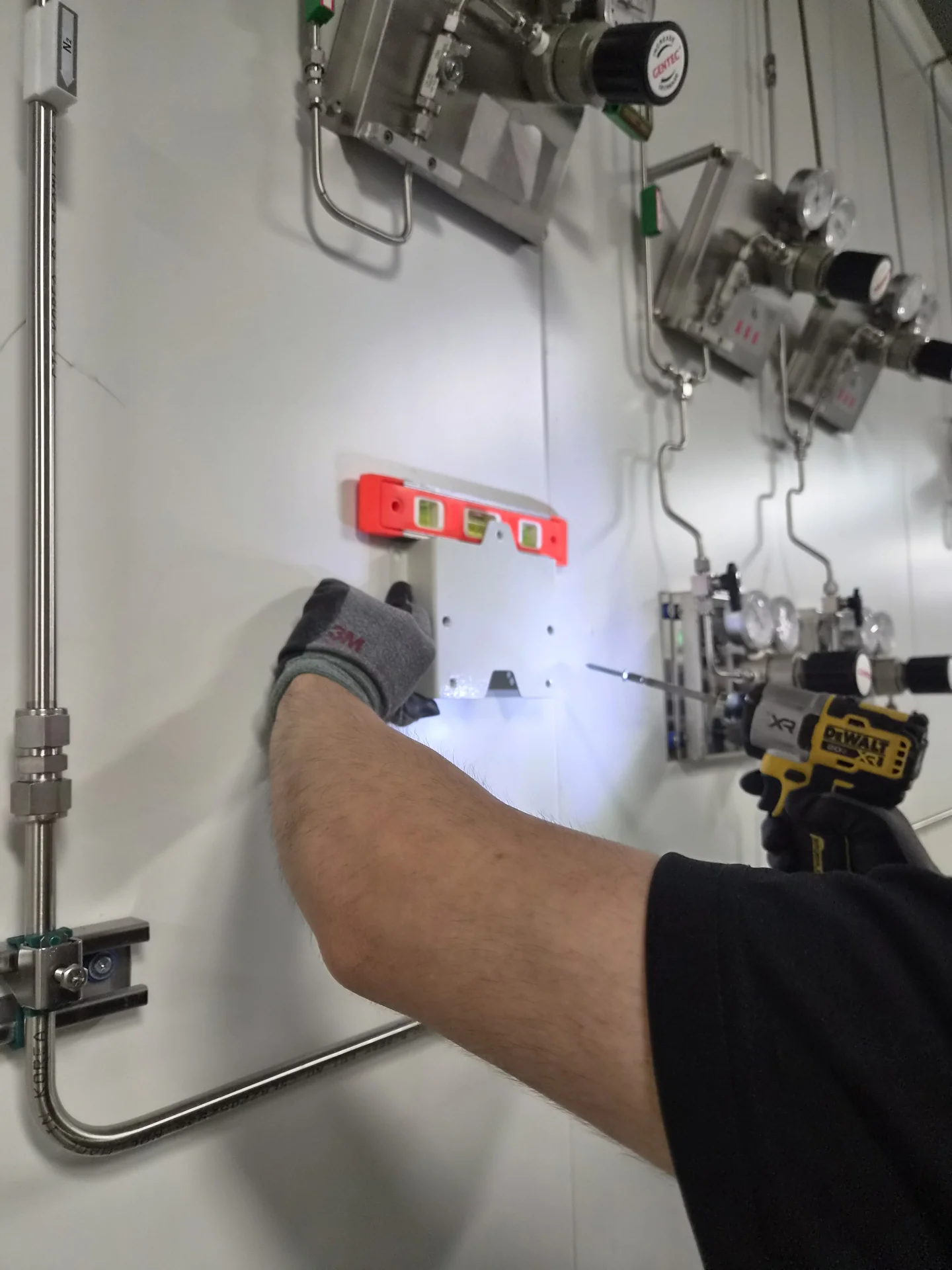
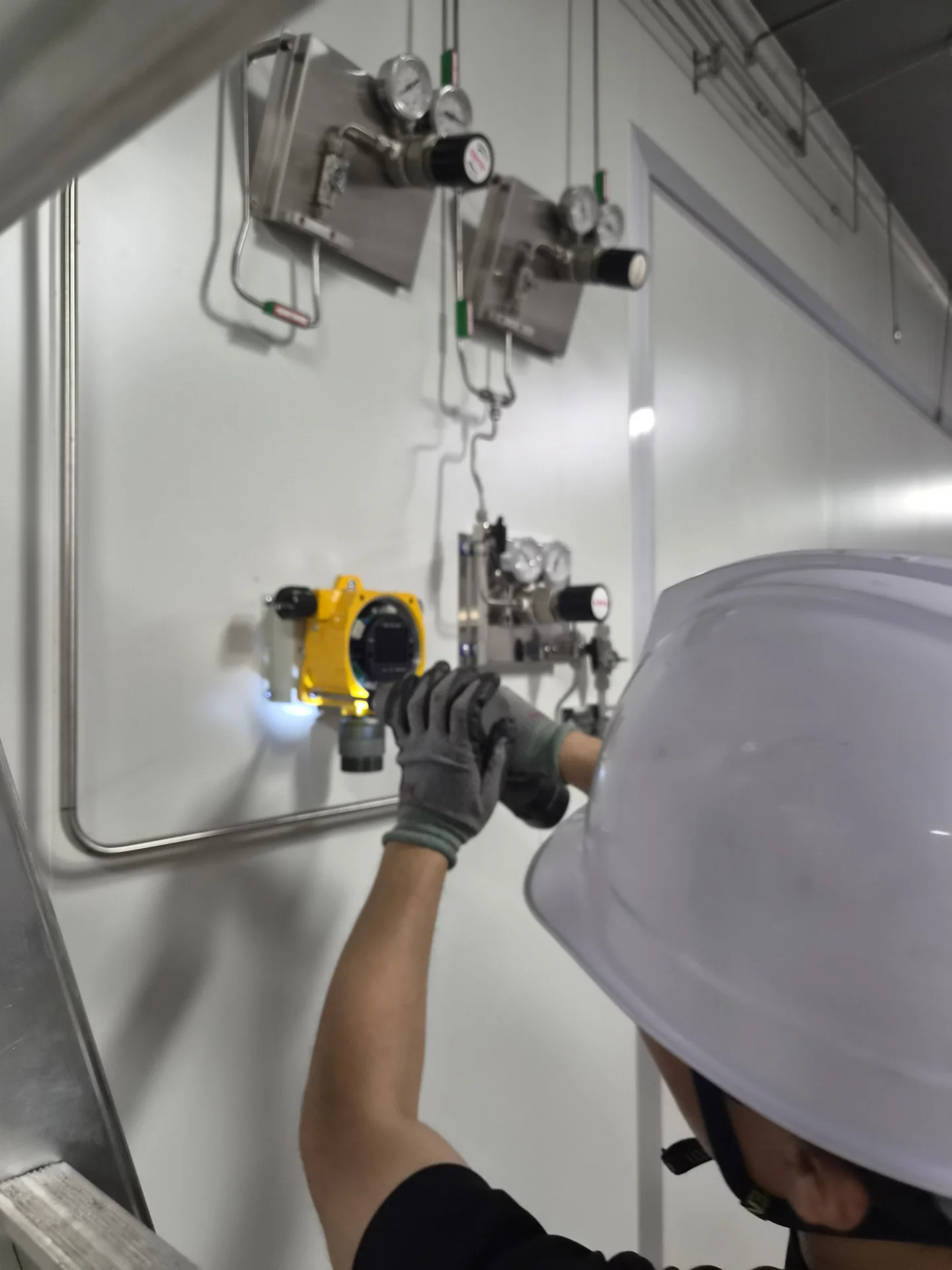
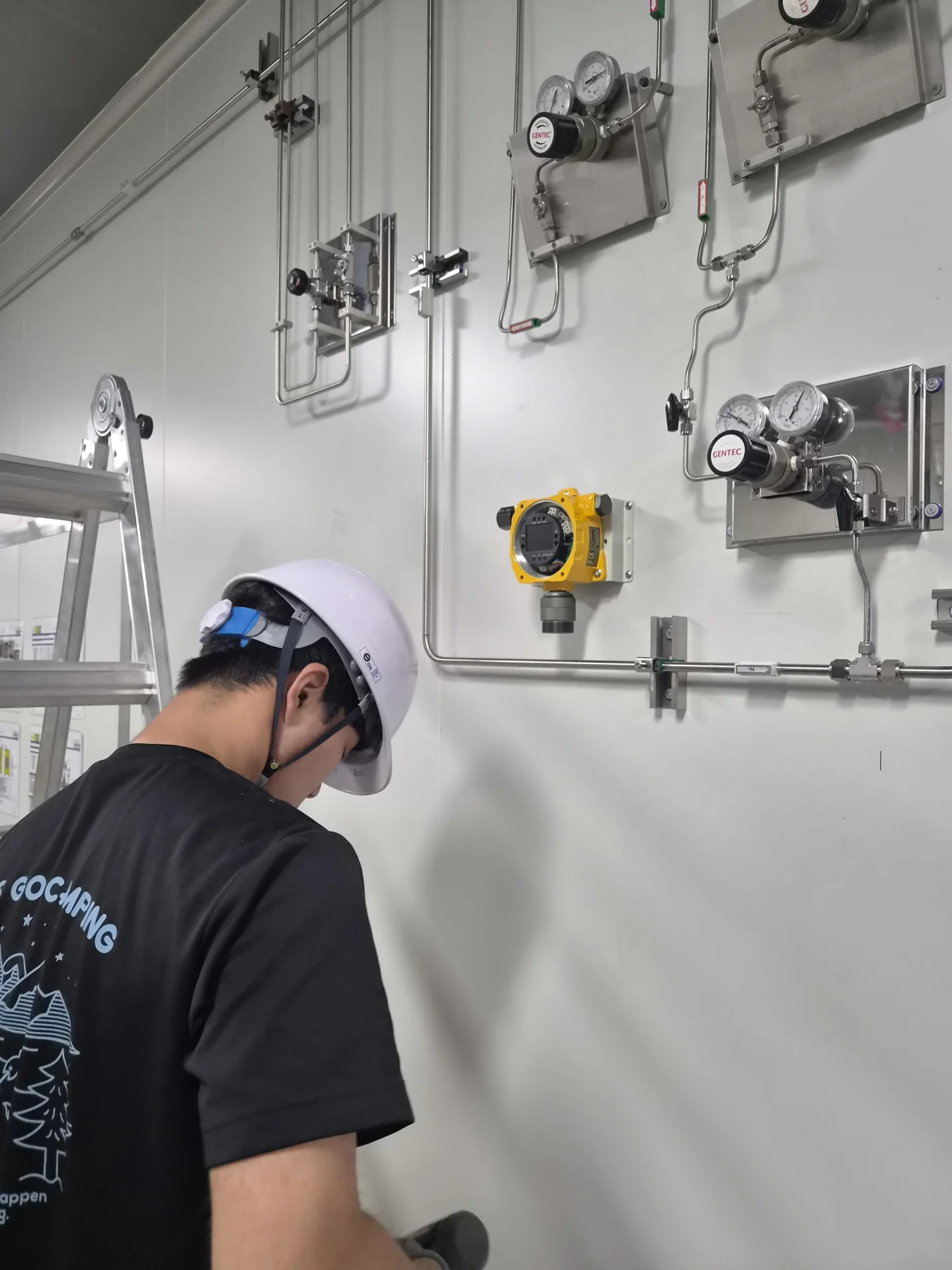
Even though the location had already been selected in advance, we didn't drill mounting holes right away. We placed the actual unit against the wall to recheck the clearance from the piping and the wiring direction, then used a level to fix the exact position.
A gas detector isn't a device that is simply installed once and forgotten — it also requires sensor inspection and maintenance afterward, so piping layout, workability, and maintainability all need to be considered together.
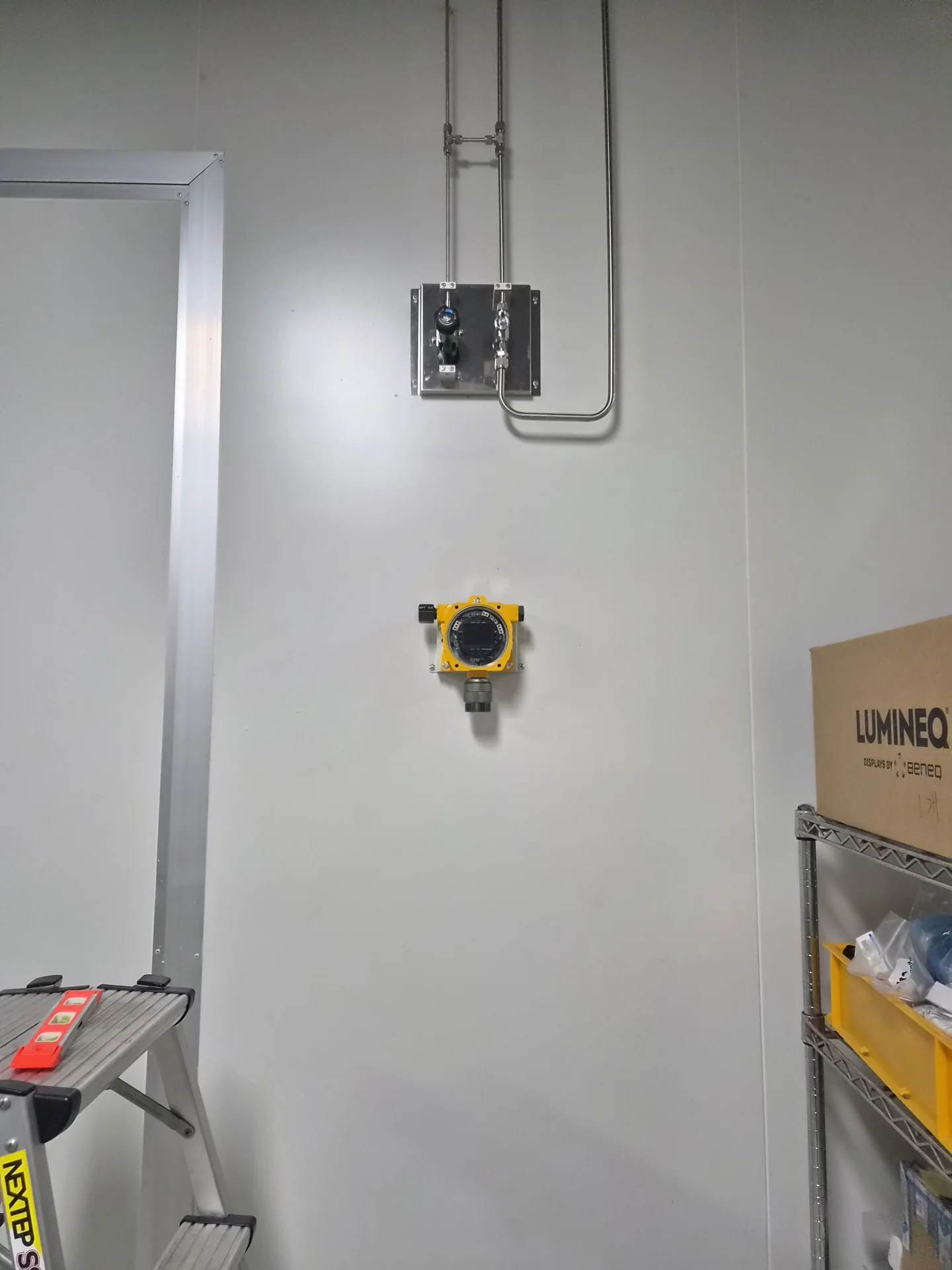
After finalizing the installation location, the fixed detector was mounted. In a photo, this looks like a single unit being attached to a wall, but on an actual site each of the following has to be checked individually: installation height, wiring entry direction, interference with existing piping, the position of the measurement point, and the space needed for maintenance. Confirming the installation location in advance during the preliminary visit helped reduce the actual working time and allowed for a cleaner installation.
Key Point of This Site: N₂ Is Not Measured Directly
There is one important point to explain about this system: this site does not analyze N₂ directly with a nitrogen sensor. What is actually measured is oxygen (O₂).
Ordinary ambient air contains roughly 20.9% oxygen (O₂) and about 78% nitrogen (N₂). When nitrogen is introduced into a space, the relative proportion of oxygen decreases. For this reason, this site was configured to measure the oxygen concentration directly with an O₂ sensor and use that value to calculate and display the N₂ concentration.
Converting O₂ Readings into N₂ Concentration
In simple terms, the conversion works as follows: N₂ (converted) ≈ 100% − O₂ concentration. For example, O₂ 20.8% converts to approximately N₂ 79.2%, O₂ 20.7% converts to approximately N₂ 79.3%, and O₂ 20.6% converts to approximately N₂ 79.4%. The values shown on this status display are calculated using this method.
However, because ordinary air also contains other components such as argon and carbon dioxide, these figures should be understood as converted values for on-site monitoring purposes rather than a precise nitrogen purity analysis.
Why Measure O₂ on a Nitrogen Site?
In a space where nitrogen is used, the key safety question for workers is "how much oxygen currently remains?" Nitrogen itself is not generally classified as a toxic gas, but if a large volume enters an enclosed space, it displaces the existing air and can lower the oxygen concentration. In simple terms, the relationship is: increased nitrogen inflow → decreased oxygen concentration → increased risk of oxygen deficiency. For this reason, the system was configured to actually measure O₂ while converting and displaying the reading as an N₂ concentration for easier management by the customer.
Converted N₂ Values vs. Nitrogen Purity Measurement
One distinction should always be made here: this method is a system for monitoring concentration changes and conditions within the work space. It serves a different purpose than analyzing the precise purity of nitrogen gas itself, such as verifying a nitrogen generator's output at N₂ 99.9%, 99.99%, or 99.999%. If precise nitrogen purity needs to be measured, a separate, dedicated gas analysis instrument capable of precisely analyzing residual oxygen should be considered. Even though both cases are described as "nitrogen measurement," the required equipment and measurement method differ depending on the actual purpose.
Installation Complete
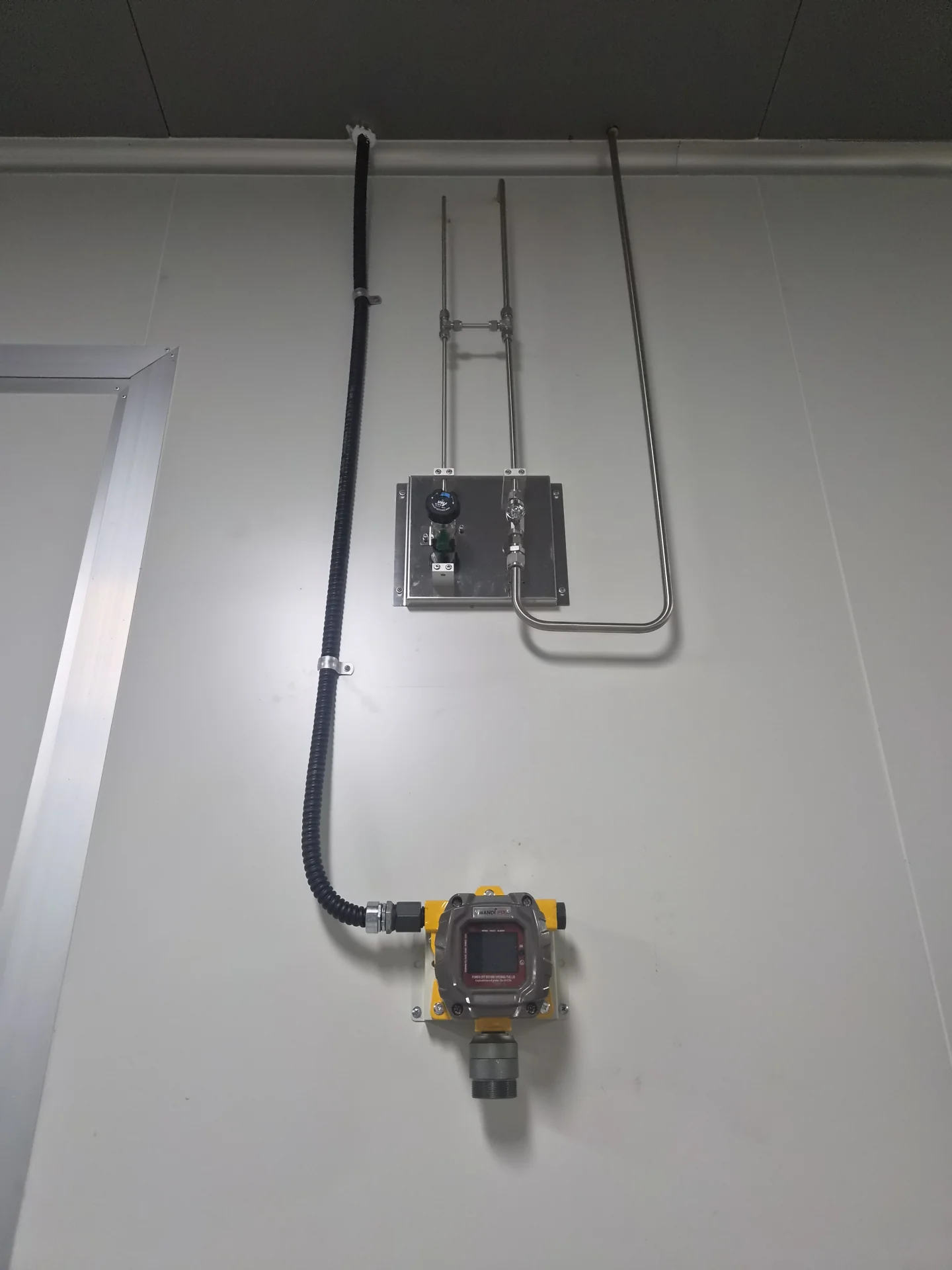
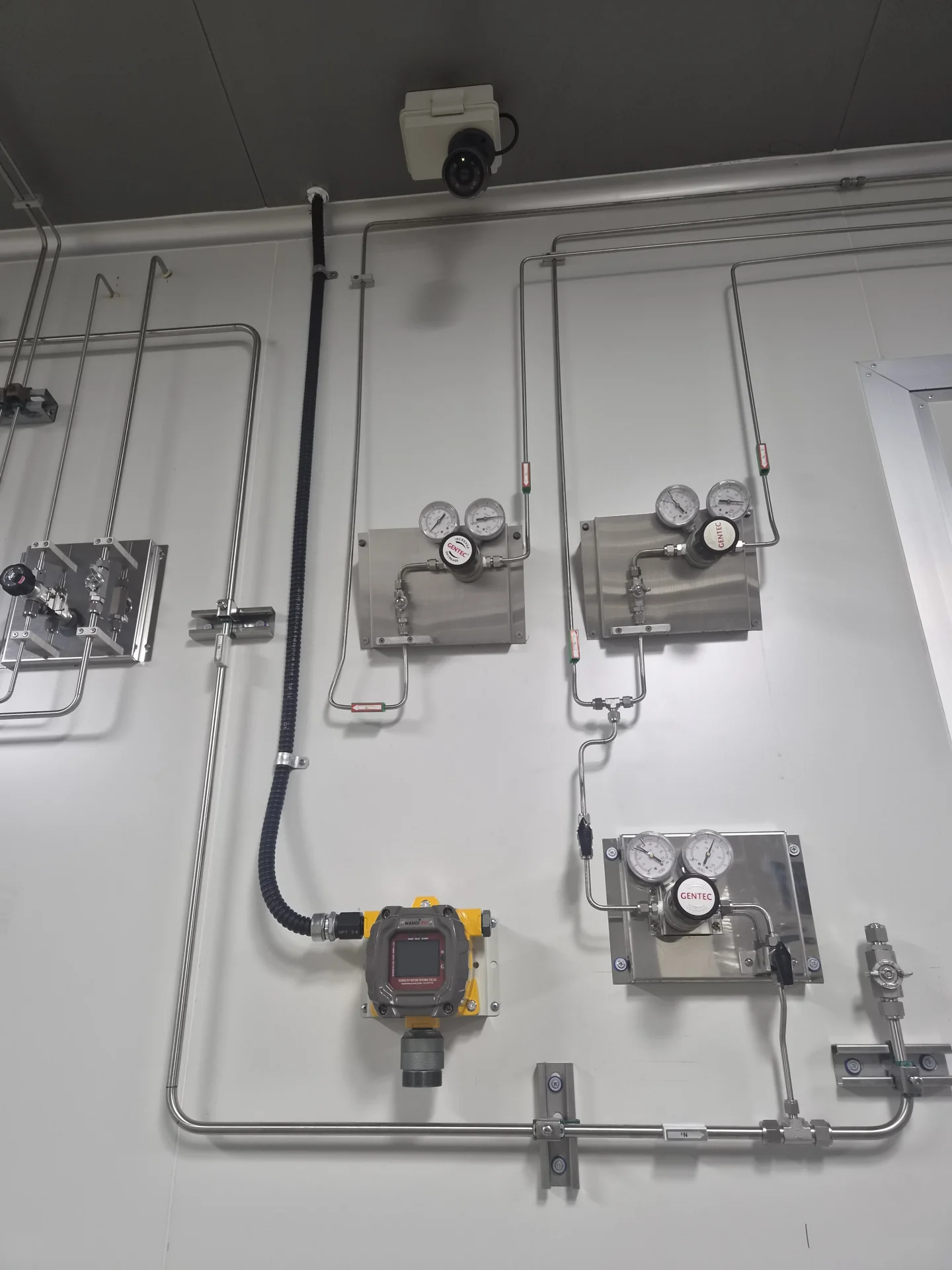
After the detector was installed, we checked the piping, power, and signal connections. With a fixed system, the work isn't finished simply by mounting the unit on a wall — it's essential to confirm that the measured values are actually being transmitted correctly to the status display.
Checking the Internal Wiring and Signals
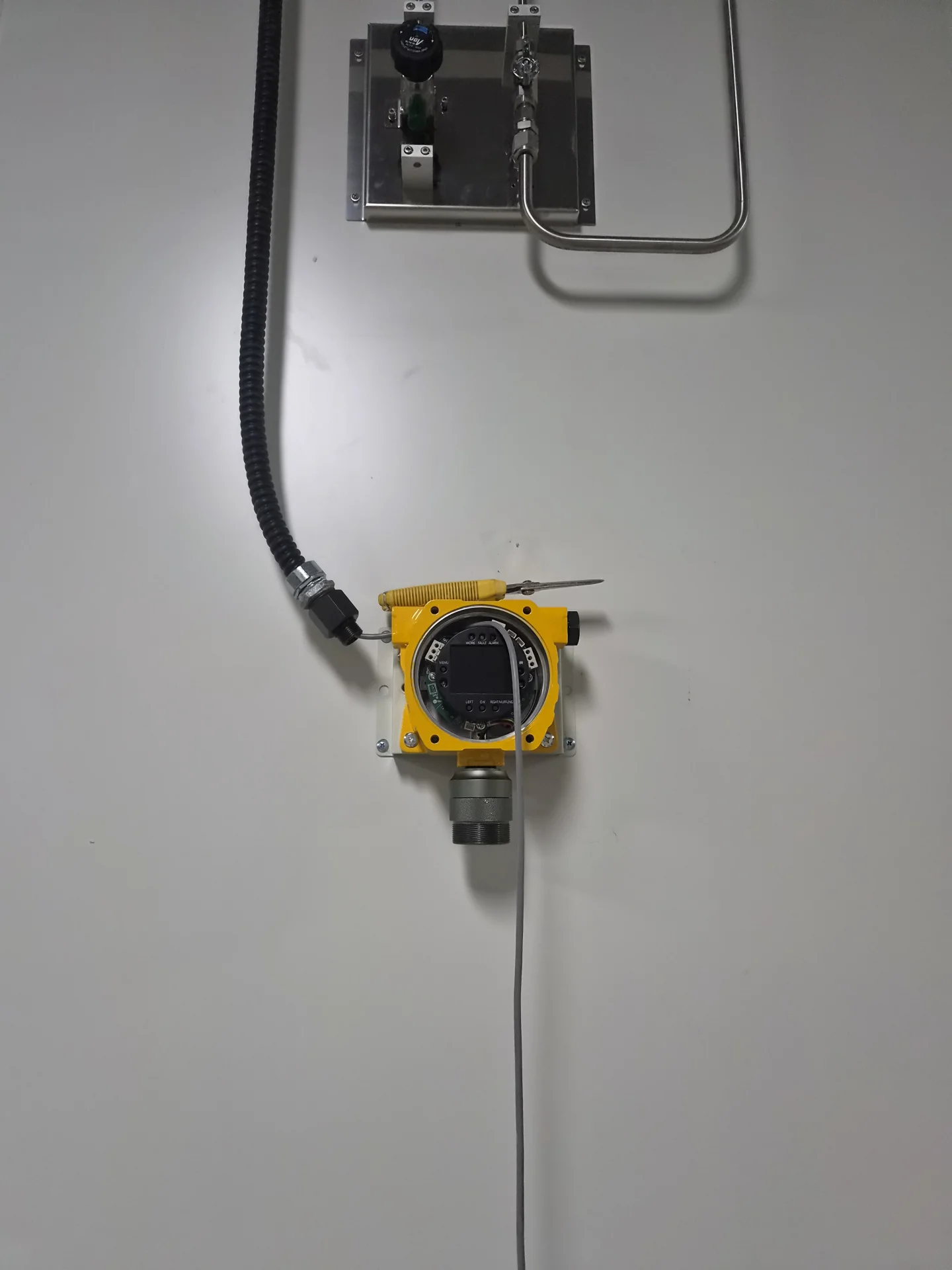
After installation, we checked the inside of the detector one item at a time: O₂ sensor operation, power connection status, output signal wiring, and whether the measured value matched the value shown on the status display. What ultimately matters is not just that a number appears on the device, but that the full chain — actual O₂ measurement → signal transmission → N₂ conversion → display on the status board — works correctly.
Bringing Multiple Measurement Points to One Location
This is the overall installation for this site.
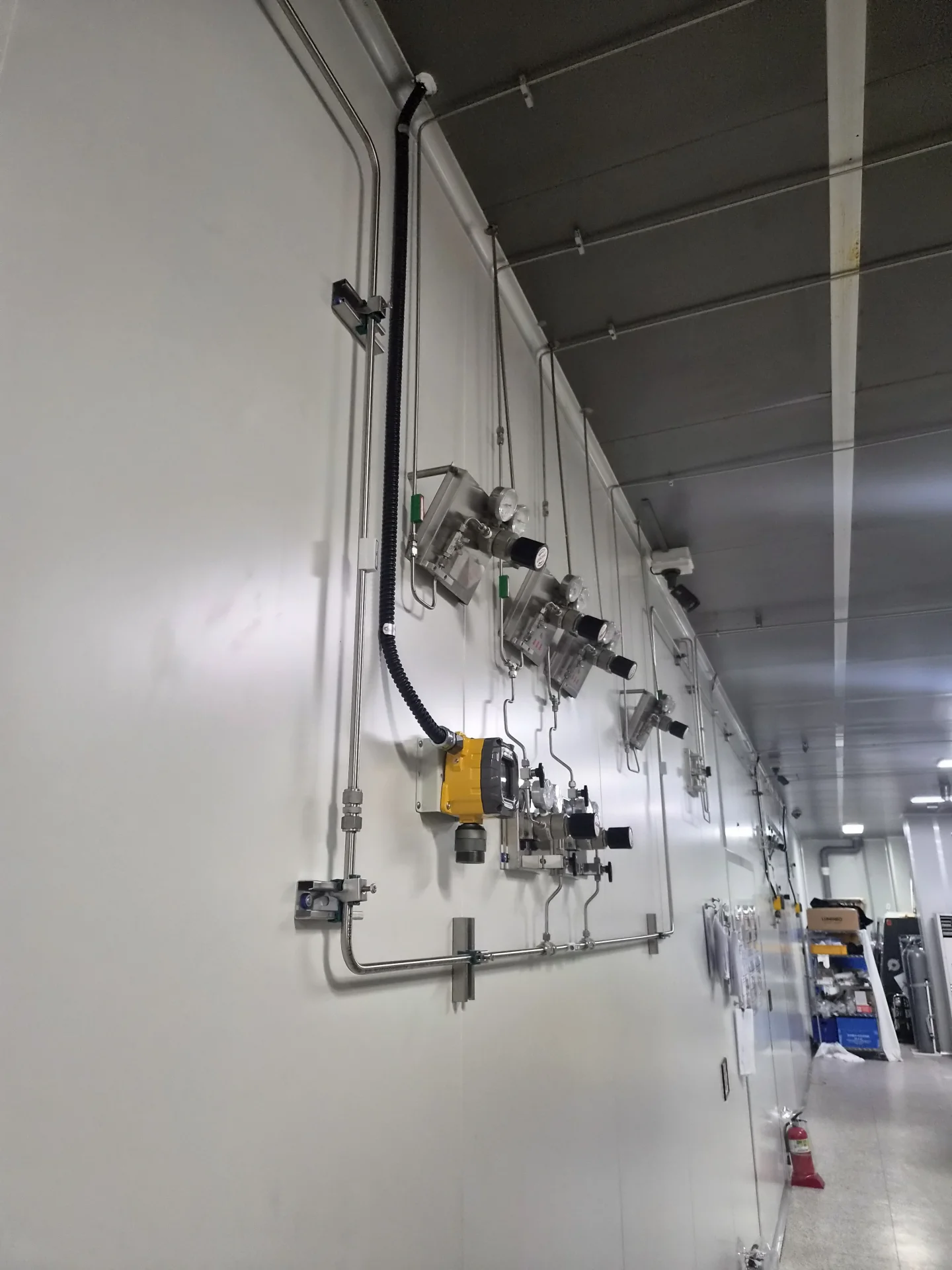
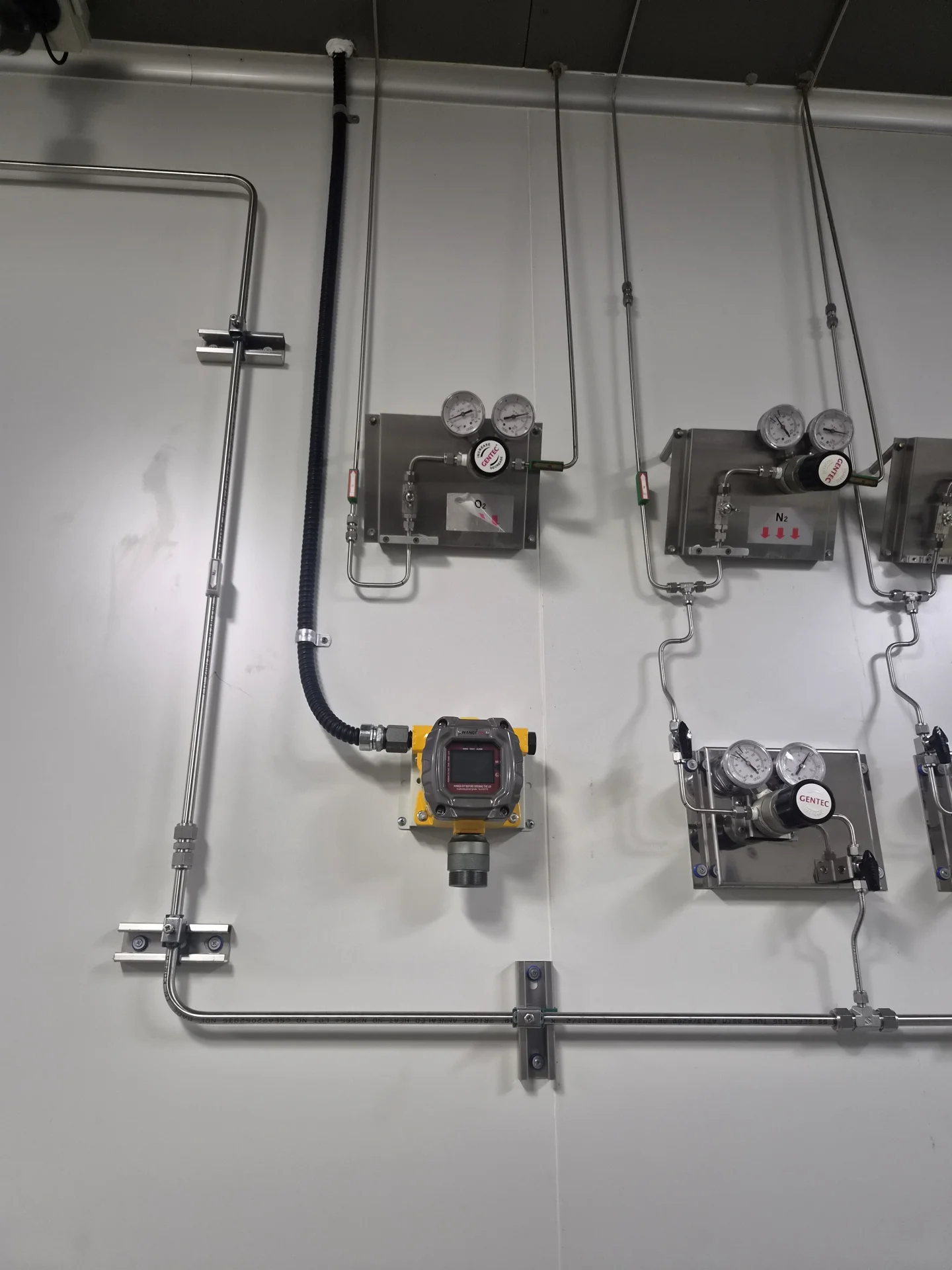
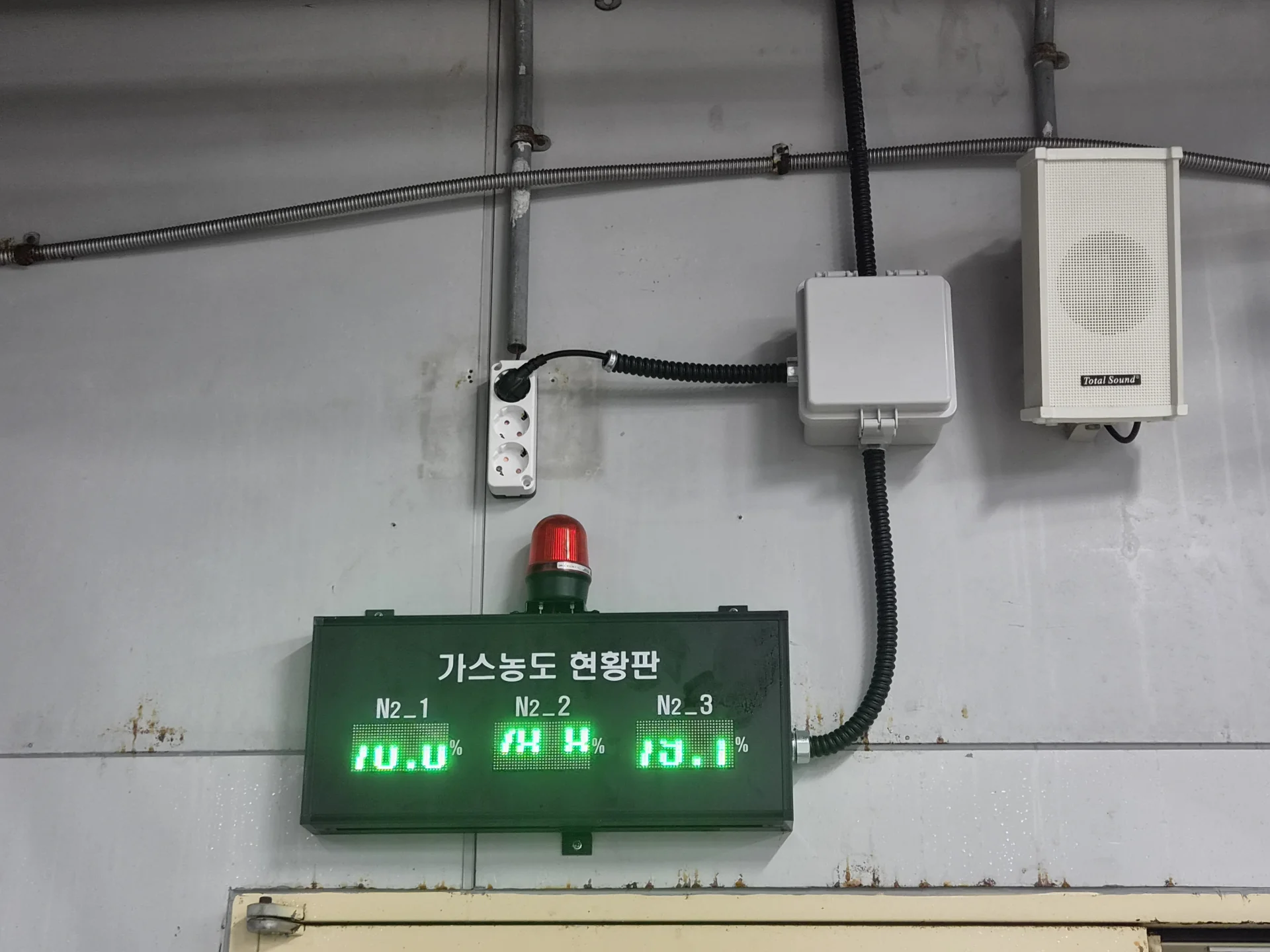
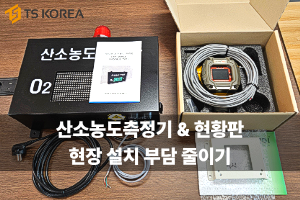
Several gas lines and regulators were installed, and the system was configured to match each measurement location. Rather than having to check each detector individually, it is far more convenient on site to be able to gather data from multiple points in a single location. For that reason, the O₂ data measured at each point is converted into an N₂ concentration and can all be checked on a single gas concentration status display.
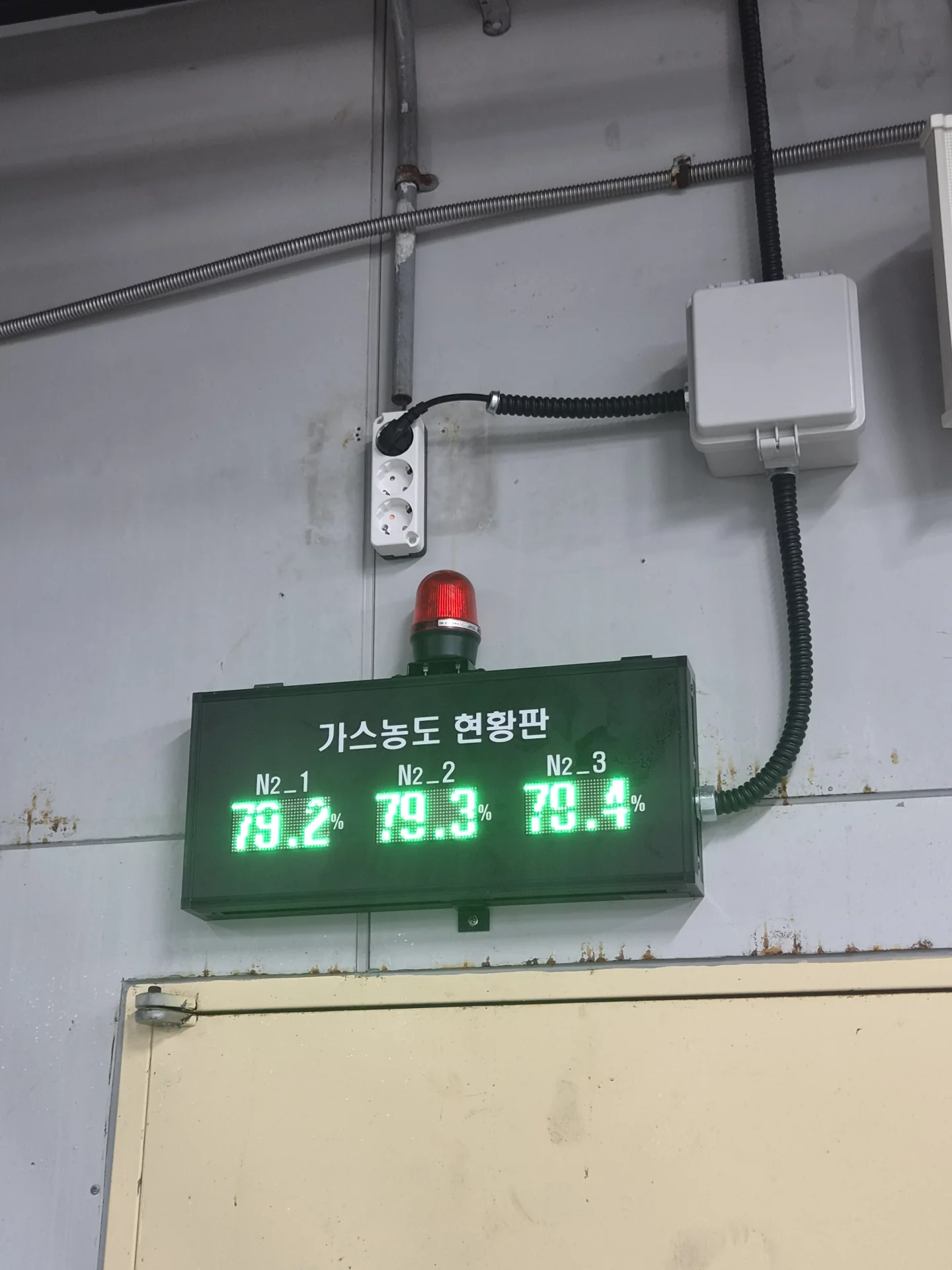
Final Commissioning: N₂_1 / N₂_2 / N₂_3
Finally, we confirmed that the values were being displayed correctly on the status board.

At the time the photo was taken, the status display showed converted N₂ values of N₂_1 79.2%, N₂_2 79.3%, and N₂_3 79.4% at the respective measurement points. Converted back to the underlying O₂ readings, this corresponds to approximately O₂ 20.8%, 20.7%, and 20.6%. In other words, while the status display shows the N₂ concentration, the system is actually measuring the O₂ concentration and converting that value into the displayed N₂ reading. Being able to view multiple measurement points on a single status display also made on-site management significantly more convenient.
Key Takeaways From This Installation
This site was not simply a matter of "installing three detectors." The core of this project was integrating the entire process — preliminary site visit, confirming the installation location and system configuration, installing the fixed O₂ detector, measuring O₂, converting to N₂ concentration, and commissioning the status display — into a single coherent system.
For a fixed measurement system in particular, properly assessing the site before installation is just as important as selecting the right product. Without checking the site layout in advance, problems can surface on installation day — piping that blocks the planned location, difficulty routing power, or trouble running signal cable to the status display. That's why our team reviews the full set of site conditions together, from the pre-installation site check through to final commissioning, whenever needed.
Confirming the Purpose First, Even for the Same "Nitrogen Measurement" Request
When a customer inquires about measuring nitrogen, the first thing our technical team confirms is: "What is the purpose of measuring nitrogen?" If the goal is to monitor changes in the nitrogen concentration of a space, a method like this one — measuring O₂ and converting it to an N₂ value — can be considered. If the goal is to confirm oxygen deficiency caused by nitrogen inflow, then direct O₂ concentration measurement is what matters most. If the goal is to verify the purity of a nitrogen generator (such as N₂ 99.9% or 99.99%), a different, dedicated precision gas analysis instrument is required for that purpose. Ultimately, it is more important to confirm the measurement purpose and site conditions first, rather than choosing equipment before that.
Closing
This nitrogen concentration monitoring system was completed successfully, following the sequence of preliminary site visit → confirming the installation location → installing the detector → piping and wiring work → O₂ measurement → N₂ value conversion → integration with the status display → final commissioning.
As with this project, a fixed gas detection system involves more than simply supplying a product — it's important to consider together how the measurement will actually be carried out on site, where the equipment should be installed, and how the measured values will be managed going forward. If you need a fixed gas monitoring system for nitrogen (N₂), oxygen (O₂), or similar applications, or if you'd like to manage readings from multiple measurement points in one place, we recommend reviewing your site layout and measurement purpose before selecting equipment.
자주 묻는 질문 (FAQ)
Q1. Why does the status display show N₂ if the sensor actually measures O₂?
Because nitrogen itself is not directly analyzed on this site. Instead, an O₂ sensor measures the oxygen concentration, and the system calculates the corresponding N₂ concentration using the relationship N₂ (converted) ≈ 100% − O₂ concentration, then displays that converted value on the status board.
Q2. Is this converted N₂ value the same as a nitrogen purity measurement?
No. This system is designed to monitor concentration changes within the work space for safety purposes, not to analyze the precise purity of nitrogen gas (such as a nitrogen generator's N₂ 99.9% or 99.99% output). Precise purity verification requires a separate, dedicated gas analysis instrument.
Q3. Why is oxygen monitoring important on a nitrogen-use site?
Because the key safety concern for workers is how much oxygen remains in the space. Nitrogen itself is not generally classified as toxic, but a large inflow of nitrogen displaces existing air and can lower the oxygen concentration, increasing the risk of oxygen deficiency.
Q4. Why is a preliminary site visit necessary before installing a fixed detector?
Because the correct installation method depends on the site's piping layout, existing equipment, power and signal routing, and future maintenance access. Confirming these conditions in advance helps avoid on-site problems on installation day and results in a cleaner, faster installation.
Q5. Can multiple measurement points be managed from a single location?
Yes. In this project, O₂ data from several measurement points was each converted into an N₂ concentration and integrated into a single gas concentration status display, allowing all readings to be checked from one location instead of visiting each detector individually.
#WANDI#NitrogenMonitoring#OxygenDetector#FixedGasDetector#GasMonitoringSystem#ConfinedSpaceSafety#IndustrialSafety#N2Monitoring#FactorySafety#GasDetectionInstallation