Applied Markets
Installed Gases
Project Details
Semiconductor Equipment Manufacturer Cleanroom — Nitrogen Environment Oxygen Deficiency Prevention
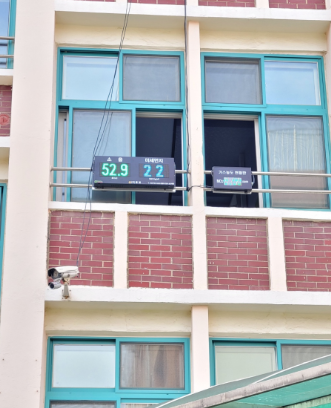
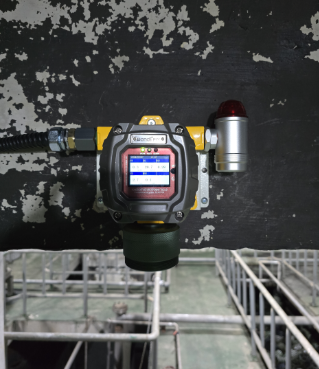
This project installed FIX800 fixed O₂ detectors and three custom-manufactured LED display boards at the cleanroom production facility of a semiconductor equipment manufacturer in Pyeongtaek, Gyeonggi-do. The facility operates cleanroom production lines that use nitrogen (N₂) gas continuously throughout the manufacturing process. Nitrogen is a colorless, odorless inert gas that cannot be detected by human senses; when it leaks inside a tightly sealed cleanroom, it displaces oxygen rapidly, creating oxygen-deficient conditions that pose an immediate asphyxiation risk to personnel. Continuous O₂ monitoring is therefore essential.
Installation Specifications
| Item | Details |
|---|---|
| Detector | FIX800 fixed O₂ (oxygen) monitor |
| Display boards | Custom-manufactured gas concentration display board × 3 units |
| Display board notes | Customer-specified design — custom-manufactured to cleanroom environmental and aesthetic requirements |
| Installation environment | Semiconductor equipment manufacturing cleanroom production line |
| Location | Pyeongtaek, Gyeonggi-do |
O₂ Monitor Installation Principles for Cleanroom Nitrogen Environments
- Installation height: Nitrogen is slightly denser than air but disperses rapidly; detectors are positioned at worker breathing height (1.0–1.5 m above floor)
- Installation position: Near nitrogen supply line valves, fittings, and connections; within areas where personnel are continuously present
- Display board position: Outside each cleanroom airlock (pre-air-shower) — enables O₂ verification before entry
- Alarm setpoints: 1st alarm at 19.5%, 2nd alarm at 18.0% — relay output can be interlocked with cleanroom airlock door access control
Benefits of Custom Display Board Fabrication
- Designed to meet cleanroom environment requirements — dust-resistant, humidity-resistant, appropriate materials
- Display board dimensions, color, and materials matched to cleanroom interior specifications
- Each of the three cleanroom zones has a dedicated display board at its entrance — independent O₂ status visible for each zone before entry
- Customer-specified features — language, measurement units, display layout — implemented as requested
Frequently Asked Questions
Why does nitrogen usage in a cleanroom create an oxygen deficiency hazard?
Cleanrooms are sealed environments with limited air exchange — designed to prevent external particulate ingress through double-door airlocks and positive pressure maintenance. In this confined structure, even minor nitrogen leakage from pipe connections or valves can rapidly reduce local O₂ concentration. Workers have no sensory means to detect nitrogen leaks, making the O₂ detector the sole safety warning system.
Are there special particulate control requirements for FIX800 units installed in a cleanroom?
Cleanroom ISO classification determines acceptable particulate generation limits. Standard FIX800 units are generally suitable for ISO Class 5–7 environments. For higher-cleanliness requirements, protective covers or enclosures can be added. Confirming the applicable cleanroom classification before specifying the installation approach is recommended.
Why were three display boards distributed rather than using a single centralized board?
The facility comprised three separate cleanroom zones, each with its own dedicated entry point. Installing one display board outside each zone's entrance allows personnel to verify the O₂ concentration within that specific zone before entering — clearly distinguishing each zone's status without ambiguity or cross-reference between areas.
What is cleanroom airlock door interlock integration?
Connecting FIX800's relay output to cleanroom airlock door electronic lock systems enables automatic physical entry restriction when O₂ concentration falls below the alarm threshold. This prevents personnel from inadvertently entering an oxygen-deficient cleanroom zone — the strongest possible hardware enforcement of confined space entry safety.
Are there other gases beyond O₂ that should be monitored in a semiconductor equipment manufacturing cleanroom?
In addition to nitrogen, semiconductor equipment manufacturing processes may also use process gases such as H₂, Ar, and He. The FIX800 O₂ sensor indirectly detects leakage of all these inert gases — any inert gas displacement of oxygen reduces the ambient O₂ reading, allowing a single O₂ detector to provide broad coverage against multiple inert gas leakage scenarios.
#CleanroomOxygenMonitor #FIX800O2Cleanroom #CustomDisplayBoard #NitrogenOxygenDeficiency #SemiconductorEquipmentSafety #PyeongtaekSemiconductor #FixedGasDetector #OxygenMonitoring #WANDIKorea #RaymondKorea
![설치] 원주 국토5호선 신림~판부간 터널공사 밀폐공간 안전용 가스측정기 FIX800 4GAS O2 CO CO2 LEL 설치!](https://wandi.co.kr/storage/construction-cases/Ekn7PulFgplHqjZgJUfOsevvzH0Kawa1G0h9NlH8.png)
![설치] 약품 폐수탱크 수위계와 인디게이터 설치 그리고 무선 모니터링까지 MP + SUP1100 + FIX-AP](https://wandi.co.kr/storage/construction-cases/UjHcHl5kWktnCXlnvMIgk6eQhh7pqwuf3u65iKLO.png)