Applied Markets
Installed Gases
Project Details
Hello.
Today we've selected one of the most representative site cases that we frequently receive installation inquiries about.
Generally, in buildings, factories, and large facilities, electrical rooms, boiler rooms, sewage treatment facilities, and fire suppression agent rooms are located in the basement.
Since these facilities are located underground, ventilation through windows is not possible unless a ventilation system is installed.
Why are these facilities designated as confined spaces?
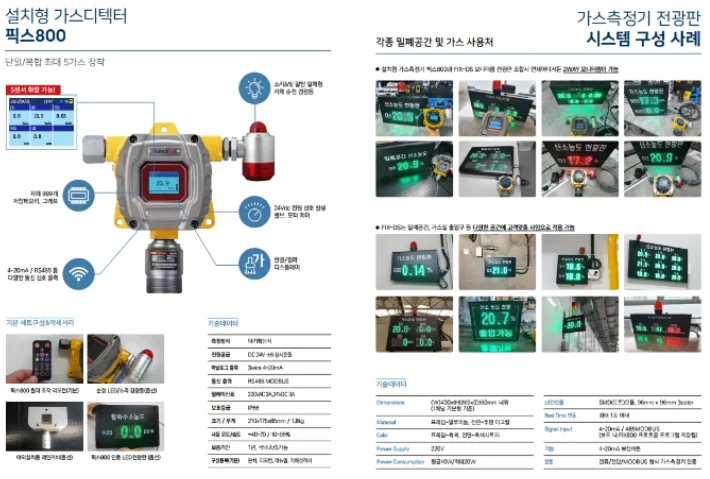
Electrical Room – Where high-voltage electricity is supplied and distributed; electrical leakage or overcurrent poses a risk of major fire → Managed with CO and LEL detection
Boiler Room – If combusted gas from the boiler fails to exhaust through the duct and backflows, or incomplete combustion occurs due to insufficient oxygen supply, there is a risk of fire and suffocation → Managed with CO, O2, and LEL detection
Sewage Treatment Facility (Septic Tank) – Backflow from the septic tank or hazardous gas generated within it poses a risk of suffocation → Managed with O2, H2S, and LEL (NH3) detection
Fire Suppression Agent Room – Malfunction or leakage of extinguishing gases such as CO2, refrigerant, or Halon poses a risk of suffocation → Managed with O2 and CO2 detection
For these reasons, these confined spaces can generally be managed to prevent suffocation, gas leak accidents, and explosion accidents by monitoring the relevant gases.
Today's site also involved installing a gas concentration measurement system in the confined space facilities in the basement of a large shopping mall, including the electrical room and boiler room.
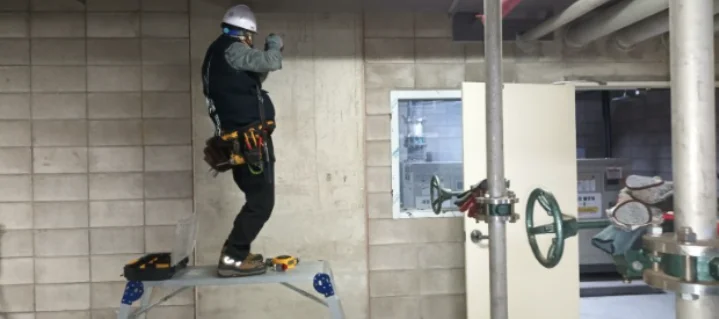
Safety first, safety always.
For work at height, we use trestle scaffolding as much as possible for safe work, and strictly follow the two-person rule when using ladders.
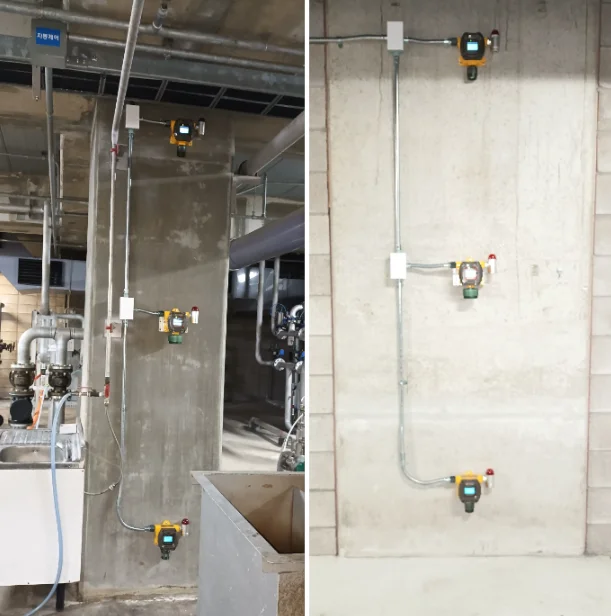
For today's site, at the special request of the safety supervisor, the detector was installed with the gas's specific gravity taken into consideration. We'll explain the measurement location based on gas density in more detail in the following photos.
Since the detector needed to match the site's wiring finish, steel conduit was used for the installation.
We select from GW flexible conduit, flame-retardant conduit, steel conduit, explosion-proof conduit, and other options based on prior consultation to match each site.
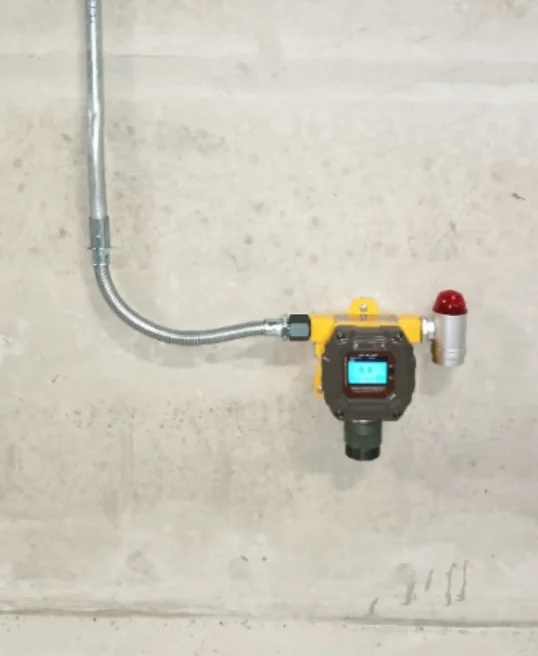
If you ask how the detector installation location should be determined based on gas density, our answer is:
"The Korea Occupational Safety and Health Agency (KOSHA) recommends installing detectors with gas density in mind, but installing them near the actual point where a leak could occur is far more important than considering density alone."
"For example, if there is a CO2 gas cylinder 1m tall, the standard recommendation — since CO2 is heavier than air — would be to install the detector 30cm from the floor, ignoring the cylinder's position. But in practice, installing it near the CO2 cylinder's valve is the correct approach. A gas being heavier than air doesn't mean it immediately sinks to the floor the moment it leaks. The detector must be installed near the leak point to ensure the fastest possible detection."
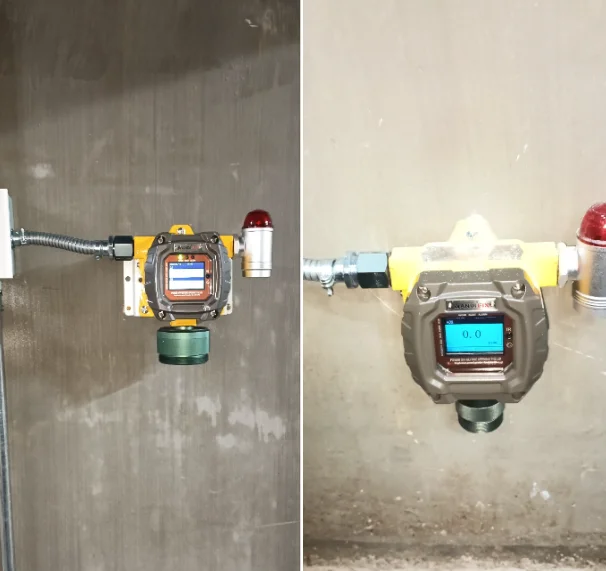
In any case, for this site, the leak points were spread across a wide area, and there was a special request from the site's safety supervisor.
Taking this into account:
1. Carbon monoxide (CO), which has a density similar to air, was installed at nose height alongside oxygen (O2).
2. Methane (LEL), which is lighter than air, was installed above head height.
3. Hydrogen sulfide (H2S), which is heavier than air, was installed near the floor.
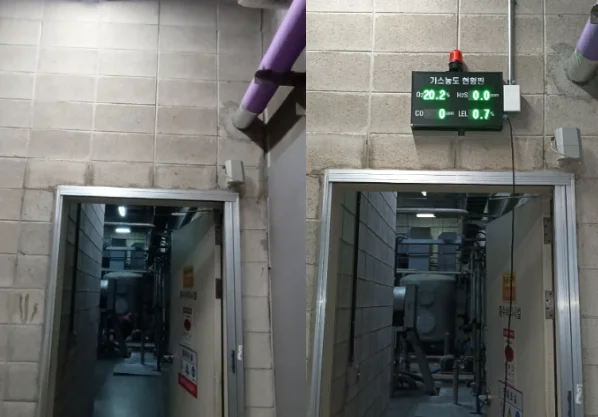
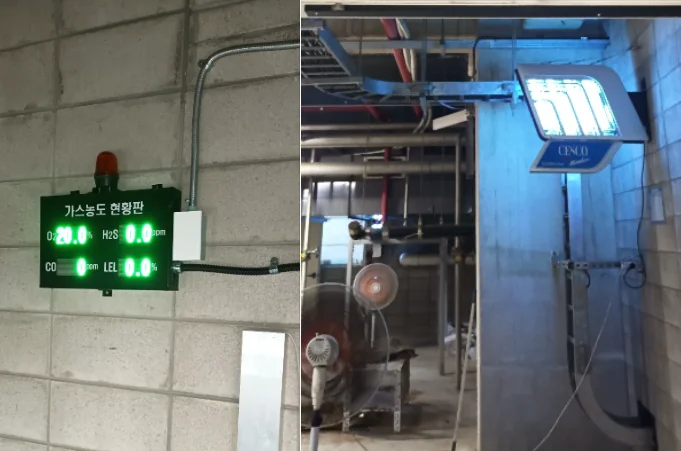
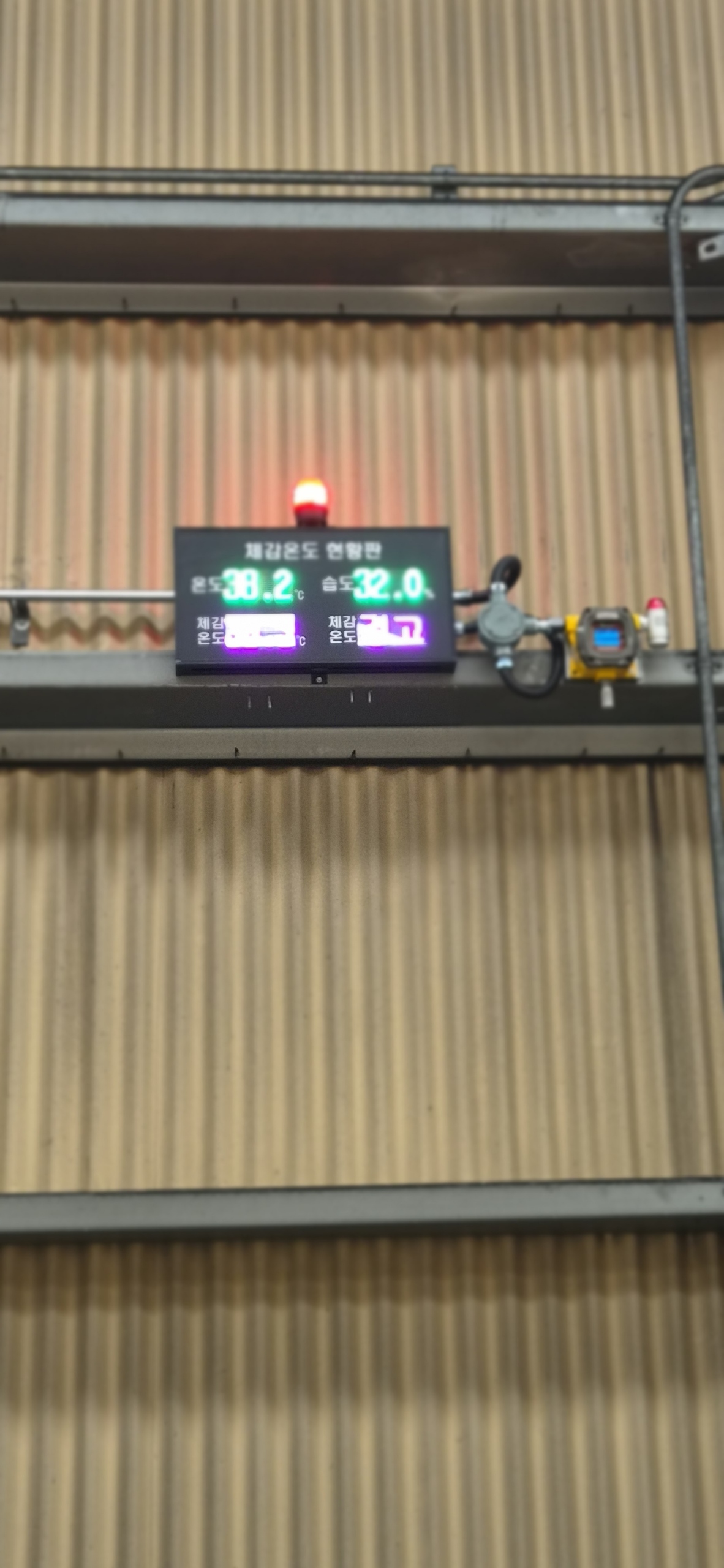
A gas concentration display board was installed at the entrance of the confined space, allowing gas concentration inside the confined space to be monitored both internally and at the entrance in a dual configuration.
For spaces storing high-concentration gases, such as fire suppression agent rooms, workers could lose consciousness and collapse immediately upon entering if a gas leak occurs, which is why this dual monitoring approach is considered essential.
Most customers who reach out for the first time worry that selecting and installing a gas detector will require a huge budget or that installation will be dangerous or complicated.
However, gas detector installation is very simple since it's done with exposed conduit, and safety gas detectors for work environments tend to be on the more affordable end among gas detectors.
This concludes today's installation case.
Thank you.
Frequently Asked Questions (FAQ)
Q1. What is a confined space and why is it dangerous?
Underground spaces such as electrical rooms, boiler rooms, sewage treatment facilities, and fire suppression agent rooms are confined spaces with limited ventilation, posing risks of gas leaks, suffocation, and explosion — requiring dedicated gas concentration management.
Q2. What gases are monitored in each type of space?
Electrical rooms are monitored with CO/LEL, boiler rooms with CO/O2/LEL, sewage treatment facilities with O2/H2S/LEL (NH3), and fire suppression agent rooms with O2/CO2.
Q3. How is the detector installation location determined based on gas density?
In principle, installing the detector near the actual leak point is most important. For this site, CO (similar density to air) was installed at nose height alongside O2, methane (LEL, lighter than air) was installed above head height, and hydrogen sulfide (H2S, heavier than air) was installed near the floor.
Q4. How is the confined space entrance managed?
A gas concentration display board is installed at the entrance, enabling dual monitoring both inside the confined space and at the entrance. This dual approach is especially important for spaces storing high-concentration gases, such as fire suppression agent rooms.
Q5. What about installation cost and difficulty?
Gas detector installation is very simple since it uses exposed conduit, and safety gas detectors for work environments are relatively affordable among gas detectors.
#WANDI #ConfinedSpaceGasDetector #ElectricalRoomSafety #BoilerRoomSafety #SewageTreatmentSafety #FireSuppressionAgentRoom #GasDensityPlacement #IndustrialSafetyEquipment #GasConcentrationMonitor #OccupationalSafety
![[레이먼드] 오,폐수 처리실 유해가스 모니터링](https://wandi.co.kr/storage/construction-cases/YxFUQVBZ8Unnk7pJzzfsmezr6xNe0LZvQRDmt7TL.jpg)
![[브이피이코리아] 종합병원 지하 밀폐공간 가스 측정기 설치_FIX800 & FIX-DS](https://wandi.co.kr/storage/construction-cases/gNOA28xSlEy5uU3AOxyHDRH5UfAe0TpMTgAt4Uag.jpg)

