📌 3 Key Takeaways
- A gas detector's mounting height depends entirely on the gas's density relative to air. Gases heavier than air should be monitored near the floor, and lighter gases near the ceiling, so a leak is caught quickly.
- Alarm setpoints aren't arbitrary numbers — they should be set in stages based on three exposure standards: TWA (Time-Weighted Average), STEL (Short-Term Exposure Limit), and IDLH (Immediately Dangerous to Life or Health).
- Getting height or setpoints wrong means an incident can happen before the gas ever reaches the detector — or, in the opposite direction, unnecessary false alarms erode trust in the safety system.
A gas detector shouldn't simply be mounted at eye level. Even in the same confined space, whether it needs to sit near the floor or near the ceiling depends entirely on which gas is being measured. Add incorrect alarm concentration setpoints (TWA/STEL/IDLH) on top of that, and a site can install an expensive detector yet still miss a real leak — or the opposite, trigger false alarms several times a day. This article breaks down installation height by gas density and the concept behind alarm setpoints from a practical field perspective.
Why Gas Density Determines Mounting Location
Gas density (specific gravity) is a gas's weight relative to air, where air equals 1. A value above 1 means the gas is heavier than air and sinks toward the floor; below 1 means it's lighter and rises. A gas detector only matters if it sits where leaked gas naturally travels and accumulates — no matter how precise the sensor is, it can't detect a leak that never reaches it.
| Category | Representative gases (approx. specific gravity) | Movement behavior |
|---|---|---|
| Heavier than air (SG > 1) | Hydrogen sulfide (~1.19), carbon dioxide (~1.53), propane/butane (~1.5–2.0), chlorine (~2.5), chlorine dioxide | Settles and accumulates at floor level, pits, manholes |
| Close to air (SG ≈ 1) | Carbon monoxide (~0.97), nitrogen | Diffuses evenly through the space, lingers near breathing height |
| Lighter than air (SG < 1) | Hydrogen (~0.07), methane (~0.55), ammonia (~0.6) | Accumulates near ceilings and upper spaces |
※ These specific-gravity figures are general engineering reference values at standard temperature and pressure; actual conditions (mixtures, temperature) may vary.

Practical Mounting Height Rules by Gas Density
The height rules commonly used on industrial sites can be summarized as follows.
- Heavier-than-air gases (SG ≥ 1) — Mount within 30cm–1m of the floor. The bottom of recessed spaces like manholes, pits, and tanks is the top-priority monitoring point.
- Lighter-than-air gases (SG < 1) — Mount within 30cm of the ceiling. Gas tends to collect near the tops of piping and enclosed rooms.
- Gases close to air density — Mount at the worker's breathing height (roughly 1.2–1.5m from the floor) so the reading reflects what a person is actually breathing.
- Known leak points — Regardless of density, prioritize locations near valves, flanges, and joints where a leak is most likely.
That said, real sites don't always behave exactly per theory — ventilation design, temperature, and airflow direction all affect how gas actually moves. That's why WANDI reviews the site's layout and ventilation system alongside density rules before proposing final mounting locations.
What Are Alarm Setpoints? Understanding TWA, STEL, and IDLH
A gas detector's alarm setpoint shouldn't be a guess like "lower is probably safer" — it should be grounded in three exposure-standard concepts.
TWA (Time-Weighted Average)
The exposure concentration averaged over a typical 8-hour shift. Momentary spikes above this value are allowed if the time-weighted average stays within limits, but repeated long-term exposure can accumulate into chronic health effects — making TWA the common basis for a first-stage (pre-alarm) setpoint.
STEL (Short-Term Exposure Limit)
The maximum allowable concentration for a brief exposure, typically 15 minutes. Even within TWA limits, a sharp short-term spike can trigger acute symptoms — so STEL is set higher than TWA and is commonly used to define a second-stage (high-concentration) alarm.
IDLH (Immediately Dangerous to Life or Health)
A concentration at which a person could lose the ability to escape, or suffer irreversible harm or death. When a detector signals a reading approaching IDLH, it should trigger immediate evacuation, ventilation, and work stoppage — typically configured as the highest-level (third-stage or emergency) alarm.
| Gas | TWA level (reference) | STEL level (reference) | IDLH level (reference) |
|---|---|---|---|
| Hydrogen sulfide (H₂S) | Low single-digit ppm | Somewhat above TWA | ~100 ppm |
| Carbon monoxide (CO) | Tens of ppm | Several times TWA | ~1,200 ppm |
| Ammonia (NH₃) | ~20–30 ppm | ~1.3–1.5x TWA | ~300 ppm |
| Chlorine (Cl₂) | Below 1 ppm | ~2x TWA | ~10 ppm |
※ These figures are simplified reference levels based on commonly cited international occupational health sources (e.g., NIOSH). Exact limits differ by country and body (Korea's Ministry of Employment and Labor, KOSHA, ACGIH, etc.) and are periodically revised, so actual alarm setpoints must be confirmed against the current KOSHA exposure standards and the relevant MSDS before use.
Fixed vs. Portable: When to Use Which
Even a perfectly calculated density-based mounting plan can't cover every blind spot across a large site with just one or two detectors. That's why WANDI recommends combining fixed detectors for continuous monitoring with portable units for on-the-spot verification.
- Fixed detectors (e.g., FIX800) — Mounted permanently at density-appropriate locations for uninterrupted 24-hour monitoring of a defined point.
- Portable detectors (e.g., EDW500) — Carried by workers to measure blind spots not covered by fixed units, narrow pipe interiors, or right before work begins.
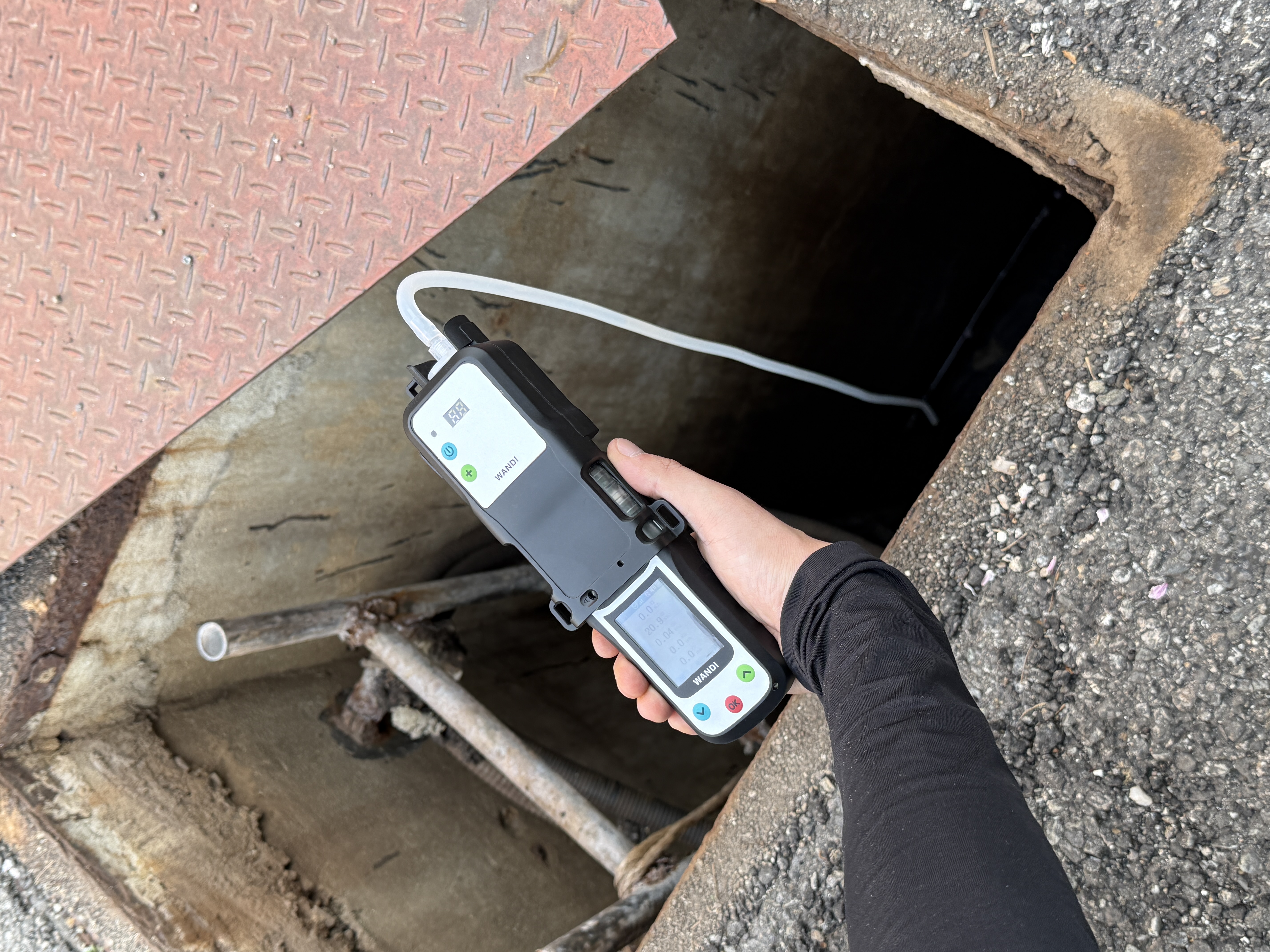
Where fixed units miss a point, portable units fill the gap — and where a portable unit flags a risky zone, a fixed detector can be added there. Running both together closes the theoretical blind spots that density calculations alone leave open, in a way that actually works on site.
A Checklist of Common Installation Mistakes
- Mounting every gas detector at eye level (1.5m) — the wrong position for both heavier and lighter gases.
- Installing right in front of an air supply or exhaust vent — readings can come in artificially low, delaying the alarm.
- Leaving alarm setpoints at the manufacturer's default — defaults may not reflect the site's actual work patterns or exposure duration.
- Setting only a first-stage alarm and skipping second-stage/emergency alarms — leaves no escalation path when concentration spikes rapidly.
- Skipping regular calibration after installation — sensor sensitivity can drift over time even if it still appears to respond normally.
Closing
Installing a gas detector doesn't by itself guarantee safety. It only does its job in a real leak when it has a location matched to the gas's density, alarm setpoints grounded in exposure standards (TWA/STEL/IDLH), and a combination of fixed and portable units. Send WANDI your site layout and list of gases handled, and we'll propose mounting locations and alarm setpoints that account for density and ventilation conditions. For consulting on gas detector placement and alarm setpoints, contact WANDI at +82-31-340-6952.