Carbon dioxide (CO₂) is a colorless, odorless, tasteless gas — undetectable by human senses even when leaking. It is generated across industrial sites: CO₂ fire-suppression systems in generator and electrical rooms, dry-ice refrigerated containers, cold-storage warehouses, fermentation and brewing facilities, and wastewater treatment. Because it cannot be smelled, CO₂ is often called "the gas you only notice when someone collapses." Since 2001, leaks from CO₂ fire-suppression systems alone have caused 11 incidents in Korea, killing 9 workers and injuring around 60. The WANDI FIX800 fixed CO₂ detector uses an NDIR infrared sensor to monitor 0–5,000 ppm concentrations 24/7, triggering instant alarms and interlock signals when danger thresholds are reached.
⚠️ 3 Key Takeaways
- CO₂ is invisible, odorless, tasteless — undetectable by human senses, and 1.5× heavier than air so it accumulates in low areas.
- The 2021 Seoul Geumcheon-gu construction-site CO₂ suppressant release killed 3 and injured 18.
- FIX800 fixed CO₂ detector — NDIR sensor + 24/7 monitoring + instant alarms and interlocks — prevents these accidents.
Part 1. Why CO₂ Is Dangerous — Environments and Real Accident Cases
Where Does CO₂ Occur?
CO₂ is generated across many industrial environments. Five settings have especially high leak/accumulation risk:
| Environment | CO₂ Source | Risk Point |
|---|---|---|
| Generator / electrical rooms | CO₂ suppression-system malfunction or leak during maintenance | Instant high-concentration release in sealed protected zone |
| Dry-ice refrigerated containers | Dry-ice sublimation generates CO₂ gas | Ventilation-restricted space; asphyxiation on entry |
| Cold-storage warehouses | Confined space, dry-ice storage | Simultaneous oxygen depletion |
| Brewing / fermentation facilities | Natural CO₂ generation during fermentation | Hazardous work inside and around tanks |
| Manholes / septic tanks / sewage | CO₂ from organic decomposition | Confined-space entry accidents |
Health Effects by CO₂ Concentration
CO₂ itself is non-toxic, but high concentrations displace oxygen and cause respiratory distress, dizziness, and loss of consciousness.
| CO₂ Concentration | Health Effect |
|---|---|
| Below 1,000 ppm | Korean MoE indoor-air standard for multi-use facilities |
| 1,000–2,000 ppm | Fatigue, drowsiness, reduced focus |
| 2,000–5,000 ppm | Headache, shoulder stiffness, cognitive decline |
| 5,000 ppm (TWA limit) | 8-hour occupational exposure limit |
| 3% (30,000 ppm) or higher | Respiratory distress, vertigo, loss of consciousness |
| 10% (100,000 ppm) or higher | Unconsciousness within minutes → death |
Real Accident Cases — Recurring CO₂ Tragedies
Case ① October 23, 2021 — Seoul Geumcheon-gu CO₂ Suppressant Release
At a building-construction site in Geumcheon-gu, 52 workers were performing insulation work in the generator room when a fire detector activated and approximately 7 tons of CO₂ suppressant discharged. 3 workers died and 18 were injured. Of the 130 suppression cylinders on site (58 kg / 87 L each), 123 discharged simultaneously.
Sources: MBC Newsdesk (2021-10-23), Kyunghyang Shinmun (2021-10-26, NFS autopsy)
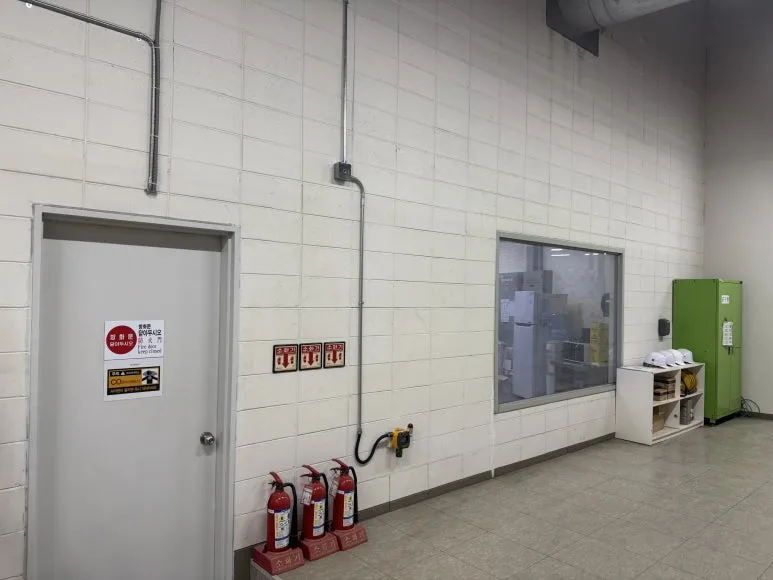
Case ② Cumulative 11 incidents, 9 deaths — Recurring CO₂ suppression accidents
According to the Ministry of Employment and Labor and KOSHA, since 2001 there have been 11 CO₂ suppression-system leak accidents in Korea, causing 9 deaths and around 60 injuries. Examples: 2001 Kumho Museum (1 dead, 50 injured), 2003 Yeonggwang circuit-breaker room (4 injured), 2008 Nonsan Geumgang University transformer room (1 dead), 2011 Incheon Hankuk GM engine-drive room (1 dead, 2 critical).
Sources: Safety1st News — CO₂ Suppression-System Maintenance and Asphyxiation, MoEL — CO₂ Suppression-System Asphyxiation Prevention Measures
Case ③ Dry-ice refrigerated container asphyxiation
Dry ice sublimates at −78.5 °C, releasing approximately 750× its volume in CO₂ gas. Inside a ventilation-restricted refrigerated container, CO₂ rises to dangerous levels within minutes. Workers who enter unaware experience dizziness, respiratory distress, and loss of consciousness.
Source: Wikipedia — Dry Ice (asphyxiation and oxygen-deficiency risk)
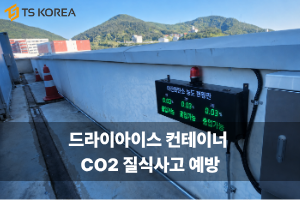
📌 Reinforced OSH Regulation — Effective October 18, 2024
MoEL and KOSHA mandated installation of oxygen or CO₂ detection / alarm devices in CO₂ suppression-system protected zones and cylinder storage areas. Sites must comply by October 18, 2024.
Conclusion — That's why a CO₂ gas detector is essential. Because human senses cannot detect CO₂ and leaks reach lethal concentrations within minutes, continuous monitoring with instant alarms via a fixed gas detector is the only solution.
Part 2. How FIX800 Fixed CO₂ Detector Prevents Accidents
FIX800's Unique Capabilities
WANDI FIX800 is a fixed multi-gas detector. In CO₂ environments, the following 7 capabilities directly contribute to accident prevention:
| FIX800 Capability | Function in CO₂ Environment |
|---|---|
| NDIR infrared CO₂ sensor | Precise 0–5,000 ppm measurement; long-term stability; low drift; no oxygen dependence |
| 24/7 continuous monitoring | Detects leaks instantly during nights and weekends when no one is present |
| Two-stage alarm | LED + buzzer alarms at danger thresholds → immediate evacuation |
| FIX-DS display integration | Visualizes concentrations outside the confined zone → check safety before entry |
| Up to 5-gas simultaneous monitoring | CO₂ + O₂ + CO + H₂S + LEL in one unit — detects CO₂ leak and O₂ deficiency together |
| RS485 Modbus / external interlock | Auto-link to control panel, ventilation fan, suppression-system lockout |
| High-strength aluminum housing | Stable operation in harsh industrial / electrical-noise environments |
How FIX800 Eliminates Risk in Real Environments
① Generator / Electrical Room CO₂ Protected Zones
When FIX800 CO₂ sensors are installed in protected zones and cylinder-storage areas, the NDIR sensor detects any concentration rise during maintenance or accidental release. The first-stage alarm (e.g., 5,000 ppm) warns workers; the second-stage alarm (e.g., 30,000 ppm) signals the external display board to block further entry. In a scenario like the 2021 Geumcheon-gu case — 130 cylinders discharging simultaneously — the externally mounted FIX-DS display would have visualized the danger in real time and prevented additional workers from entering.
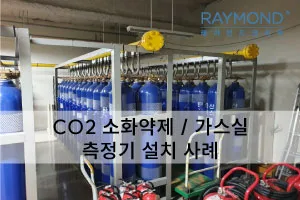
② Dry-Ice Refrigerated Containers / Logistics Centers
With FIX800 installed inside the container and FIX-DS displayed outside, workers can verify internal CO₂ concentration before opening the door. If unsafe, entry is postponed until ventilation clears the space. The core value of FIX800 is making invisible risk visible before entry — risk a portable detector would only reveal after a worker is already inside.
③ Cold Storage / Fermentation Facilities — Simultaneous O₂ + CO₂ Monitoring
Cold-storage warehouses combine oxygen deficiency with CO₂ accumulation. FIX800 hosts O₂ and CO₂ sensors in one unit and alarms when O₂ drops below 18% or CO₂ exceeds 5,000 ppm. This dual-protection model is proven in Anseong, Changwon, and many other cold-storage and dry-ice installations.
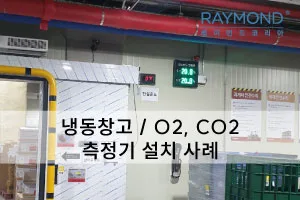
④ External Interlocks — From Prevention to Blocking
Wiring FIX800's RS485 Modbus output to ventilation fans, suppression-system safety pins, and control panels enables automatic ventilation start-up and suppression-system lockout when danger thresholds are reached. This transforms detection from passive alarming into an active accident-blocking system.
FIX800 CO₂ Model Standard Specifications
| Item | Specification |
|---|---|
| Sensor type | NDIR (Non-Dispersive Infrared) |
| Measurement range | 0–5,000 ppm (high-concentration option 0–5 %vol) |
| Alarm setpoints | 1st: 5,000 ppm / 2nd: 30,000 ppm (field-adjustable) |
| Communication outputs | RS485 Modbus RTU, 4–20 mA, alarm relay |
| Housing | High-strength aluminum, industrial-grade |
| Expansion options | Up to 5-gas (O₂·CO·H₂S·LEL·CO₂), suction pump, FIX-DS display board |
🛡️ FIX800 CO₂ Detector — Making Invisible Risk Visible
Generator rooms · dry-ice containers · cold storage · fermentation — custom-fit installation
💬 Request a Free Quote 📋 View FIX800 Details
Phone +82-2-2088-7334 · +82-31-340-6952
Closing — Check Before the Accident Happens
CO₂ asphyxiation accidents are tragedies born of "it won't happen here." Regulations strengthened after the 2021 Geumcheon-gu accident now require alarm devices in protected zones — yet maintenance gaps continue to cause incidents. FIX800 blocks every CO₂ accident pathway through 24/7 monitoring, instant alarms, and external interlocks. Trust FIX800 with the risk that human senses cannot detect.
Frequently Asked Questions (FAQ)
Q1. Where should a CO₂ gas detector be installed?
Installation is recommended in any ventilation-restricted space: generator/electrical/transformer rooms with CO₂ suppression systems, dry-ice refrigerated containers, cold-storage warehouses, brewing/fermentation facilities, manholes, and septic tanks. As of October 18, 2024, Korean OSH regulations mandate oxygen or CO₂ detection/alarm devices in CO₂ suppression-system protected zones and cylinder storage areas.
Q2. CO₂ is non-toxic, so why monitor it?
CO₂ itself is non-toxic, but high concentrations displace oxygen, causing respiratory distress, dizziness, and loss of consciousness. Above 3% (30,000 ppm) causes breathing difficulty; above 10% (100,000 ppm) can cause unconsciousness and death within minutes. Because CO₂ is colorless and odorless, human senses cannot detect it — continuous monitoring is the only reliable solution.
Q3. What sensor type and measurement range does FIX800 CO₂ model use?
FIX800 CO₂ uses an NDIR (Non-Dispersive Infrared) sensor with a standard range of 0–5,000 ppm. A high-concentration option (0–5 %vol / 50,000 ppm) is also available. NDIR has no oxygen dependence and excellent long-term stability, making it ideal for 24/7 monitoring.
Q4. Are portable gas detectors not enough?
Portable detectors only reveal concentrations after a worker has already entered, allowing only reactive response. FIX800 fixed-type detectors visualize internal gas concentrations on the external FIX-DS display before entry, blocking accidents proactively. They also provide 24/7 monitoring during nights and weekends when no one is present.
Q5. Can FIX800 measure other gases simultaneously with CO₂?
Yes. FIX800 can host up to 5 gas sensors in a single unit. Because oxygen deficiency often accompanies CO₂ accumulation, the O₂ + CO₂ combination is common. Confined-space installations may also use a 5-gas combination (O₂·CO·H₂S·LEL·CO₂).
Q6. Can FIX800 interlock with ventilation fans or suppression systems?
Yes. FIX800 provides RS485 Modbus RTU, 4–20 mA, and alarm relay outputs that integrate with central control panels, ventilation fans, and suppression-system safety pins. When danger thresholds are reached, ventilation can auto-start and suppression systems can lock, creating an active accident-blocking system.
Q7. What was the 2021 Seoul Geumcheon-gu CO₂ accident?
On October 23, 2021, at a building-construction site generator room in Geumcheon-gu, Seoul, 52 workers were performing insulation work when a fire detector activated and approximately 7 tons of CO₂ suppressant discharged. 3 died and 18 were injured. Of 130 suppression cylinders, 123 discharged simultaneously. This accident led to mandatory installation of gas detection/alarm devices in CO₂ suppression-system protected zones.
Q8. How can I request a FIX800 CO₂ detector quote?
Visit the WANDI quote page (wandi.co.kr/en/quote) and enter your site environment (gas type, quantity, installation location) to receive a custom quote within 1–2 business days. You can also call +82-2-2088-7334 / +82-31-340-6952 for direct consultation.