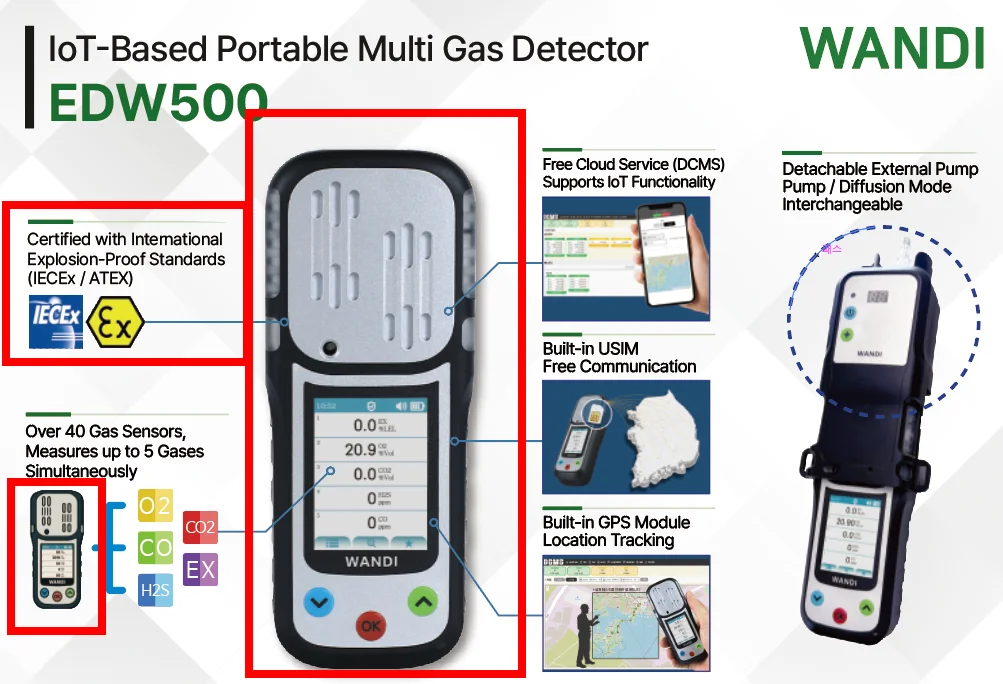
Fluorine (F₂) is the most strongly oxidizing element in the periodic table, widely used in semiconductor, display, lithium-ion battery, PTFE (Teflon), and uranium enrichment (UF₆) manufacturing. However, fluorine is an extremely toxic, corrosive gas that reacts violently with almost all materials, causing immediate damage to eyes, skin, and the respiratory system. WANDI EDW500, certified under IECEx (IECEx TPS 25.0057X, TÜV SÜD), is a portable 5-gas simultaneous detector that provides real-time protection for workers in fluorine-handling environments.
What is Fluorine (F2)?
Fluorine has the chemical formula F₂, atomic number 9, and molecular weight 38. It is a pale yellow gas at room temperature with extremely high reactivity — reacting with water to produce hydrogen fluoride (HF), and corroding most metals, non-metals, and organic materials. It is an essential raw material for semiconductor etching, nuclear fuel (UF₆) synthesis, and lithium battery electrolyte manufacturing.
⚠️ Extreme Oxidizer Warning
Fluorine reacts violently with water, glass, most metals, and polymers even at room temperature. Standard respirators are insufficient — full SCBA is required, along with fluorine-specific gas detectors.

Health Effects of Fluorine on the Human Body
| Concentration (ppm) | Exposure | Health Effect | Hazard Level |
|---|---|---|---|
| 0.1 | Continuous | Pungent odor, mild eye/nasal irritation | Caution |
| 1.0 | 8 hr TWA | Severe eye/skin/respiratory irritation, coughing | Warning |
| 3–10 | Short-term | Chemical burns to skin/mucous membranes, respiratory distress | Danger |
| 25+ | Immediately | NIOSH IDLH — immediate life threat, lung damage | IDLH |
※ Source: ACGIH TLV-TWA 1.0 ppm, NIOSH IDLH 25 ppm, OSHA PEL 0.1 ppm (Ceiling)
Real Accident Case
Oak Ridge National Laboratory Fluorine Leak (USA, 1994)
During uranium enrichment at Oak Ridge National Laboratory, a fluorine gas leak caused immediate respiratory damage to multiple workers. The secondary production of HF from fluorine reacting with moisture compounded the injuries. This case highlighted the necessity of dual-detection systems capable of simultaneously sensing both F₂ and HF in fluorine-handling environments.
※ Source: U.S. Department of Energy Accident Investigation Report, Oak Ridge, 1994
WANDI EDW500 — IECEx-Certified 5-Gas Simultaneous Detection
(TÜV SÜD / IECEx TPS 25.0057X)
simultaneously detected
Usable in highest hazard zones
The EDW500's explosion-proof rating of Ex da ia IIC T4 Ga (Zone 0, EPL Ga) makes it safe for use in high-risk zones where fluorine and flammable gases coexist, such as semiconductor and UF₆ plants. Combining fluorine sensors with HF, O₂, EX, and Cl₂ enables simultaneous detection of HF generated when fluorine reacts with moisture during a leak.
Prevention Scenario: What if WANDI EDW500 Had Been Used?
- 1Pre-entry measurement: Check F₂ concentration with EDW500 before entering fluorine cylinder storage or supply areas.
- 2F₂ + HF simultaneous alarm: Since HF is generated when fluorine reacts with moisture, EDW500 detects both F₂ and HF simultaneously to address compound hazards.
- 3Immediate evacuation: Alarm triggers IoT cloud notification to supervisors; workers evacuate immediately.
- 4Medical treatment: Exposure to F₂ and HF requires treatment for chemical burns to skin, eyes, and respiratory tract; measurement records serve as critical emergency and legal documentation.
A Closer Look at the WANDI EDW500
Below are real photos of the WANDI EDW500 portable multi-gas detector and its use on site.