📌 3 Key Takeaways
- WANDI's two flagship gas detectors, the portable EDW500 and the fixed FIX800, are both called "gas detectors," but they solve very different problems. The EDW500 is carried by a worker to check conditions right before entering a confined space; the FIX800 is mounted in one place and watches that spot around the clock.
- Korea's Occupational Safety and Health Standards Rule requires both a pre-work concentration check and continuous monitoring during confined-space work. In practice, many sites apply a personal portable device (like the EDW500) and a continuous fixed installation (like the FIX800) to cover their respective roles.
- In one WANDI installation case, a site in Seoul had already installed a FIX800 unit, yet still purchased an EDW500 separately for a hotel basement confined space. The two products are not competitors — more often, sites use them together.
"Can't we just buy one gas detector?" is one of the most common questions WANDI hears from facility managers. The short answer: the EDW500 and FIX800 are not substitutes for each other — they are devices with different jobs. This article breaks down the structural differences between the two products, shows how each is actually applied on site through WANDI's installation cases, and offers a checklist to help you decide which one your site needs.

Why Do Gas Detectors Come in Portable and Fixed Types?
Safety management for confined spaces or areas where hazardous gas may occur comes down to two different questions. The first — "Is it safe to enter this space right now?" — is a question for the moment just before a worker enters. The second — "Is this equipment safe at this very moment?" — is a question that continues for as long as the equipment is running. The first needs to be checked by something the worker carries; the second needs something that stays in place and watches, even when no one is there. WANDI supplies the EDW500 for the first case and the FIX800 for the second.
EDW500 — The Portable IoT Multi-Gas Detector That Goes Where the Work Is
The EDW500 is a multi-gas detector that a worker carries and moves with. It is designed to immediately answer the question that must be answered before entering a confined space such as a manhole, septic tank, or tank interior: "Is this space safe right now?"

① Simultaneous Measurement of Up to 5 Gases
Depending on the sensor configuration, the EDW500 can simultaneously measure up to five gases — such as oxygen (O2), carbon monoxide (CO), hydrogen sulfide (H2S), combustible gas (LEL), and carbon dioxide (CO2). The usual approach is to first identify which gases can actually occur on site, then configure the needed combination.
② Dual ATEX and IECEx Explosion-Proof Certification
The EDW500 holds both the European ATEX certification and the international IECEx certification, making it suitable for use in explosion-hazard areas where combustible gas or dust may be present.
③ IoT Cloud (DCMS) — Remote Monitoring With No Communication Fees
A built-in SIM (communication module) lets the device transmit data even on sites without Wi-Fi, and managers can access the DCMS cloud platform from a smartphone or PC to remotely check a worker's gas readings and location. WANDI provides this cloud service with no separate communication fee or subscription charge.
④ Automatic Suction Pump — Check Before Anyone Goes In
Some configurations include an automatic suction pump and sampling hose, allowing gas in spaces that are hard for a person to enter directly — such as manholes or sump pits — to be drawn out and measured from outside.
🔹 Sites Where the EDW500 Is Especially Needed
- Sites where workers must physically enter narrow spaces such as manholes, sewer lines, or sump pits
- Mobile inspection or patrol work where a fixed installation isn't practical
- Sites subject to a confined-space work program under the Serious Accidents Punishment Act or Occupational Safety and Health Act, which requires workers to personally carry a gas detector
- Outdoor or remote sites without Wi-Fi or other communication infrastructure
FIX800 — The Fixed Gas Detector That Stands Watch Around the Clock
The FIX800 is a fixed-installation gas detector mounted on a wall or pipe to provide continuous, 24-hour monitoring. It fits spaces where no one is present at all times, yet gas concentration must still be continuously watched — such as septic tanks, fire-suppressant storage rooms, or underground electrical rooms.

① A Range of Sensor Types — NDIR, Electrochemical, PID, and Catalytic Combustion
The FIX800 can be configured with infrared (NDIR), electrochemical (EC), photoionization (PID), or catalytic-combustion sensors depending on the target gas, covering more than 30 different gases as needed for the site.
② FIX-DS Display Board Integration — See the Reading On Site, Instantly
Paired with the FIX-DS gas concentration display board, current readings can be checked immediately on a large display, letting workers see the status at a glance right at the entrance or work area before going in.
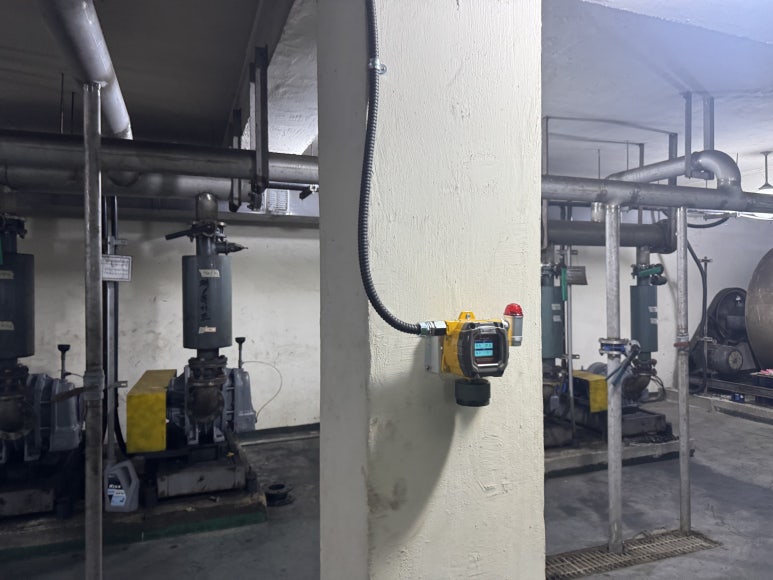
③ RS485 Modbus, 4-20mA, and Alarm Relays — Automatic Integration With Ventilation Fans and Fire-Suppression Systems
The FIX800 supports RS485 Modbus communication, 4-20mA analog output, and alarm relay contacts, enabling configurations where a ventilation fan automatically activates on alarm, or where the unit integrates with fire-suppression equipment or a central control system.
④ Heavy-Duty Aluminum Housing
Built for long-term installation in harsh industrial environments, the FIX800 uses a heavy-duty aluminum housing for durability.
🔹 Sites Where the FIX800 Is Especially Needed
- Continuous monitoring of confined spaces with no one present, such as septic tanks or sewage treatment facilities
- Areas where detection and alarm equipment is legally required, such as protected zones for CO2 fire-suppression systems or fire-suppressant storage rooms
- Equipment that needs to automatically trigger ventilation fans or exhaust systems and take immediate action on alarm
- Sites requiring long-term monitoring of a fixed point, such as tunnel shafts or underground electrical rooms
EDW500 vs. FIX800 at a Glance
| Category | EDW500 (Portable) | FIX800 (Fixed) |
|---|---|---|
| Basic form | Carried and used by a worker on the move | Fixed-installed on a wall, pipe, etc. |
| When it watches | Personal check before entry and during work | 24-hour continuous monitoring |
| Simultaneous gases | Up to 5 (O2, CO, H2S, LEL, CO2, etc.) | Up to 5, covering 30+ gases depending on sensor type |
| Sensor types | Mainly electrochemical and catalytic combustion | Choice of NDIR, electrochemical, PID, or catalytic combustion |
| Explosion-proof certification | Dual ATEX + IECEx certification | Confirm separately based on site conditions |
| Remote monitoring | Built-in SIM IoT, free DCMS cloud | RS485 Modbus, FIX-DS display board integration |
| External equipment integration | GPS location, fall-detection alarm | Automatic integration with ventilation fans, fire suppression, alarm relays |
| Installation cost profile | No separate wiring or installation work needed | Requires installation work such as power and communication wiring |
※ This table summarizes general characteristics based on WANDI's product materials and installation cases; actual available sensors and options may vary by site condition. Please confirm exact specifications with WANDI before ordering.
What Does the Law Require for Each Device?
Part 3, Chapter 10 of Korea's Occupational Safety and Health Standards Rule (Prevention of Health Hazards from Confined-Space Work) requires measuring oxygen and hazardous-gas concentrations before confined-space work and continuously verifying that air quality remains adequate throughout the work. The same rule also requires workers entering a confined space to carry a personal gas detector — a role filled by portable devices like the EDW500. Separately, Article 628-2 of the same rule requires oxygen or carbon dioxide detection and alarm equipment to be installed in protected zones for CO2 fire-suppression systems or in rooms storing large quantities of fire-suppressant agent — an area handled by continuously monitoring fixed equipment like the FIX800. In other words, the law itself requires "personal, carried verification" and "equipment-based, continuous verification" under separate provisions.
※ The legal summary above describes the general intent of these regulations. Actual applicability and detailed requirements vary by workplace, so confirmation with the relevant authority or a specialist is recommended.
A Checklist for Choosing by Site
- Do workers need to physically enter the space? → A portable device like the EDW500 is essential.
- Can gas occur even when no one is present? → A continuously monitoring fixed device like the FIX800 is needed.
- Should a ventilation fan or fire-suppression system activate automatically on alarm? → Check the FIX800's alarm relay and external integration features.
- Is this a site without Wi-Fi or other communication infrastructure? → Consider whether the EDW500's built-in SIM IoT approach fits.
- Is detection and alarm equipment legally required for this area? (e.g., a CO2 fire-suppression protected zone) → A fixed device like the FIX800 is the baseline requirement.
- Already have a fixed device — do you also need a personal portable one? → A portable device should fill in the entry checks and mobile sections that a fixed installation cannot cover.
Should You Use Both Together?
In practice, many sites use both rather than choosing just one. In one WANDI installation case, a hotel basement confined-space site in Seoul already had a FIX800 installed, yet still purchased an EDW500 separately because the site manager had no device to carry personally. Even where a fixed device continuously monitors a specific point, a worker who needs to travel to that point or patrol other areas still needs a separate portable device. Conversely, a site with only a portable device may want to consider covering the gap during hours when no one is present with a fixed device.

Closing
The EDW500 and FIX800 aren't devices to compare as "which one is better" — they should be chosen based on "which risk at our site this device is meant to cover." If workers physically enter the space, choose the EDW500; if equipment needs to be watched even when no one is present, choose the FIX800; and if both risks exist on your site, we recommend considering both together. For help configuring the right equipment and a quote for your site, contact WANDI at +82-31-340-6952.
Related Reading
- Gas Measurement Before Manhole and Sewer Line Work — Preventing Asphyxiation and Poisoning with the EDW500 Portable 5-Gas Detector
- Can't Install a Gas Detector Directly in an Explosion-Hazard Area? FIX800 Suction-Sampling System Installation Case
- Preventing Septic Tank Confined-Space Asphyxiation — FIX800 and FIX-DS Continuous Oxygen Monitoring Case in Yeongdeungpo
Frequently Asked Questions (FAQ)
Q1. Which sites need the EDW500, and which need the FIX800?
If workers must physically enter a space such as a manhole, septic tank, or tank, the portable EDW500 is needed. If gas concentration must be continuously monitored even when no one is present, the fixed FIX800 is needed. Sites with both kinds of risk commonly use both together.
Q2. If a FIX800 is already installed, is the EDW500 unnecessary?
No. The FIX800 only monitors the one fixed point where it's installed, so a separate device a worker can personally carry is still needed when traveling to that point or patrolling other areas. In fact, there are cases where an EDW500 was purchased in addition to an already-installed FIX800.
Q3. How do the sensor types differ between the two products?
The EDW500 is mainly built around electrochemical and catalytic-combustion sensors, suited to portability and fast response. The FIX800 can be configured with infrared (NDIR), electrochemical (EC), photoionization (PID), or catalytic-combustion sensors depending on the target gas, covering more than 30 different gases.
Q4. Can both products measure multiple gases at once?
Yes. Both the EDW500 and FIX800 can measure up to five gases simultaneously, depending on sensor configuration. The usual approach is to first confirm which gases can actually occur on site, then order the needed combination.
Q5. Does the FIX800 automatically integrate with ventilation fans or fire-suppression systems?
Yes. The FIX800 supports RS485 Modbus communication, 4-20mA analog output, and alarm relay contacts, allowing a ventilation fan to automatically activate on alarm or integration with fire-suppression equipment or a central control system. As a personal portable device, the EDW500 instead focuses on remote monitoring via IoT cloud and GPS location rather than this kind of equipment integration.
Q6. What explosion-proof certification does the EDW500 have?
The EDW500 holds both European ATEX certification and international IECEx certification, making it suitable for explosion-hazard areas. Whether the FIX800 needs explosion-proof certification depends on the installation environment (whether it qualifies as an explosion-hazard area), so this should be confirmed before ordering.
Q7. Is remote monitoring possible on a site without Wi-Fi?
The EDW500 has a built-in SIM (communication module) that transmits data even without Wi-Fi, and WANDI's DCMS cloud service can be used with no separate communication fee or subscription charge. The FIX800 is based primarily on wired communication such as RS485, so it's best to confirm a communication method suited to the installation environment in advance.
Q8. How can I get a quote or consultation for purchase?
Contact WANDI (+82-31-340-6952) or a supplying partner with your site conditions — whether workers need to enter the space, whether continuous monitoring is needed, your communication infrastructure, and the gases to be measured — to receive guidance on whether the EDW500, FIX800, or both fit your needs, along with a quote.
Sources
· WANDI installation case, "Why IoT Gas Detectors Are Essential in Silicone Chemical Plants – WANDI EDW500 Delivery Case" (J-Solution) — wandi.co.kr/construction-cases/278
· WANDI installation case, "Portable Gas Detector Supply and Field Calibration of an Installed Gas Detector — Hotel Basement Confined Space" (VPI Korea) — wandi.co.kr/construction-cases/377
· WANDI installation case, "Gas Detector Installation in a General Hospital Basement Confined Space — FIX800 & FIX-DS" (VPI Korea) — wandi.co.kr/construction-cases/398
· WANDI installation case, "Oxygen and Toxic Gas Detector Installation at a Wastewater Treatment Plant" (VPI Korea) — wandi.co.kr/construction-cases/394
· Occupational Safety and Health Standards Rule, Part 3 Chapter 10 (Prevention of Health Hazards from Confined-Space Work); Article 628-2 (Measures for Fire-Suppression Equipment Using Carbon Dioxide)
· Two situational images: Unsplash (OSPAN ALI, Rita Daisy) — not actual site photos.