💡 3 Key Takeaways
- Explosion-proof test facilities often can't have gas detectors installed directly at leak points.
- At the Korea Energy Agency's Automobile Fuel Efficiency Center, WANDI's FIX800 was deployed as an aspirated (sampling) system, placed in a safe zone while sampling tubing drew in air for analysis.
- Across tubing runs of 20–50m, the system detected CO and H2 gas in about 10 seconds.
Why Is It Difficult to Install Gas Detectors Directly in Explosion-Proof Zones?
Fixed gas detectors are typically mounted directly at points where a leak is likely to occur. But when that point sits inside a facility requiring explosion-proof certification, things change. The detector body, wiring, and connection methods all need to meet explosion-proof standards, and even routine maintenance requires following explosion-hazard-zone entry procedures — driving up both installation difficulty and cost. For these sites, a practical alternative is an aspirated (sampling) approach: keeping the detector in a safe area outside the hazardous zone and drawing air in through sampling tubing for analysis.
The Site — Korea Energy Agency Automobile Fuel Efficiency Center (Jincheon, Chungcheongbuk-do)

This case took place at the Korea Energy Agency's Automobile Fuel Efficiency Center in Jincheon, Chungcheongbuk-do. Because the facility tests vehicle fuel efficiency and emissions, part of it required explosion-proof considerations, making it unsuitable for a standard fixed detector mounted directly at the leak point. The partner company, J Solution, began a site review in April, covering installation environment assessment, equipment selection, piping and installation planning, system setup, commissioning, and final testing — a project that took about four months before all work was completed in July. Because the plan required repeated on-site coordination, it took considerably more review time than a typical installation.
The Problem — A Explosion-Proof Zone Needed a Different Approach Than Direct Installation
Fixed gas detectors are normally mounted directly at locations where leaks may occur. But because this test facility included zones that had to meet explosion-proof certification requirements, mounting the detector directly at the leak point wasn't appropriate. Instead of placing the detector inside the explosion-proof zone itself, the team adopted an aspirated (sampling) system that draws air through sampling tubing into a separate pre-treatment box for analysis. The detector body is installed in a safe location outside the explosion-proof zone, with only the tubing extending into the hazardous area.
The Solution — How the WANDI FIX800 Aspirated Sampling System Works
The aspirated system operates through the following flow.

- Sample intake — A pump draws air from the measurement point inside the explosion-proof zone.
- Sampling tube transport — The drawn air travels through tubing (roughly 20–50m depending on the site) to the pre-treatment box.
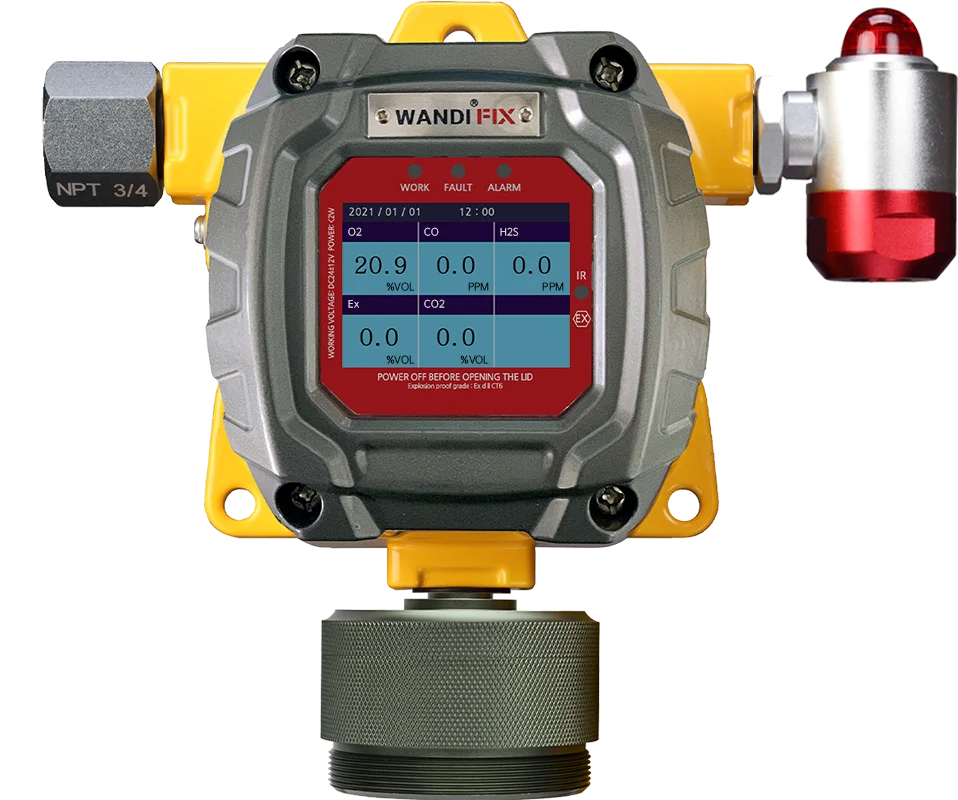
- Analysis at the pre-treatment box — A WANDI FIX800 installed inside the pre-treatment box analyzes CO and H2 concentration in the transported air.
- Alarm and display integration — If readings exceed the threshold, an alarm triggers and values are shown in real time on the display board and system.
The key advantage of this structure is that the detector body can stay outside the explosion-proof zone. Since only tubing and an intake point are located inside the hazardous zone, this greatly reduces both the explosion-proof requirements on the detector itself and the burden of hazardous-zone entry procedures during maintenance.
Commissioning After Installation — Checking Five Items One by One
A fixed gas detector isn't ready to operate the moment it's installed. Commissioning must verify the following items in sequence.

① Air intake check
Verify air is drawn in normally through the sampling tubing
② Detector measurement check
Verify the FIX800 measures gas normally inside the pre-treatment box
③ Alarm activation check
Verify the alarm triggers correctly when thresholds are exceeded
④ Display/system integration check
Verify readings are correctly linked to the display board and upstream systems
Actual Test Results — Detection in About 10 Seconds Even Across 20–50m of Tubing

During commissioning, actual test gas was injected to verify detection performance. Air drawn in on-site travels through the sampling tubing to the pre-treatment box, where the WANDI FIX800 inside analyzes the gas. After repeated testing, the team confirmed that the FIX800 detected gas about 10 seconds after injection. Tubing lengths varied by sensor location at this site, ranging from about 20m to 50m, and even the longest 50m run showed detection within roughly 10 seconds.
That said, response time can vary depending on sampling tube length, pump flow rate, installation conditions, and the target gas. This makes site-specific design and thorough commissioning verification essential when applying an aspirated system.
| Category | Direct-Mount (Diffusion) Type | Aspirated (Sampling) Type — FIX800 |
|---|---|---|
| Detector location | Mounted directly at the expected leak point | Safe zone (pre-treatment box) — only tubing extends into the hazardous zone |
| Explosion-proof requirement | Detector body itself must be explosion-proof rated | Only tubing and intake are inside the hazardous zone |
| Maintenance/replacement | Requires hazardous-zone entry procedures | Maintenance possible in the safe zone where the pre-treatment box sits |
| Response speed | Detects immediately upon leak | Delayed by tubing length/flow rate — about 10 seconds at 20-50m in this case |
| Suitable sites | General confined spaces, treatment facilities | Explosion-proof test facilities, hard-to-access zones, high-temp/high-pressure processes |
※ Source: wandi.co.kr Construction Case #354 (Korea Energy Agency Automobile Fuel Efficiency Center, installed by J Solution)
Management Still Matters After Installation
A fixed gas detector isn't a device you can walk away from once installed. Sensor performance can change over time, so regular inspection and calibration are essential to maintaining accuracy. J Solution, the partner on this project, provides one-stop support covering equipment supply, installation, commissioning, calibration, and maintenance, while WANDI Korea also supports post-installation operation through its in-house technical team's nationwide calibration and after-sales infrastructure.
Other Sites That Need an Aspirated (Sampling) System
- Explosion-proof-certified test facilities — vehicle fuel efficiency/emissions test labs, chemical test buildings
- Hard-to-access elevated or confined zones — locations where detector maintenance itself is difficult
- High-temperature/high-pressure process lines — environments where exposing the detector body directly is difficult
- Exhaust ducts near semiconductor/chemical cleanrooms — consolidating multiple points into one analysis location via tubing
- Research lab gas cylinder storage rooms — when separating the cylinder storage area from the analysis equipment is preferred
WANDI FIX800 Aspirated System — What to Check Before Adoption
- Tubing length per measurement point — Different tubing lengths across points can cause different response times, so upfront design is needed.
- Pump flow rate setting — Longer tubing requires sufficient flow to maintain response speed.
- Pre-treatment box location — Choose a safe-zone location that is still easy to access for maintenance.
- Repeated commissioning verification — Confirm stability through multiple rounds of testing with actual test gas.
Closing
An explosion-proof zone doesn't have to mean gas detection is out of reach. As shown in this case at the Korea Energy Agency's Automobile Fuel Efficiency Center, an aspirated (sampling) system using the WANDI FIX800 is a practical solution that keeps the detector body in a safe zone while still accurately capturing gas conditions inside the hazardous area. With detection confirmed in about 10 seconds even across 20–50m of tubing, this case offers a useful reference for anyone evaluating similar explosion-proof or access-restricted sites.
A Closer Look at the WANDI FIX800
The detector used in this case is the WANDI FIX800 fixed-type multi-gas detector. Below is an actual photo of the FIX800 unit.