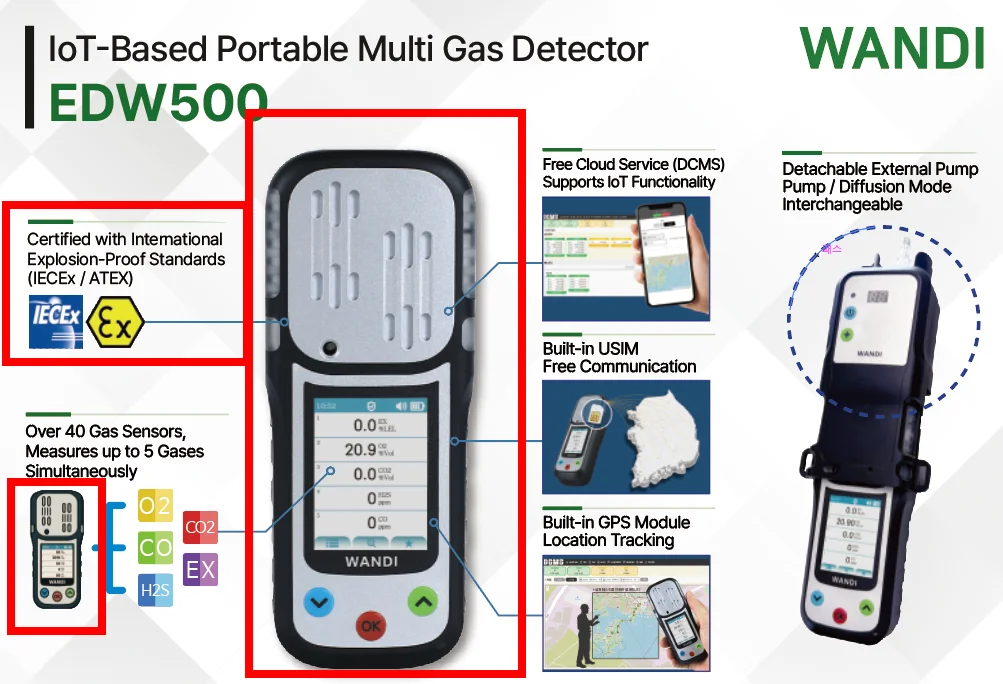
Hydrogen peroxide (H₂O₂) is a powerful oxidizer used widely in semiconductor wafer cleaning, food-packaging sterilization, pharmaceutical/bio processes, and bleaching processes. At low concentrations it is used safely as a disinfectant, but industrial high-concentration H₂O₂ (30~90%) carries a dual hazard — lung damage from vapor inhalation and explosive decomposition on contact with high temperatures or contaminants. The WANDI EDW500 portable 5-gas detector holds IECEx international explosion-proof certification (IECEx TPS 25.0057X), allowing workers to carry it and verify safety in real time at any site where H₂O₂ is present.
What Is Hydrogen Peroxide (H₂O₂)?
Hydrogen peroxide is a powerful oxidizer with a structure like water plus one additional oxygen atom (H-O-O-H). A 3% aqueous solution is used as a household disinfectant, but industrial sites use 30~90% high-concentration products. H₂O₂ decomposes rapidly on contact with heat, light, metal ions, or organic matter, releasing large amounts of oxygen, and in this process a pressure rise can cause an explosion. In vapor form, it strongly irritates the eyes, skin, and respiratory tract.
Health Effects of H₂O₂ Gas
| Concentration (ppm) | Exposure Standard | Health Effect |
|---|---|---|
| 1 ppm | TWA (8-hr average, ACGIH) | Chronic eye/airway irritation with long-term exposure |
| 5~10 ppm | Short-term danger concentration | Eye redness/pain, breathing difficulty, headache |
| 50 ppm | NIOSH IDLH (immediate danger) | Lung irritation, corneal damage, skin burns |
| 75 ppm | OSHA IDLH | Pulmonary edema, severe chemical burns, reduced consciousness |
| High-concentration liquid (30%+) | Direct contact | Skin whitening/blisters, risk of eye blindness |
⚠️ The Dual Hazard of H₂O₂: Toxicity + Explosiveness
Industrial high-concentration H₂O₂ directly harms the body with its strong oxidizing power, while at the same time decomposing violently on contact with organic matter or metal ions to generate explosive pressure. The risk doubles especially in high-purity environments like semiconductor cleanrooms if contaminants are introduced.

Major Industrial Sites Using H₂O₂
Hydrogen peroxide is used in semiconductor wafer cleaning (SC-1, SC-2 processes), food/beverage packaging sterilization (aseptic packaging lines), VHP (vaporized hydrogen peroxide) sterilization in pharmaceutical/bio processes, pulp/textile/bleaching processes, wastewater treatment advanced oxidation processes (AOP), and as a propellant in the space/defense industry. Because process concentration and handling methods differ in each field, site-tailored monitoring is essential.
Real Accident Case: Hydrogen Peroxide Explosion Risk
In 2016, at a manufacturing facility in Florida, USA, a high-concentration hydrogen peroxide (90%) storage tank was contaminated with organic matter, causing a rapid decomposition reaction and a pressure explosion. Two workers were injured, and H₂O₂ vapor spread tens of meters around the site, forcing nearby workers to evacuate. Domestically as well, there have been multiple reported cases of workers complaining of respiratory irritation and eye pain when H₂O₂ vapor accumulated at high concentrations in semiconductor processes. (Source: U.S. Chemical Safety and Hazard Investigation Board, 2016)
💡 If EDW500 Had Been Carried
Had the worker been carrying an EDW500, they would have received a vibration/buzzer/LED alarm the moment the H₂O₂ concentration exceeded the alarm threshold and could have evacuated immediately. Because real-time data is transmitted to the cloud, the manager, too, could have grasped the on-site situation remotely and responded quickly.
WANDI EDW500: IECEx-Certified Portable 5-Gas Detector
The WANDI EDW500 is a portable multi-gas detector that can simultaneously measure up to 5 gases including H₂O₂. It holds IECEx international explosion-proof certification (Certificate No.: IECEx TPS 25.0057X, certifier: TÜV SÜD), allowing safe use even in Zone 0 environments with explosion risk. Its explosion-proof rating is Ex da ia IIC T4 Ga (EPL Ga) — the highest-level explosion-proof performance, usable even in the most hazardous IIC-class gas environments such as hydrogen and acetylene.
WANDI EDW500 Installation Cases

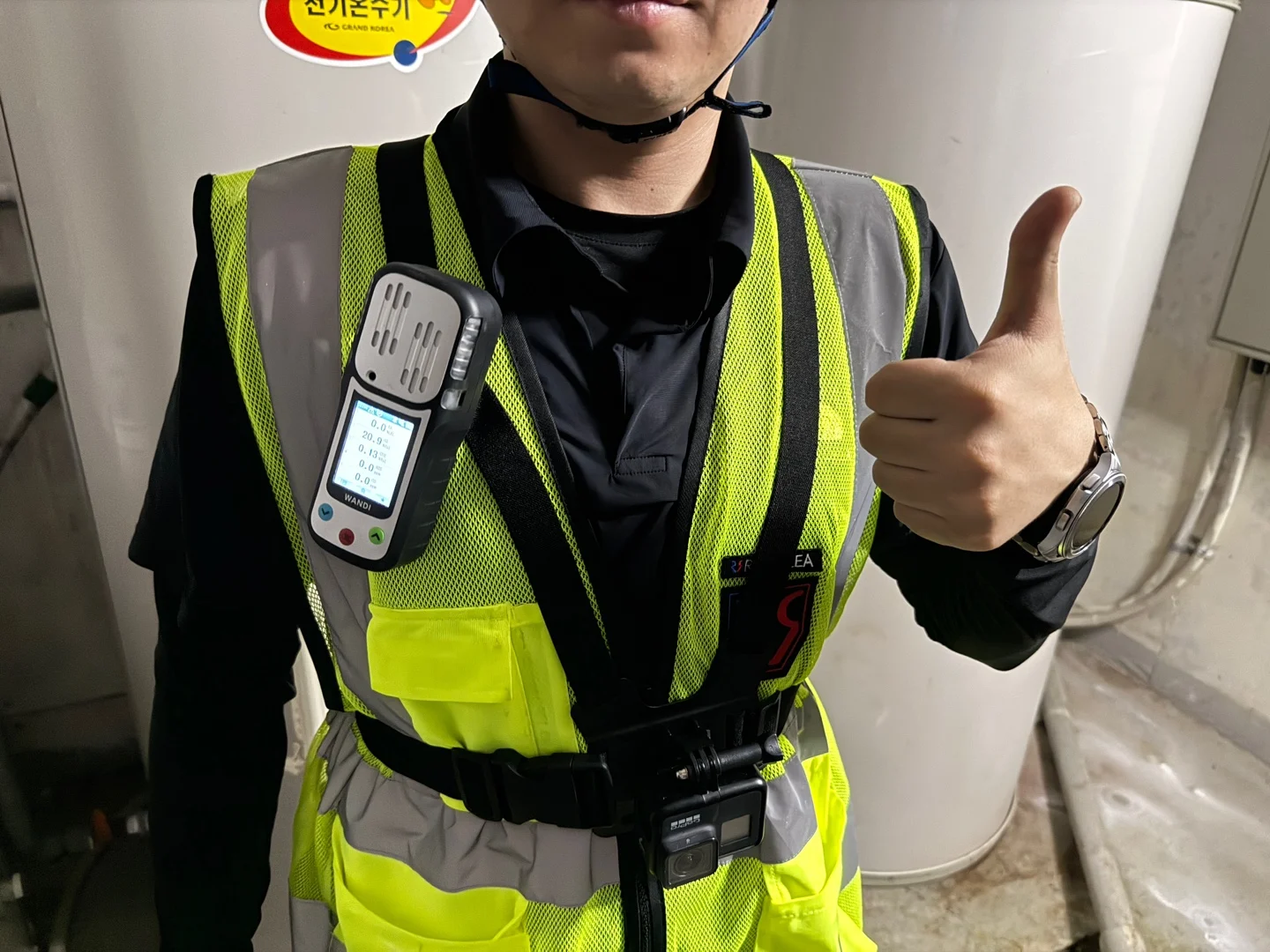
A 4-Step Scenario to Prevent H₂O₂ Accidents with EDW500
- 1Pre-work site measurement: Before entering the work zone, check the H₂O₂ concentration with the EDW500; stop work if the TWA limit is exceeded
- 2Continuous monitoring during work: The worker continuously monitors concentration while wearing the EDW500, evacuating immediately if an alarm fires
- 3Real-time cloud transmission: Measurement data is automatically sent to the cloud server, so the manager grasps the on-site situation remotely
- 4Legal data retention: Work history and alarm records are saved automatically, meeting the Occupational Safety and Health Act confined-space work-record obligation

EDW500 Key Specifications and IECEx Explosion-Proof Certification
| Item | Specification |
|---|---|
| Measured gases | Up to 5 gases simultaneously (H₂O₂, O₂, CO, H₂S, EX, CO₂, etc. combinable) |
| Explosion-proof cert. | IECEx TPS 25.0057X (TÜV SÜD certified), Ex da ia IIC T4 Ga, Zone 0 |
| Alarm method | LED visual alarm + buzzer audible alarm + vibration tactile alarm (triple alarm) |
| Data management | Cloud real-time transmission, automatic logging of measurement history and alarms |
| Battery | Rechargeable lithium-ion, 12+ hours of continuous use |
| Dust/water protection | IP67 rating |
🏆 The Meaning of IECEx International Explosion-Proof Certification
IECEx (IEC Explosion-proof) is a global explosion-proof certification system operated by the International Electrotechnical Commission (IEC). The EDW500 obtained Certificate No. IECEx TPS 25.0057X from TÜV SÜD, allowing use in IECEx member countries — Australia, Europe, the Middle East, Southeast Asia, and more — without separate re-certification. It is an EPL Ga-class product that can be used safely even in Zone 0 (the highest-risk zone where combustible gas is continuously present).
A Closer Look at the WANDI EDW500
Below are real photos of the WANDI EDW500 portable multi-gas detector.